Reflections of Life: Distinguishing Living from Nonliving Worlds with Complexity Metrics
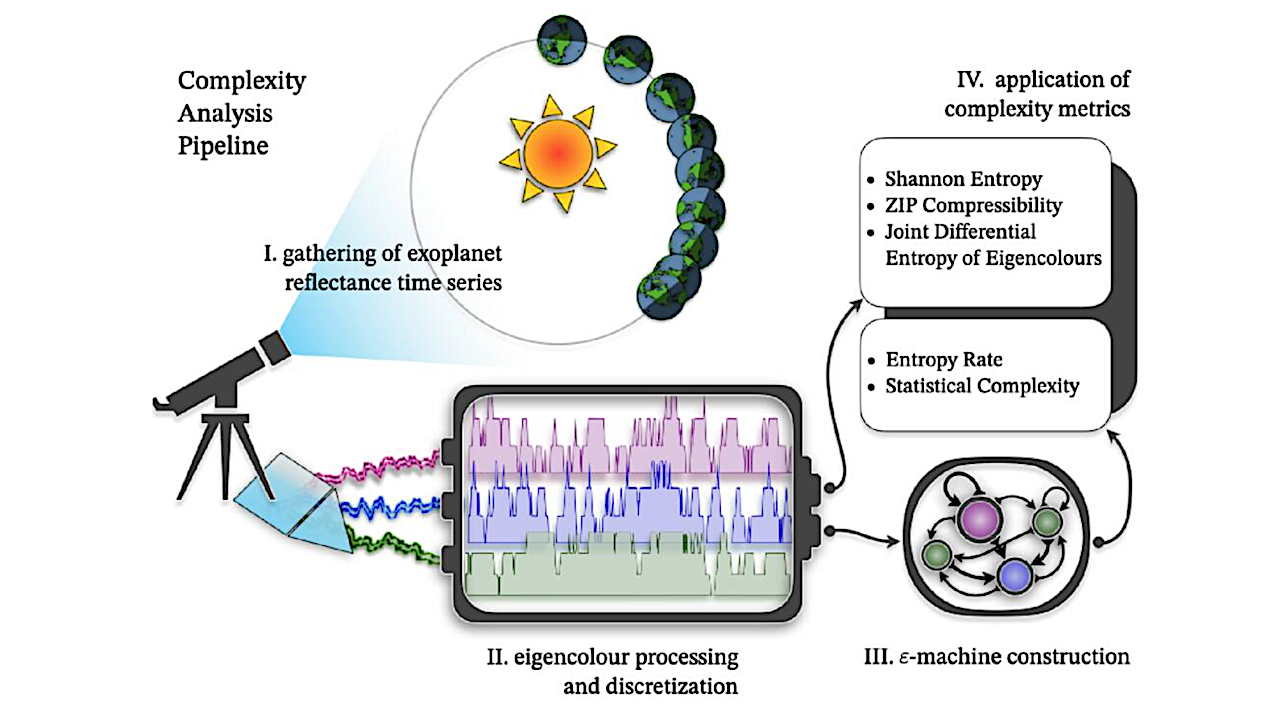
Detecting life beyond Earth is the primary goal of astrobiology. In this study, we showcase the effectiveness of information and complexity-based metrics for detecting signs of life on exoplanets.
These metrics are applied to time series of disk-integrated light reflectance from Earth and its close relative, Mars, a planet predicted to have once been very similar to Earth. The light curves used in this study are analogous to those obtainable for exoplanets situated at great distances, hence we are treating Earth and Mars as proxy exoplanets.
We found that Earth scores higher across all information-theoretic and complexity-based metrics employed, compared to Mars. These include the Shannon entropy, zip compressibility, joint differential entropy of eigencolours, statistical complexity and epsilon machine entropy rate.
This supports the hypothesis that planetary complexity, as measured from reflectance time series, could be a promising indicator of life. The method does not rely upon chemical properties or in situ analyses, and could be applied to data from current and upcoming missions such as the James Webb Space Telescope and Habitable Worlds Observatory.
DOI:10.3847/1538-3881/ae6b7b
Stuart Bartlett, Xianlei San, Siteng Fan, Gary Segal, Damian R. Sowinski, Yuk L. Yung
- Reflections of Life: Distinguishing Living from Nonliving Worlds with Complexity Metrics
The Astronomical Journal The Astronomical Journal via x-mol.net - Reflections of Life: Distinguishing Living from Nonliving Worlds with Complexity Metrics, The Astronomical Journal