Origin & Evolution of Life

Liquid–liquid Phase Separation As A Driver Of Abiogenesis And Evolution
By Keith Cowing
Status Report
Academia Molecular Biology and Genomics
May 22, 2026
Filed under , , , , , , , , , , , , , ,
Liquid–liquid Phase Separation As A Driver Of Abiogenesis And Evolution
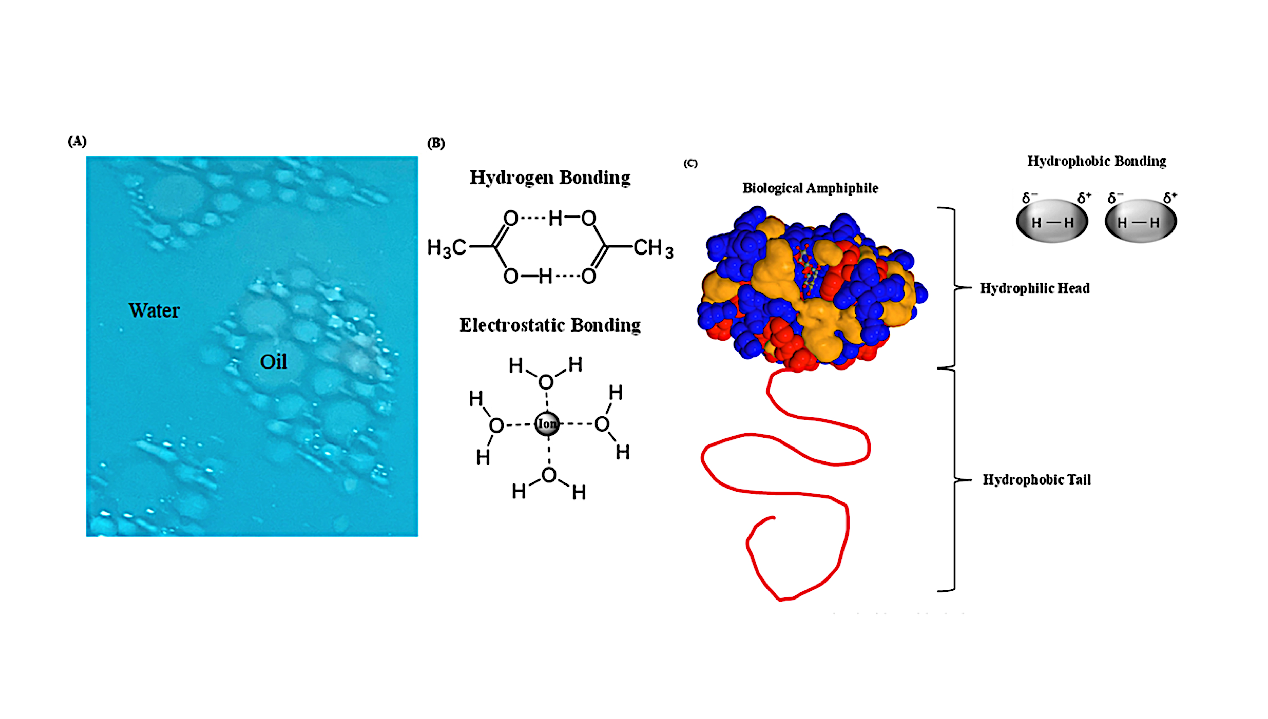
(A) Membraneless compartmentalization resulting from liquid–liquid phase separation (LLPS). Oil in water represents an example of LLPS, which is a first-order phase transition in soft condensed matter that is driven by molecular interactions that cause separation into two coexisting liquid phases. (B) Intermolecular interactions between intrinsically disordered biopolymers mediate LLPS. Solid lines represent covalent bonds and dashed lines represent non–covalent bonds. Hydrogen bonding occurs between a hydrogen atom covalently connected to an electronegative atom, which induces a partial positive charge to the hydrogen atom and renders it available to bond noncovalently with atoms on other molecules. Electrostatic bonding occurs between ions and water, where the charged ion, a cation in this case, attracts the opposite partial charges on the polar water molecule. Hydrophobic bonding is driven by the exclusion of water, causing non-polar molecules to aggregate, mediated by the surrounding water, forming a highly ordered shell and initiating induced dipole-induced dipole interactions between hydrophobic molecules. (C) Galectin-3 is a partially intrinsically disordered protein and plays a significant role in evolution. Galectin-3 can be described as a biological amphiphile since it has a structured hydrophilic C-terminus and an intrinsically disordered hydrophobic N-terminus. Hydrophilic peptides are shown in blue, hydrophobic peptides are shown in red, molecular cavities are shown in yellow, and β-lactose (gray carbon and red oxygen) is docked in the carbohydrate recognition domain (CRD) of galectin-3. — Academia Molecular Biology and Genomics

The origin of life may have emerged through physical mechanisms that enable molecular organization and self-assembly. Building on Alexander Oparin’s concept of coacervate droplets, liquid–liquid phase separation (LLPS) offers a plausible route for prebiotic molecules to concentrate and interact, supporting the transition from chemistry to biology.

LLPS provides a dynamic, membrane-free environment that could enhance RNA function and facilitate the evolution of regulatory and signaling networks that are foundational to the creation of life.

By linking molecular interactions and emergent behaviors, LLPS bridges the gap between simple biochemical interactions and collective cellular organization. Deoxyribonucleic acid (DNA), ribonucleic acid (RNA), peptides, ions, and other organics can be incorporated into coacervates that concentrate molecules, accelerate reactions, and compartmentalize specific chemicals, which effectively organize primitive environments and produce an arena for “natural selection” to ignite.

This framework suggests that RNA, DNA, and proteins each possess intrinsic agency (molecular behavior), which is defined as possessing the ability to sense, respond, and self-organize. When coupled through LLPS, a novel and enhanced agency arises to provide higher-order properties and coordinated function.

Emerging theories may explain how such networks achieve coherence and suggest that the boundary conditions created by LLPS provide the architecture by which abiogenesis, evolution, and cognition are possible.

Liquid–liquid phase separation as a driver of abiogenesis and evolution, Academia Molecular Biology and Genomics (open access)

Astrobiology,

Biologist, Explorers Club Fellow, ex-NASA Space Biologist and Payload integrator, Editor of NASAWatch.com and Astrobiology.com, Lapsed climber, Explorer, Synaesthete, Former Challenger Center board member 🖖🏻