Embedding Equity, Diversity, and Inclusion in the WST Collaboration
The proposed Wide-field Spectroscopic Telescope (WST) is a next-generation telescope facility with a 12-meter primary mirror that may be operational in the 2040s.
The project has a broad range of scientific goals and engages a large Community of more than 1000 members across multiple time zones, institutions, career stages, and professional roles.
As for any large-scale scientific collaboration, building WST is therefore not only a technical and scientific challenge, but also a social and organisational one. This is particularly important in Astronomy and STEM disciplines more broadly, where marginalized groups remain underrepresented, particularly in leadership positions.
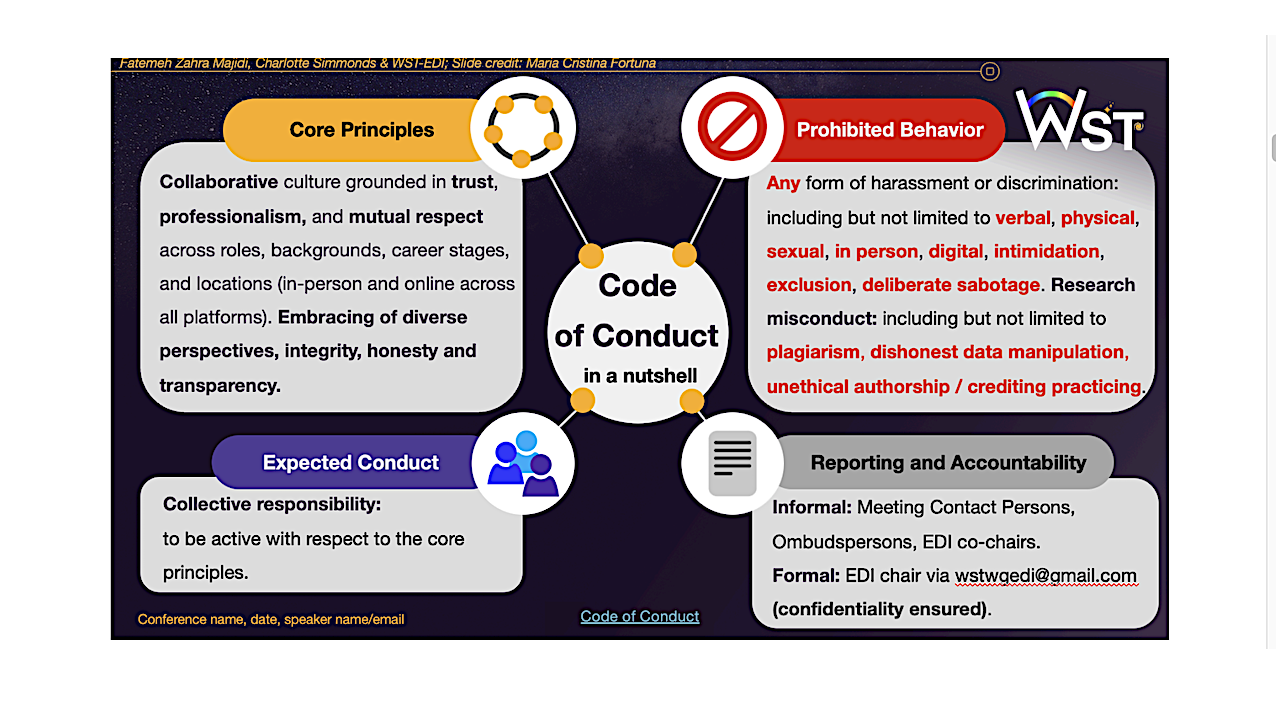
In this paper, we describe the creation and first year of activity of the WST Equity, Diversity, and Inclusion (EDI) working group. We discuss how the group has worked to embed EDI considerations into the early phases of the Collaboration, and we present our ongoing and future projects aimed at broadening participation, accountability, and community sustainability, while delivering groundbreaking science.
We also reflect on the challenges of sustaining EDI work in a large and rapidly evolving collaboration, including recognition of EDI contribution, uneven participation, communication across heterogeneous groups, and the need to connect facility-level initiatives with broader organisational and territorial responsibilities.
We present our activities as a situated example of how EDI can be approached as part of the governance, communication, and community infrastructure required to build sustainable research environments.
Laurane Fréour, Anna Puglisi, Maria Cristina Fortuna, Fatemeh Zahra Majidi, Umberto Rescigno, Amelia Bayo, Francesca Primas, Sabine Thater, Laurence Tresse, Stephanie Escoffier, Letizia P. Cassarà, Roland Bacon, Sofia Randich, Vincenzo Mainieri
Comments: SPIE proceedings, 13 pages, 1 figure
Subjects: Instrumentation and Methods for Astrophysics (astro-ph.IM)
Cite as: arXiv:2606.19013 [astro-ph.IM] (or arXiv:2606.19013v1 [astro-ph.IM] for this version)
https://doi.org/10.48550/arXiv.2606.19013
Focus to learn more
Submission history
From: Laurane Fréour
[v1] Wed, 17 Jun 2026 12:36:52 UTC (1,132 KB)
https://arxiv.org/abs/2606.19013
Astrobiology, Astrochemistry, Astronomy, DEI, Diversity,