Gaia Exoplanet Orbits, Demographics, and Evolution Survey (GEODES): Characteristics of Three Long-Period Companions Accelerating their Host Stars
The upcoming release of Gaia DR4 will yield thousands of giant planet candidates, eventually enabling studies of giant planet eccentricities, masses, and occurrence rates across a broad range of stellar host masses, metallicities, and ages.
However, some of these planet candidates are expected to be false positives, and even genuine detections will require additional observations to precisely determine their orbits and masses.
We present here the first results of the Gaia Exoplanet Orbits, Demographics, and Evolution Survey (GEODES), an observational campaign to identify the most promising planet candidate hosts for pre-DR4 vetting and post-DR4 validation and characterization.
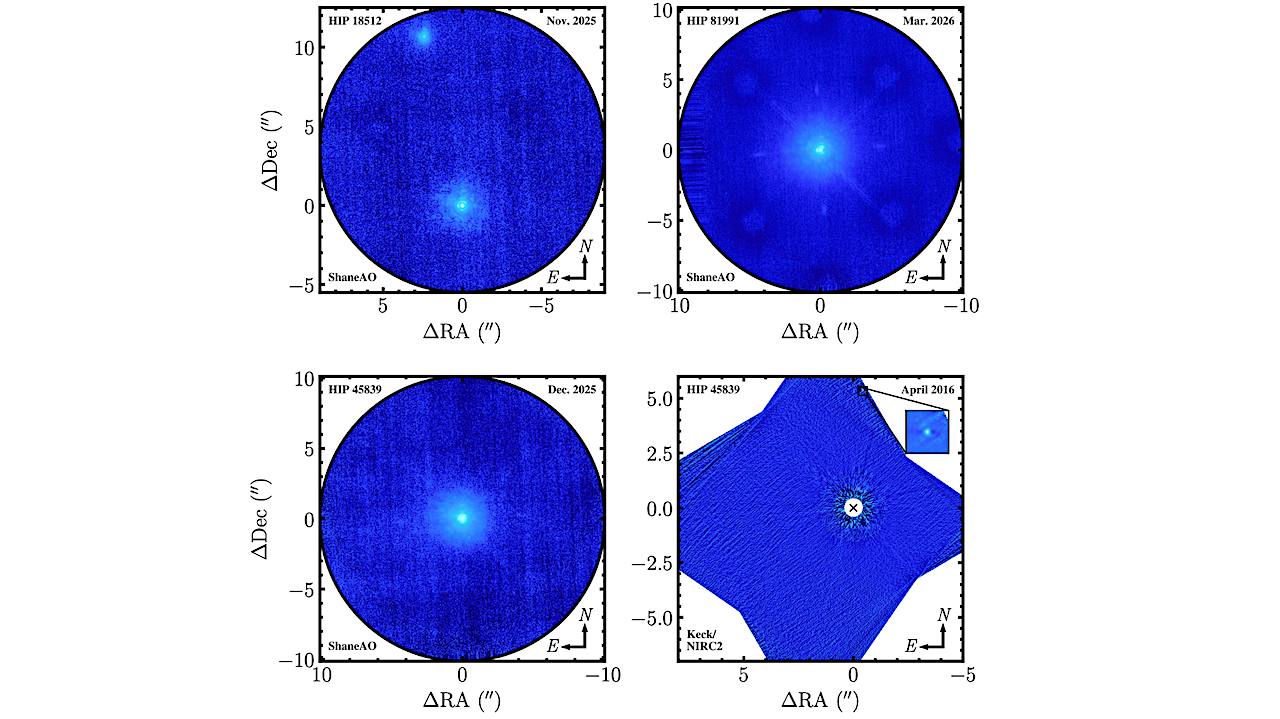
In this paper we showcase three systems from our broader sample exhibiting both tangential and radial accelerations, each representing a distinct outcome of our survey strategy. We combine Hipparcos, Hipparcos-Gaia, Gaia DR2, and Gaia DR3 absolute astrometry with adaptive optics (AO) imaging and precision RVs to constrain companion masses and orbits.
HIP 18512, a nearby (15.3 pc) K4V dwarf, hosts a low-mass stellar companion at 10.87″ ± 0.07″ (166 AU) which produces significant RV and astrometric accelerations on its host star. The RV trend and astrometric acceleration of the nearby (24.2 pc) K4V star HIP 45839, together with an AO imaging non-detection, constrain the companion to a = 17.9^{+4.8}{-2.7} AU (P = 70–127 years) and M = 45.2^{+10.5}{-12.7} MJup.
In the case of HIP 81991 (43.8 pc, G5V), the astrometric and RV data indicate that the companion has a separation of 6.4^{+0.6}{-0.3} AU (P = 14.4–17.7 years) and a mass of 9.5^{+5.4}{-2.2} MJup, and is more likely a planet (65%) than a brown dwarf (35%).
Judah Van Zandt, Brendan Bowler, Erik Petigura, Kyle Franson, Jerry Xuan, Marvin Morgan, Lauren Biddle, Rocio Kiman, Jingwen Zhang, Howard Isaacson, B.J. Fulton, Andrew Howard, Justin Crepp, William Thompson, Dori Blakely
Subjects: Earth and Planetary Astrophysics (astro-ph.EP); Solar and Stellar Astrophysics (astro-ph.SR)
Cite as: arXiv:2605.23018 [astro-ph.EP] (or arXiv:2605.23018v1 [astro-ph.EP] for this version)
https://doi.org/10.48550/arXiv.2605.23018
Focus to learn more
Submission history
From: Judah Van Zandt
[v1] Thu, 21 May 2026 20:41:14 UTC (7,161 KB)
https://arxiv.org/abs/2605.23018
Astrobiology, exoplanet,