


Determining molecular abundances in astrophysical environments is crucial for interpreting observational data and constraining physical conditions in these regions. Chemical modelling tools are essential for simulating the complex processes that […]
modeling

Posted inAI - Data - Apps - Cybernetics, Atmospheres, Climate, Weather, Exoplanets, -moons, -comets, Status Report
AI-enhanced Planetary Meteorology: Deep Learning Reveals Hidden Details In Earth’s Atmosphere
Predicting local weather extremes remains one of the greatest hurdles in meteorology, which requires high-resolution, reliable humidity data. A new study unveils a breakthrough: the first high-resolution Global Navigation Satellite […]

Posted inAI - Data - Apps - Cybernetics, Exoplanets, -moons, -comets, Status Report
A Transformer-based Generative Model For Planetary Systems
Numerical calculations of planetary system formation are very demanding in terms of computing power.

Posted inAtmospheres, Climate, Weather, Biogeochemical Cycles & Geobiology, Exoplanets, -moons, -comets, Status Report
Exoplanetary Atmospheres Retrieval Via A Quantum Extreme Learning Machine
The study of exoplanetary atmospheres traditionally relies on forward models to analytically compute the spectrum of an exoplanet by fine-tuning numerous chemical and physical parameters.

Posted inAI - Data - Apps - Cybernetics, Astrochemistry, Biochemistry & Organic Chemistry, Biophysics, Biosignatures & Paleobiology, Interstellar, Press Release
Pioneering AI Approach Enhances Prediction Of Complex Astrochemical Reactions
Decoding cosmic evolution depends on accurately predicting the complex chemical reactions in the harsh environment of space. Traditional methods for such predictions rely heavily on costly laboratory experiments or expert […]

Posted inAI - Data - Apps - Cybernetics, Atmospheres, Climate, Weather, Imaging & Spectroscopy, Status Report, Titan
Rapid Automated Mapping of Clouds on Titan With Instance Segmentation
Despite widespread adoption of deep learning models to address a variety of computer vision tasks, planetary science has yet to see extensive utilization of such tools to address its unique […]
Posted inAI - Data - Apps - Cybernetics, Astrochemistry, Astronomy & Telescopes, Atmospheres, Climate, Weather, Exoplanets, -moons, -comets, Status Report
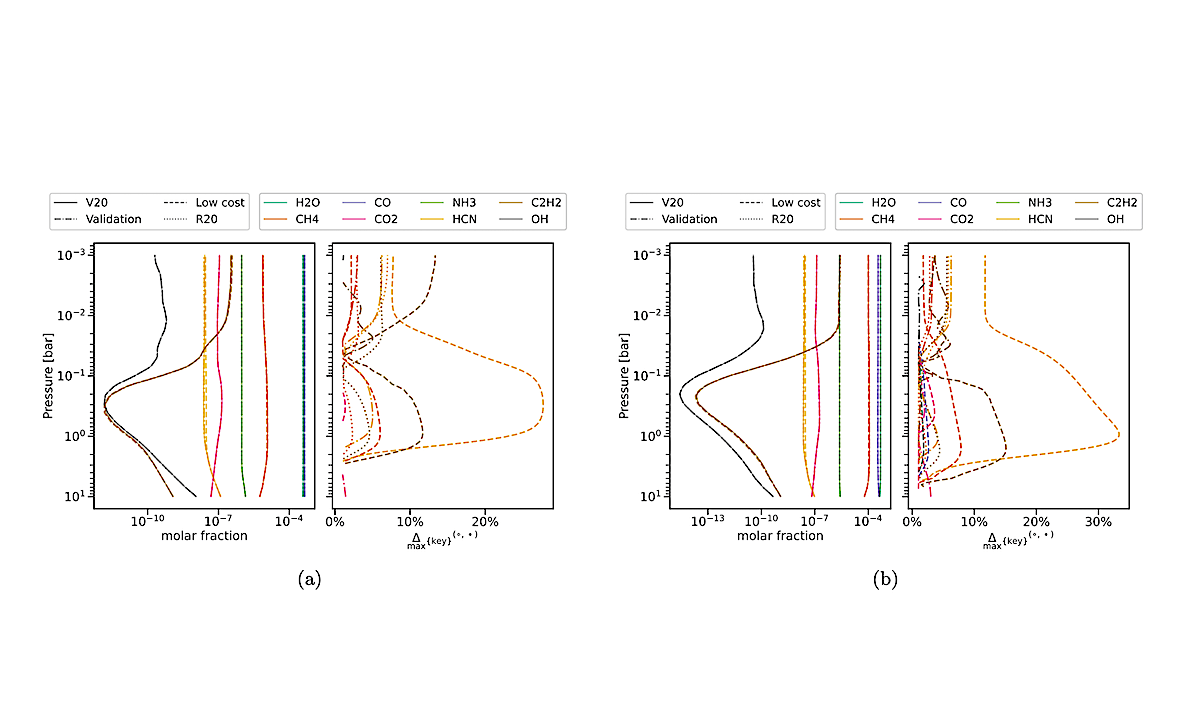
DARWEN: Data-driven Algorithm for Reduction of Wide Exoplanetary Networks
Exoplanet atmospheric modeling is advancing from chemically diverse one-dimensional (1D) models to three-dimensional (3D) global circulation models (GCMs), which are crucial for interpreting observations from facilities like the James Webb […]

Posted inAI - Data - Apps - Cybernetics, Atmospheres, Climate, Weather, Biogeochemical Cycles & Geobiology, Biosignatures & Paleobiology, Exoplanets, -moons, -comets, Habitable Zones, Imaging & Spectroscopy, Status Report
ExoLyn: A Golden Mean Approach To Multi-species Cloud Modelling In Atmospheric Retrieval
Context. Clouds are ubiquitous in exoplanets’ atmospheres and play an important role in setting the opacity and chemical inventory of the atmosphere. Understanding clouds is a critical step in interpreting […]

Posted inAtmospheres, Climate, Weather, Biogeochemical Cycles & Geobiology, Exoplanets, -moons, -comets, Status Report
Interpolation and Synthesis of Sparse Samples in Exoplanet Atmospheric Modeling
This paper highlights methods from geostatistics that are relevant to the interpretation, intercomparison, and synthesis of atmospheric model data, with a specific application to exoplanet atmospheric modeling. Climate models are […]

Posted inAI - Data - Apps - Cybernetics, Astronomy & Telescopes, Biosignatures & Paleobiology, Habitable Zones, Imaging & Spectroscopy, Status Report
Rebuilding The Habitable Zone From The Bottom Up With Computational Zones
Computation, if treated as a set of physical processes that act on information represented by states of matter, encompasses biological systems, digital systems, and other constructs, and may be a […]