Transport of Water In A Transient, Impact-Generated Atmosphere On Mercury
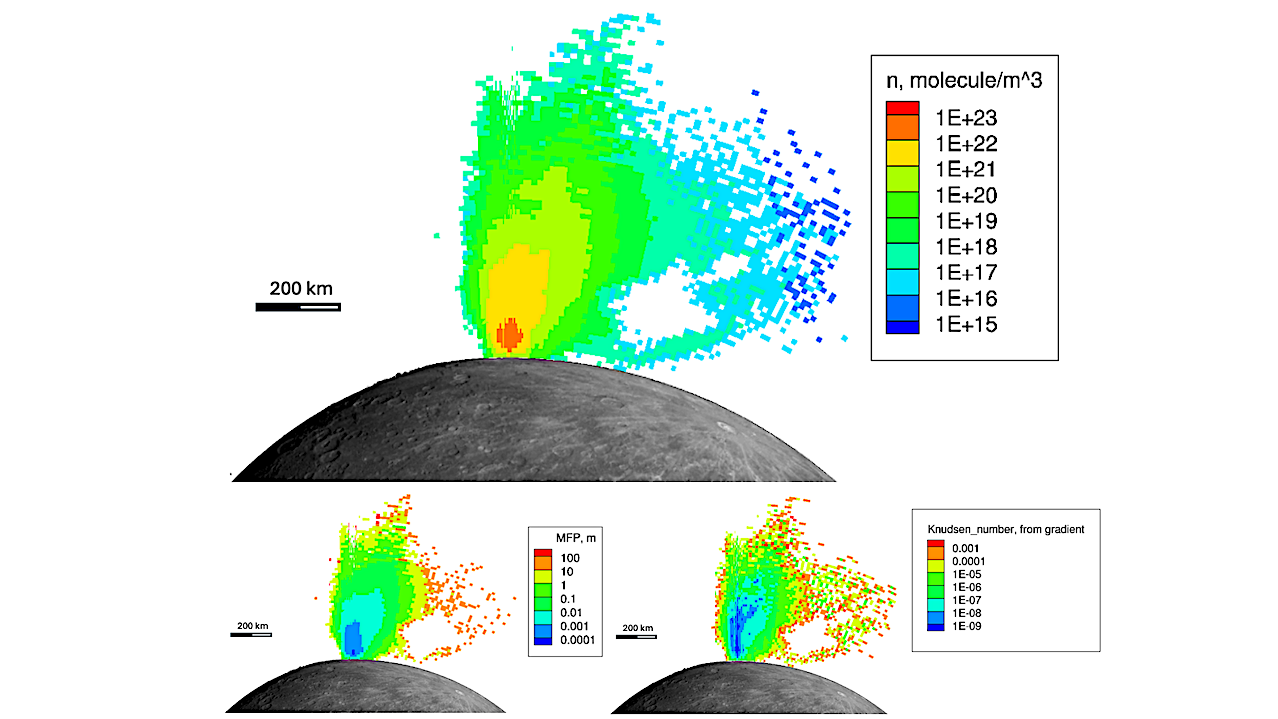
Mercury’s polar cold traps host water ice deposits that are likely populated with impact-delivered water via Mercury’s exosphere.
However, Mercury’s near-sun location experiences an extremely high photodestruction rate that rapidly destroys water with a timescale of only ~3.5 hours. Here we use the PLANET DSMC code to investigate the fate of water from a single 1 km radius comet impact striking Mercury’s North Pole (30 km/s at angle of 60°).
We find that the evolving plume separates into four distinct phases:
1) an early plume phase in which ballistic escape and photodestruction reach their peaks,
2) a reentry phase in which water falling back toward the surface forms a self-shielded shock-topped atmosphere that migrates across the surface and ballistic loss ceases,
3) a quasi-steady phase in which a self-shielding dawn atmospheric enhancement (DAE) forms and drives, a tenuous migration of exospheric water to the cold traps with a longitudinal dependence, and finally
4) a late phase in which self-shielding ends and photodestruction dominates, effectively ending substantial water migration.
In this work, we quantify the fates of the arriving water molecules, and describe some of the more important features of this highly unsteady, evolving three-dimensional atmosphere.
We find that 23% of the initial water is photodestroyed, 65% of the water ballistically escapes the system (of which, 79% photodissociates prior to reaching the Hill radius), and 14% ends up in Mercury’s cold traps, which is significantly more than the ~5% that migrates to the Moon’s cold traps during an equivalent impact.
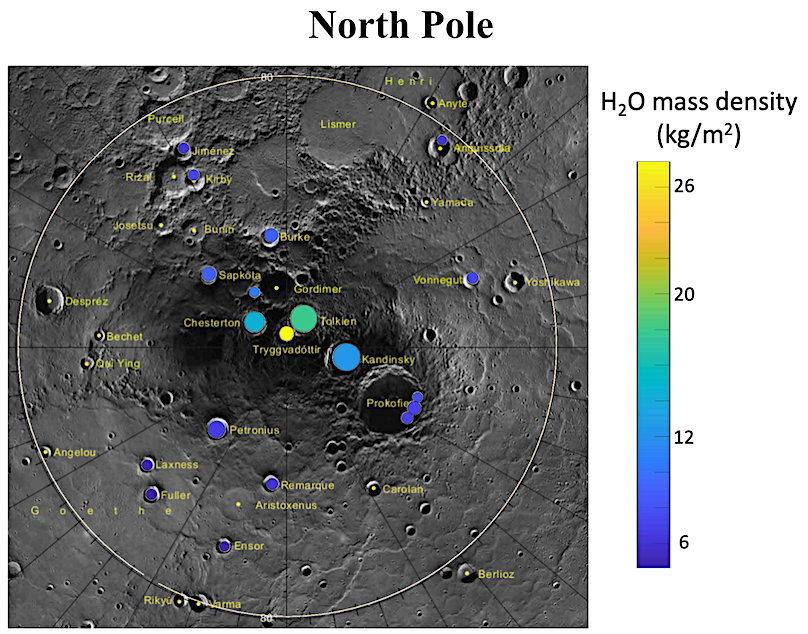
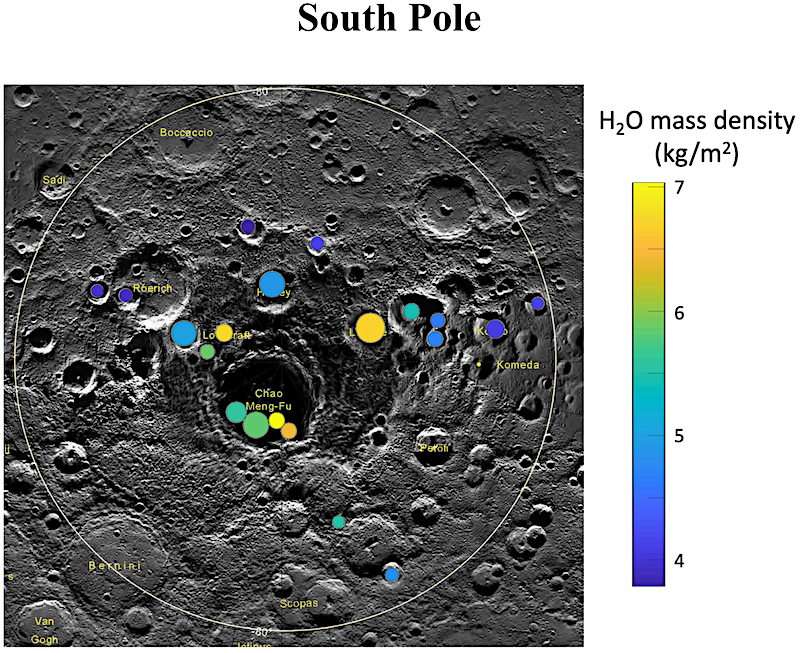
Mass density of deposited ices into Mercury’s discrete cold traps. The comet impact deposits significant water into Mercury’s cold traps; The discrete cold traps collect (top) ~6-26 kg/m2 in the North and (bottom)~4-7 kg/m2 of comet ice throughout the impact process; with cold trap densities generally increasing with increasing latitude; highest densities are found closest to the impact site at the north pole. The sizes of these circles correspond to their surficial extent. Note different scale bars for north and south poles. Diffuse cold traps are not plotted in these figures, as they would cover the discrete cold traps. Cold trap densities plotted above a subset of the USGS maps of the Borealis quadrangle in the north (top) and the Bach Quadrangle in the south (bottom) — astro-ph.EP
Jordan K. Steckloff, David B. Goldstein, Philip L. Varghese, Laurence M. Trafton, Parvathy Prem
Subjects: Earth and Planetary Astrophysics (astro-ph.EP)
Cite as: arXiv:2606.05024 [astro-ph.EP] (or arXiv:2606.05024v1 [astro-ph.EP] for this version)
https://doi.org/10.48550/arXiv.2606.05024
Focus to learn more
Related DOI:
https://doi.org/10.1029/2025JE009436
Focus to learn more
Submission history
From: Jordan Steckloff
[v1] Wed, 3 Jun 2026 15:47:54 UTC (23,834 KB)
https://arxiv.org/abs/2606.05024
Astrobiology, Astrogeology, Astrochemistry,