A Gem System With A Lava World And A Habitable Zone Sub-Neptune Orbiting TOI-1752
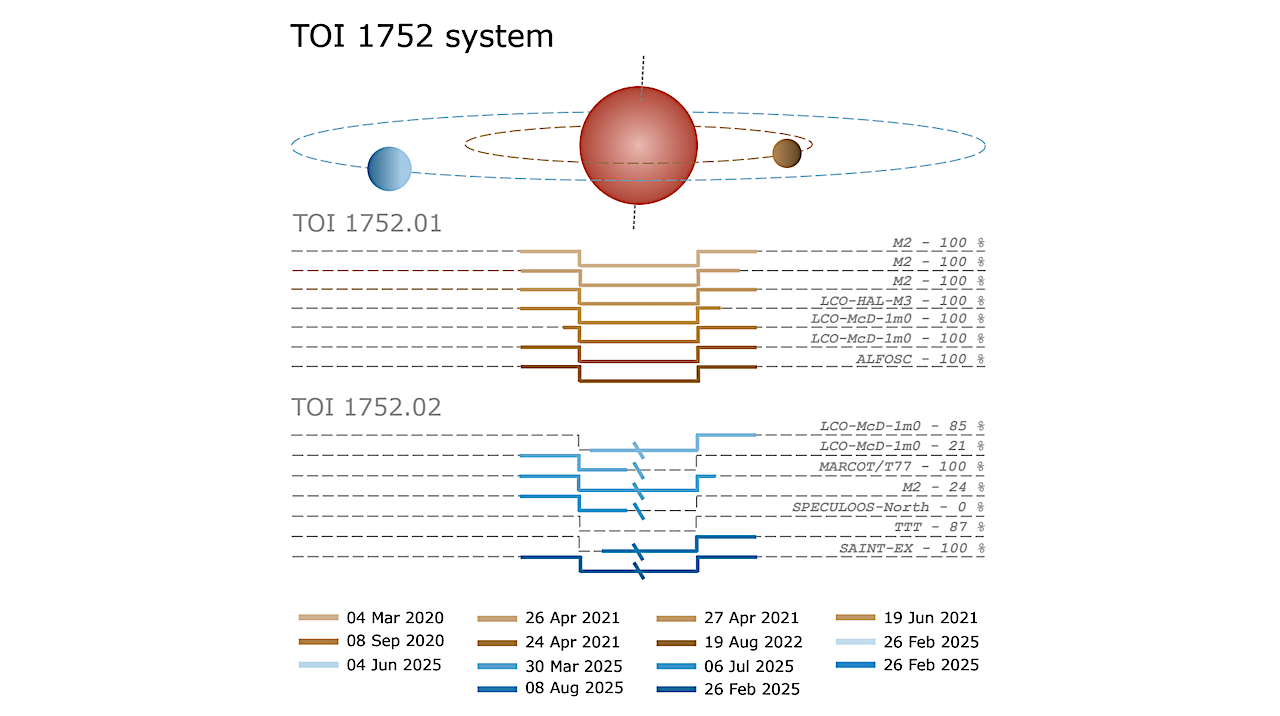
The Transiting Exoplanet Survey Satellite (TESS) has delivered a large number of transiting planet candidates around nearby stars by identifying periodic decreases in stellar brightness.
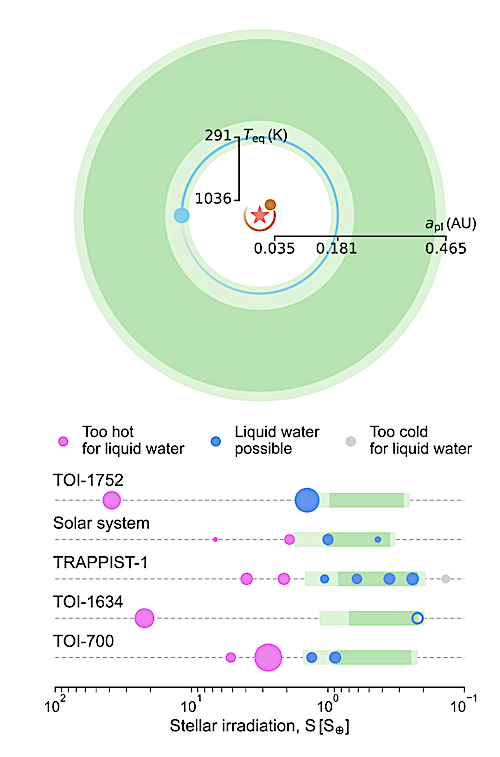
A top-down view of the orbits of the TOI–1752 planets (upper panel). The conservative habitable zone is shown in dark green, and the optimistic habitable zone in light green (Kopparapu et al. 2013). We also compare the TOI–1752 system to the solar system and other benchmark exoplanet systems with low-mass host stars and small habitable-zone planets (lower panel). The relative sizes of the planets are to scale. Empty symbols represent non-transiting planets (no radius known). — astro-ph.EP
Establishing the planetary nature of these signals and determining their fundamental properties is a necessary step toward detailed studies of their internal structure, atmospheres, and formation pathways.
In this work, we investigate the planetary nature of the TOI-1752 system (M1 V, 103.02±0.34 pc), which hosts two TESS candidates: TOI-1752 b, a short-period object consistent with a lava-world scenario, and TOI-1752 c, a sub-Neptune-size planet candidate located in the optimistic habitable zone.
We obtained ground-based multi-color photometric follow-up observations of TOI-1752, which we combined with TESS photometry to assess the nature of both signals. We performed a formal statistical validation using the TRICERATOPS framework, while independently vetting the candidates with the neural-network-based classifier WATSON-Net, which provides a machine-learning assessment of their planetary likelihood based on light-curve morphology, centroid diagnostics, and auxiliary vetting features.
We validate TOI-1752 b as a bona fide planet with a radius of 1.69±0.07R⊕ and an orbital period of 0.935186+0.000001−0.000002 days, and TOI-1752 c with a radius of 2.29+0.13−0.14R⊕ and an orbital period of 32.7144±0.0004 days. The combined analysis confirms TOI-1752 as a new planetary system, places TOI-1752 c within the optimistic habitable zone of its host star, and identifies TOI-1752 b as a promising target for atmospheric characterization, with an estimated emission spectroscopy metric (ESM) of up to ∼8.
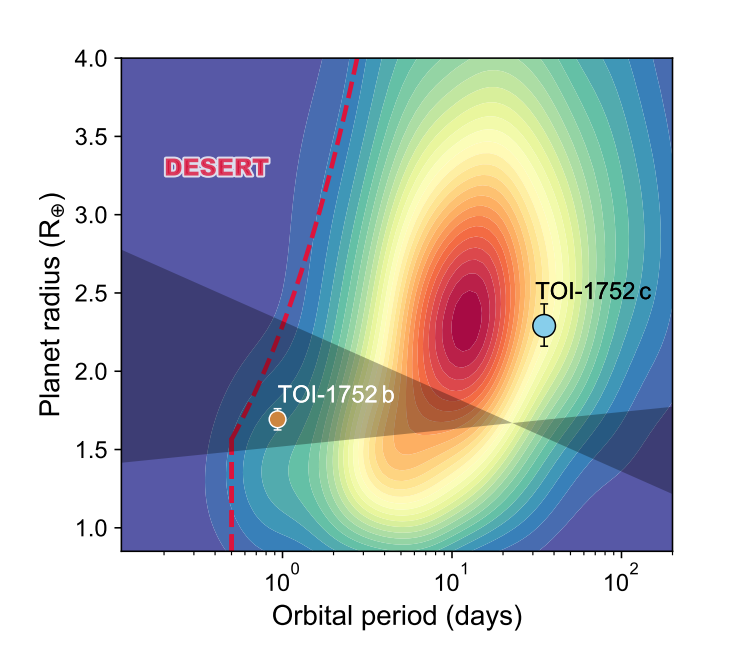
Location of the validated new planets (TOI–1752 b in brown and TOI–1752 c in blue) in the period–radius diagram. The different density levels and the corresponding color map indicate planet occurrence, with redder regions being more populated and bluer regions less populated. The red dashed line marks the boundary of the Neptune desert, as defined by Castro-González et al. (2024a). The black-shaded region shows the radius valley of sub-Neptune exoplanets around low mass stars measured by Cloutier & Menou (2020) and the radius valley for exoplanets around Sun-like stars measured by Martinez et al. (2019), scaled to low mass stars by Cloutier & Menou (2020). — astro-ph.EP
A. Peláez-Torres, F. J. Pozuelos, G. Morello, M. Dévora-Pajares, K. Barkaoui, L. Gkouvelis, E. Pallé, K. A. Collins, B. V. Rackham, S. Geraldía-González, M. Centenera-Merino, R. Varas, E. Esparza-Borges, Z. Parlapani, J. Flores, J. Aceituno, P. J. Amado, A. Burdanov, Y. Calatayud-Borras, D. R. Ciardi, B.-O. Demory, T. Gan, S. Giacalone, M. Gillon, Y. Gómez Maqueo Chew, K. Kawauchi, A. Khandelwal, J. Korth, M. Lendl, J. P. de Leon, J. Livingston, N. Morales, F. Murgas, N. Narita, J. L. Ortiz, H. Parviainen, M. Pichardo Marcano, I. Plauchu-Frayn, D. Queloz, D. Rapetti, J. Saito, A. Sánchez-López, A. B. Savel, R. P. Schwarz, U. Schroffenegger, M. Serra-Ricart, C. Stockdale, A. H. M. J. Triaud, J. de Wit, F. Zong Lang
Comments: 17 pages, 14 figures, 4 tables, accepted for publication in MNRAS
Subjects: Earth and Planetary Astrophysics (astro-ph.EP)
Cite as: arXiv:2604.15816 [astro-ph.EP] (or arXiv:2604.15816v1 [astro-ph.EP] for this version)
https://doi.org/10.48550/arXiv.2604.15816
Focus to learn more
Submission history
From: Alberto Peláez Torres
[v1] Fri, 17 Apr 2026 08:12:33 UTC (2,564 KB)
https://arxiv.org/abs/2604.15816
Astrobiology, exoplanet,