Characterizing Six Seismic Solar Analogs Observed By Kepler, K2, And HERMES
Solar analogs, stars that closely match the fundamental properties of the Sun, provide key benchmarks for testing stellar structure and evolution across different ages and activity levels.
Their detailed characterization helps place the Sun in context within the broader population of solar-like stars. This study presents the characterization of six seismic solar analogs observed by the NASA Kepler and K2 missions. Combining asteroseismic constraints from space-based photometry with high-resolution spectroscopy and Gaia astrometry, we derived their fundamental parameters and assessed their resemblance to the Sun.
Global seismic properties and individual oscillation modes were extracted from the photometric light curves, while atmospheric parameters were obtained from data collected by the HERMES spectrograph at the Mercator telescope. Stellar modeling using seven independent stellar evolution codes yielded consistent masses, radii, and ages.
These stars have masses between 0.91 and 1.04~M⊙, radii between 0.95 and 1.08~R⊙, and ages from about 1.8 to 9.1~Gyr, with typical systematic uncertainties of ± 0.02~M⊙, ± 0.01~R⊙, and ± 0.7~Gyr, respectively. One star, EPIC~206064678, exhibits properties very similar to those of the Sun, with M=1.016±0.033M⊙, R=0.990±0.011R⊙, and an age of 5.40±0.12,Gyr. It can therefore be considered a close solar twin, although it is slightly older and more metal-rich (0.25±0.07,dex).
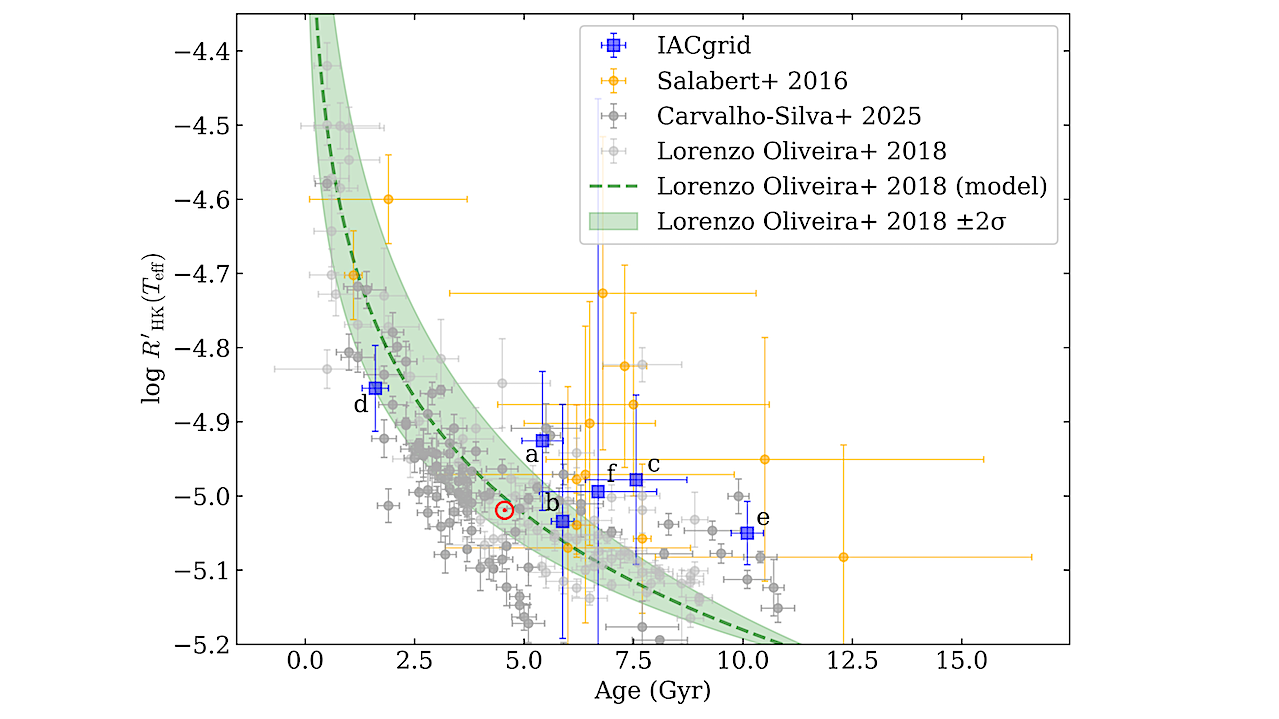
Four targets display binarity signatures and all exhibit very low chromospheric activity. This work broadens the sample of well-characterized seismic solar analogs towards a larger sample of metallicities and ages, providing new references for comparative stellar studies and future asteroseismic investigations.
R. A. García, S. Mathur, G. T. Hookway, D. Godoy-Rivera, T. Masseron, J. Bétrisey, G. Buldgen, C. Lindsay, T. S. Metcalfe, O. J. Scutt, A. Stokholm, P. G. Beck, O. Benomar, G. R. Davies, A. Jiménez, J. Merc, M. B. Nielsen, E. Panetier, F. Pérez Hernández, L. Borg, S. N. Breton, L. Debacker, A. Escorza, D. H. Grossmann, A. Hamy, B. Liagre, M. N. Lund, S. Mathis, D.B. Palakkatharappil, A. R. G. Santos, V. Delsanti, L. González-Cuesta, V. Fox, N. Proust
Comments: Accepted for publication in A&A. 17 pages, 11 figures
Subjects: Solar and Stellar Astrophysics (astro-ph.SR)
Cite as: arXiv:2604.27090 [astro-ph.SR] (or arXiv:2604.27090v1 [astro-ph.SR] for this version)
https://doi.org/10.48550/arXiv.2604.27090
Focus to learn more
Submission history
From: Rafael A. Garcia
[v1] Wed, 29 Apr 2026 18:33:01 UTC (5,438 KB)
https://arxiv.org/abs/2604.27090
Astrobiology, stellar cartography,