Ice as a Photochemical Shield: Adsorption Energetics and Spectroscopic Modulation of Interstellar Thiocyanates HCSCN and HCSCCH in TMC-1
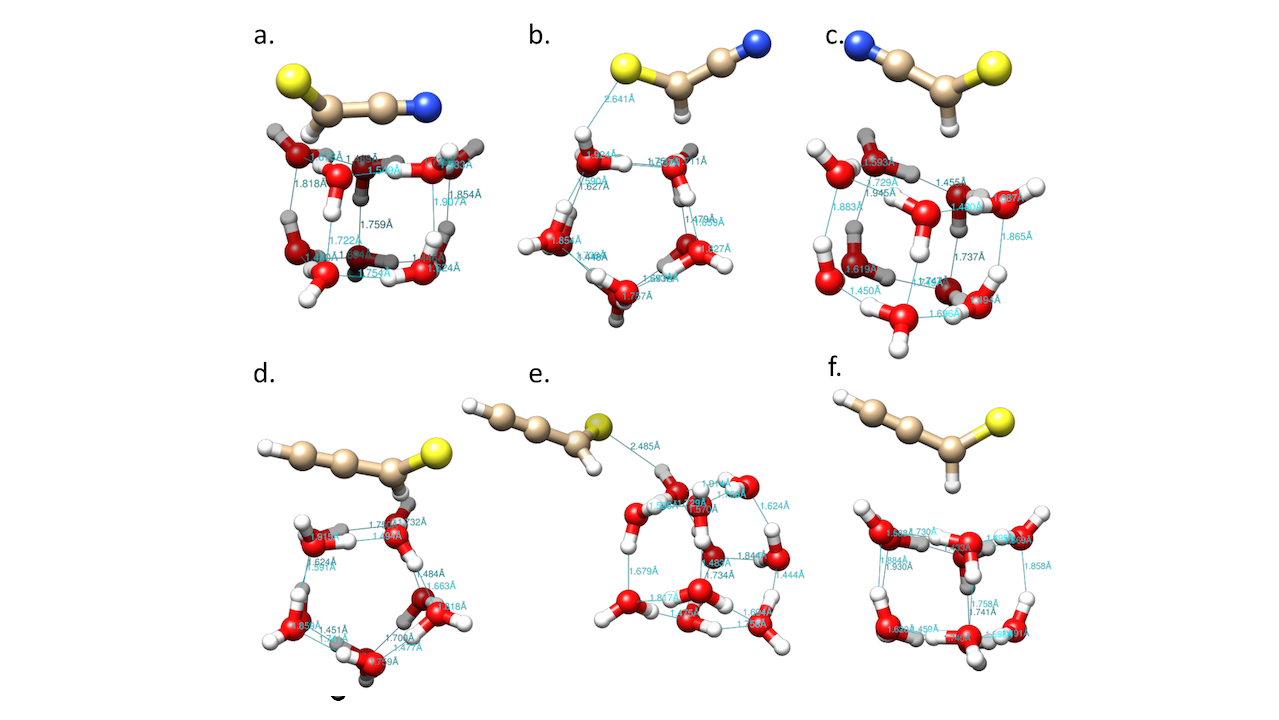
The recent detections of thioformyl cyanide (HCSCN) and propynethial (HCSCCH) in TMC-1 provide critical insights into the interstellar sulfur inventory, yet their sequestration and survivability on dust grain mantles remain poorly constrained.
Here, we present a computational study of the site-specific adsorption of HCSCN and HCSCCH on amorphous solid water (ASW), modelled via water clusters (H2O)n, n = 6-16, at the wB97X-D/def2-TZVP level of theory, corroborated by QTAIM topological analyses and TD-DFT vertical excitations.
Our results reveal a highly heterogeneous binding environment, with desorption energies spanning 1500 to 4900 K. Strongly bound cavity sites induce significant Stark shifts in the C=S stretching modes. Crucially, while the ice matrix exerts a negligible solvatochromic shift on UV transition wavelengths, deeply bound CN-cavity configurations exhibit a pronounced hyperchromic enhancement of the oscillator strength.
Implementing these site-specific parameters into the UCLCHEM gas-grain code demonstrates that these species undergo a gradual thermal desorption profile rather than a singular sublimation event.
Furthermore, the hyperchromic effect establishes a Survival Paradox: while deeply trapped populations are thermodynamically shielded against thermal desorption, they simultaneously possess enhanced UV absorption cross-sections, rendering them vulnerable to photodissociation by the interstellar radiation field prior to sublimation.
Saptarshi G. Dastider, Amit Singh Negi, Krishnakanta Mondal, Jobin Cyriac
Subjects: Astrophysics of Galaxies (astro-ph.GA); Chemical Physics (physics.chem-ph); Computational Physics (physics.comp-ph)
Cite as: arXiv:2604.17536 [astro-ph.GA] (or arXiv:2604.17536v1 [astro-ph.GA] for this version)
https://doi.org/10.48550/arXiv.2604.17536
Focus to learn more
Submission history
From: Saptarshi Ghosh Dastider
[v1] Sun, 19 Apr 2026 16:56:50 UTC (18,810 KB)
https://arxiv.org/abs/2604.17536
Astrobiology, Astrochemistry,