A TESS Test of the Hybrid Ring Strategy for Technosignature Searches Using GRB 221009A

We present the first observational test of the hybrid ring strategy, a general coordinated signaling scheme proposed by Seto (2025), which provides a practical Schelling-point realization for interstellar signaling.
We use the exceptionally bright GRB 221009A as the anchoring flash for the scheme, together with the accurately measured distance to the Galactic center. This combination provides a high-precision relation linking sky position to a tightly constrained arrival-time window.
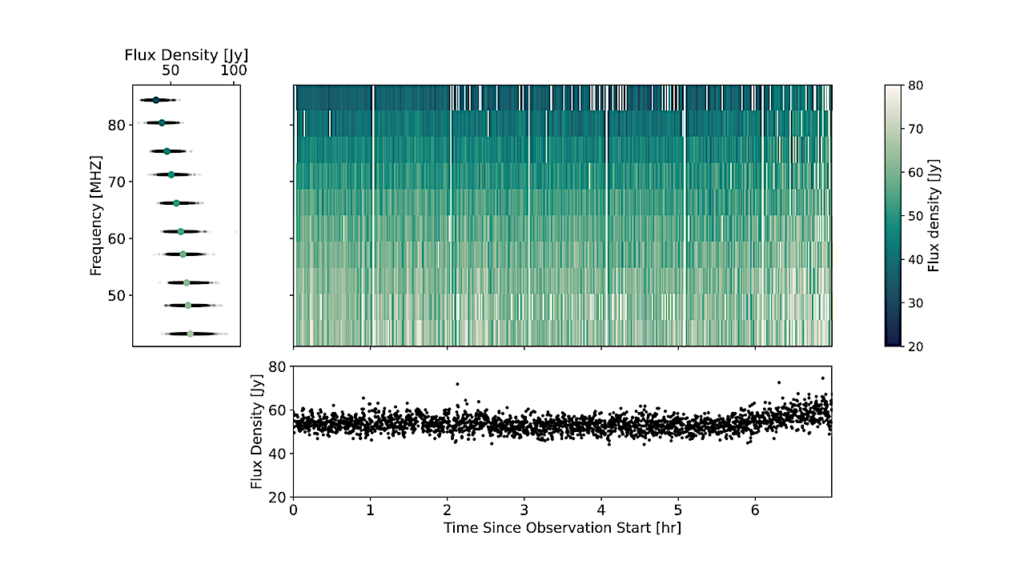
TESS observed the region around the GRB nearly continuously for ~50 days in 2024, providing survey light curves that enable a direct test of this scheme with sharply predicted arrival-time windows of ∼3.4 days.
Among 58 carefully selected stars, we identify two that show noticeable single-time-bin brightenings inside their predicted windows (where each time bin corresponds to a 200 s integrated TESS exposure).
In both cases the brightenings coincide with excursions in at least one nearby star and are therefore most consistent with instrumental origins. This test demonstrates that the hybrid ring strategy is practical with existing survey data and could serve as a promising basis for future technosignature searches.
Naoki Seto
Comments: 18 pages, 5 figures
Subjects: Instrumentation and Methods for Astrophysics (astro-ph.IM); Popular Physics (physics.pop-ph)
Cite as: arXiv:2604.06807 [astro-ph.IM] (or arXiv:2604.06807v1 [astro-ph.IM] for this version)
https://doi.org/10.48550/arXiv.2604.06807
Focus to learn more
Submission history
From: Naoki Seto
[v1] Wed, 8 Apr 2026 08:21:05 UTC (1,415 KB)
https://arxiv.org/abs/2604.06807
Astrobiology, SETI,