Terraforming Mars: Mass, Forcing, And Industrial Throughput Constraints
Terraforming Mars can be evaluated with a small set of system-level feasibility constraints linking (i) target pressures and compositions to required atmospheric inventories, (ii) target surface temperatures to required radiative control authority, (iii) inventories and radiative agents to sustained industrial throughput and power over a build time, and (iv) persistence against collapse, escape, and geochemical sinks.
We use transparent order-of-magnitude scalings to map proposed levers (endogenous CO2 release, synthetic super-greenhouse gases, CO2-H2 CIA, engineered aerosols/nanoparticles, orbital mirrors/albedo modification, and regional solid-state greenhouse “paraterraforming”) onto common metrics {M, τIR/ΔFTOAM˙, P}.
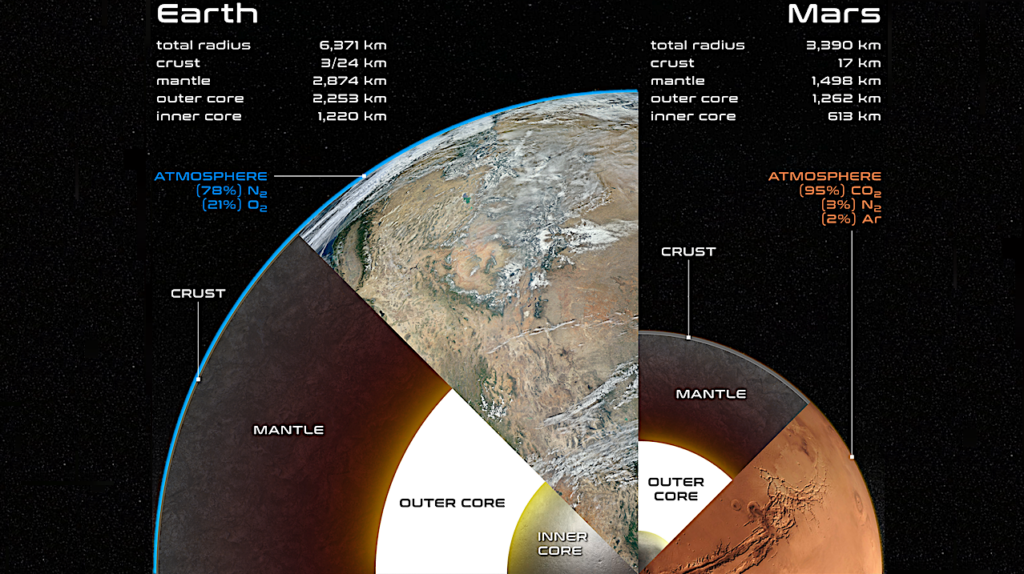
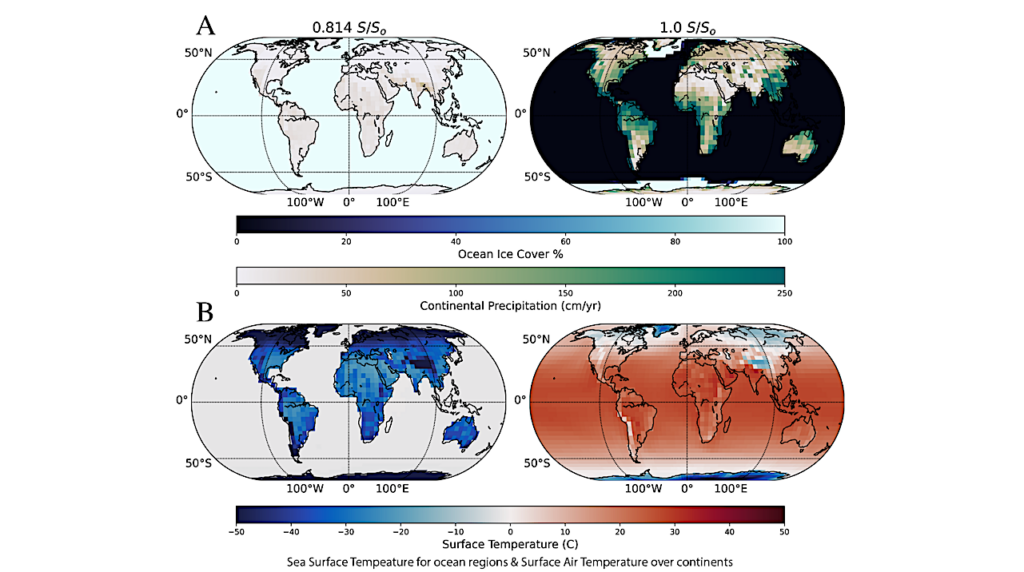
We find: (1) human-relevant pressures imply exaton-class inventories, Matm≃4πR2MarsPs/gMars∼1017-1018 kg; (2) accessible CO2 plausibly provides ≲20 mbar, yielding ≲10 K warming under present insolation; (3) achieving Ts ~ 250-273 K at current insolation requires an effective IR opacity target τIR,eff∼2–4 (uncertain at the ~30-50% level but not altering mass-scale conclusions); (4) breathable endpoints are dominated by O2 and buffer-gas mass and by a minimum oxygenation work ≳1025 J, implying M˙∼107-108 kg\,s−1 and multi-102 TW to PW-class average power for century-to-millennial build times.
We conclude that regional habitability gains via paraterraforming are plausible on near-term industrial scales, whereas global transformation of Mars requires multi-century planetary industry and becomes credible only under conditions of (a) massive exogenous volatile supply or much larger discovered inventories, and (b) sustained high-authority climate control and retention against sinks and loss.
Slava G. Turyshev
Comments: 24 pages, 2 figures, and 10 tables
Subjects: Earth and Planetary Astrophysics (astro-ph.EP); Instrumentation and Methods for Astrophysics (astro-ph.IM)
Cite as: arXiv:2603.00402 [astro-ph.EP] (or arXiv:2603.00402v1 [astro-ph.EP] for this version)
https://doi.org/10.48550/arXiv.2603.00402
Focus to learn more
Submission history
From: Slava G. Turyshev
[v1] Sat, 28 Feb 2026 01:30:06 UTC (51 KB)
https://arxiv.org/abs/2603.00402
Astrobiology,