Primary Stress Factors and Adaptive Mechanisms of Microalgae in Space Environments and Their Applications in Space Life Support Systems
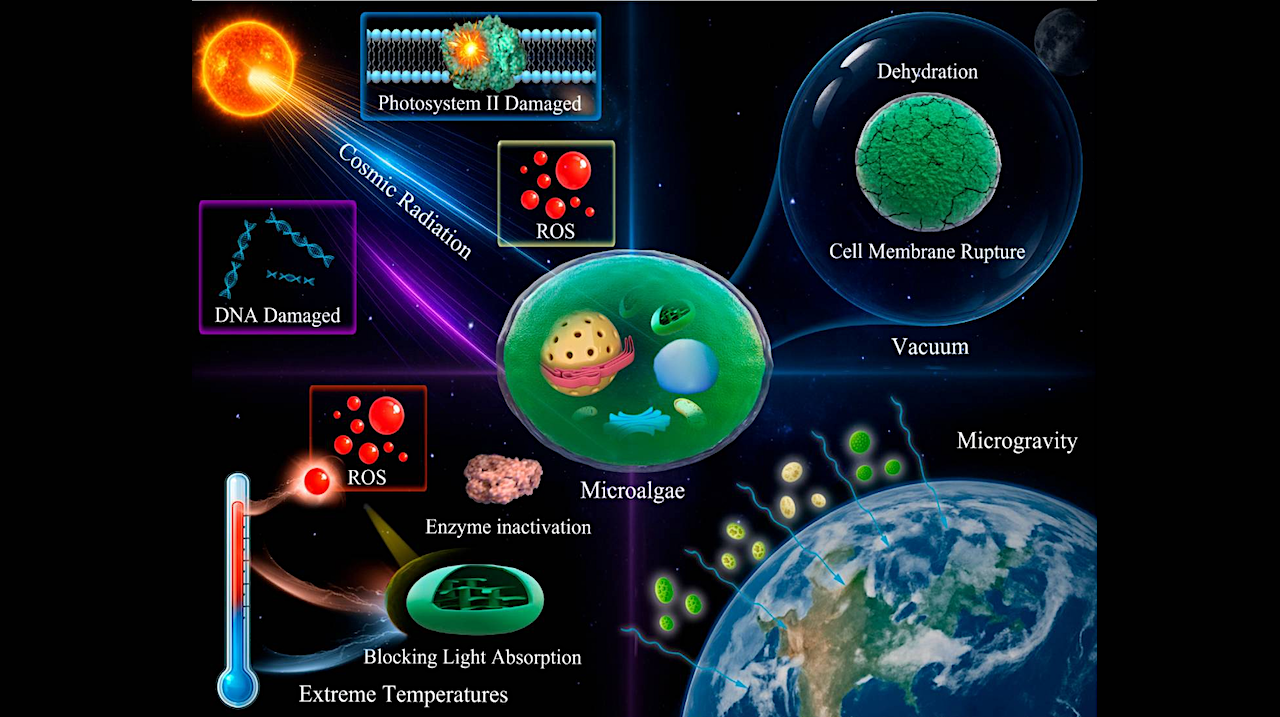
Cyanobacteria and eukaryotic microalgae (collectively referred to here as ‘microalgae’) represent early-evolving oxygenic phototrophs and are widely considered ideal candidates for bioregenerative life support systems (BLSS) due to their high metabolic efficiency and ecological robustness.
Photosynthetic systems centered on microalgae show strong promise for life support in future deep-space exploration. However, the space environment imposes a range of harsh stressors, including intense radiation, extreme temperature fluctuations, vacuum conditions, and microgravity, all of which critically challenge biological survival. The capacity to resist extreme environments, maintain viability, and reproduce is of great significance.
This review systematically summarizes the responses and adaptive mechanisms of microalgae in extraterrestrial settings, including the regulation of radiation defense, photosynthetic metabolic reprogramming, structural protection, and dormancy strategies. Furthermore, the practical applications of microalgae in BLSS encompass atmospheric regulation, food supplementation, and wastewater recycling.
By highlighting both achievements and current limitations, this review provides insights into the potential of microalgae as a cornerstone for future long-duration space missions and planetary base construction, while identifying key directions for future research on strain improvement, photobioreactor optimization, and system integration.
- Primary Stress Factors and Adaptive Mechanisms of Microalgae in Space Environments and Their Applications in Space Life Support Systems, Plants via PubMed (open access)
- Primary Stress Factors and Adaptive Mechanisms of Microalgae in Space Environments and Their Applications in Space Life Support Systems, Plants (open access)
Astrobiology,