GJ 523b Is A Massive, 170 Myr-old Mega-Earth, Likely On A Polar Orbit
We use WIYN/NEID radial velocity measurements to confirm the planetary nature and measure the mass of the TESS transiting exoplanet candidate around the mid-K dwarf GJ 523 (V=9.23, K=6.525).
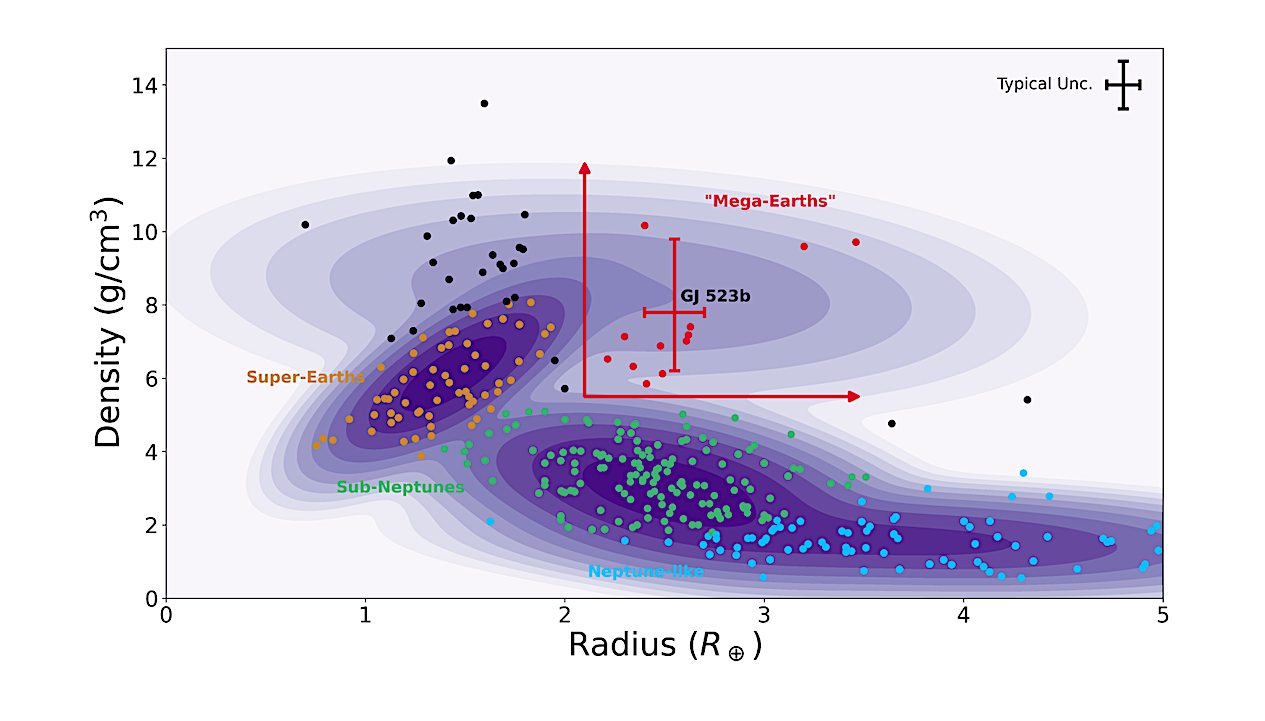
We find that GJ 523b is on a 17.75 day orbit and has a radius of 2.55±0.15R⊕, a mass of 23.5±3.3M⊕, and a zero-albedo equilibrium temperature of 538 K. GJ 523b’s high bulk density of 7.8±1.8 g cm−3 and position on a mass-radius diagram implies a surprising low atmospheric mass fraction despite its relatively large mass. Additionally, we determine that the system has an age of 169+100−48 Myr through a gyrochronological analysis of GJ 523 and its comoving companions.
We also use the SED-derived stellar radius, the photometric rotation period, and the spectroscopic vsini⋆ to derive a stellar inclination of 17.6±5.0 degrees, implying that GJ 523b has a minimum orbital obliquity of 71.4+4.7−5.0 degrees. GJ 523b’s high mass, apparent lack of a gas envelope, young age, and high orbital obliquity present a challenge to typical planet formation pathways, and at the moment there is not enough data on the system to definitively determine how GJ 523b formed.
Finally, we present a new observational classification for ultra-dense, sub-Neptune-sized exoplanets similar to GJ 523b: the mega-Earths, planets with Rp≥2.1R⊕ and ρp≥5.5 g cm−3.
Maxwell A. Kroft, Thomas G. Beatty, Joseph M. Salzer, Claire Zwicker, Anastasia Triantafillides, Juliette Becker, Melinda Soares-Furtado, Jessi Cisewski-Kehe, Jack J. Lissauer, Tayt S. Armitage, Joseph R. Livesey, Ritvik Sai Narayan, Susanna Widicus Weaver, Ke Zhang, Allyson Bieryla, David R. Ciardi, Catherine A. Clark, Miranda Felsmann, Rachel B. Fernandes, Steve B. Howell, Michael B. Lund
Comments: 26 pages, 14 figures, submitted to AJ
Subjects: Earth and Planetary Astrophysics (astro-ph.EP)
Cite as: arXiv:2603.24682 [astro-ph.EP] (or arXiv:2603.24682v1 [astro-ph.EP] for this version)
https://doi.org/10.48550/arXiv.2603.24682
Focus to learn more
Submission history
From: Maxwell Kroft
[v1] Wed, 25 Mar 2026 18:02:18 UTC (3,391 KB)
https://arxiv.org/abs/2603.24682
Astrobiology, exoplanet,