Nanotechnology & SynBio

Behavioral, Physiological, and Transcriptional Mechanisms of Memory in a Synthetic Living Construct
By Keith Cowing
Status Report
biorxiv.org
March 27, 2026
Filed under , , , , , , ,
Behavioral, Physiological, and Transcriptional Mechanisms of Memory in a Synthetic Living Construct
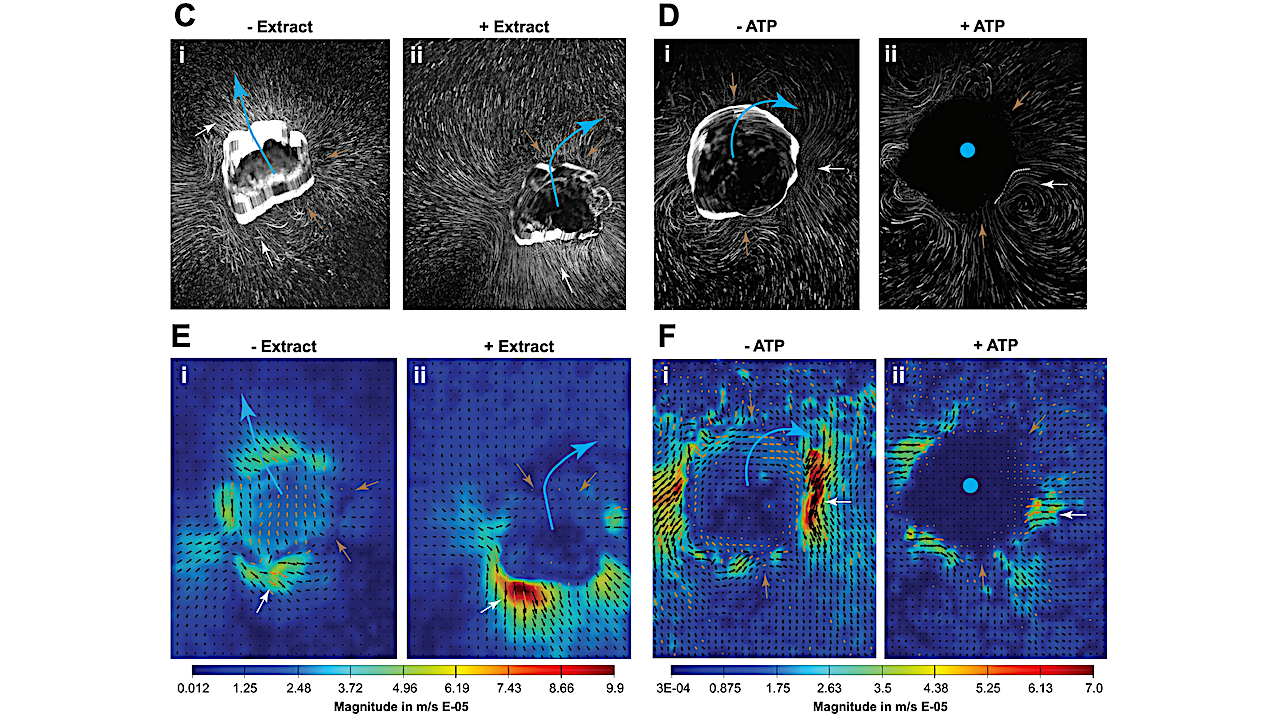
Chemical stimuli change the trajectory and flow fields of basal Xenobots without affecting the cilia beating. (C) shows embryo extract stimulus (Supplementary Movie 13) and (D) shows ATP stimulus (Supplementary Movie 14) illustrating stimulus-induced change in trajectory, motion and flow-field organization. Blue arrows indicate the trajectory of the Xenobots, white arrows indicate regions of major thrust/flow around the Xenobot, and brown arrows indicate regions of minimal or no thrust/flow around the Xenobot. N=4 for embryo extract stimulus and N=5 for ATP stimulus. (E-F) Representative images of PIVbased velocity fields, with black arrows indicating local flow direction and color map indicating flow speed, before (i) and after (ii) chemical stimuli: (E) embryo extract stimulus (Supplementary Movie 15) and (F) ATP stimulus (Supplementary Movie 16). These images illustrate changes in fluid-flow direction and speed, thrust intensity, and the overall velocity-field architecture following chemical stimuli. Blue arrows indicate the Xenobot trajectory, white arrows indicate regions of major thrust/flow around the Xenobots, and brown arrows indicate regions of minimal or no thrust/flow around the Xenobots. N=4 for extract stimuli and N=5 for ATP stimuli. — biorxiv.org

Synthetic living constructs, which lack the long histories of selection in ecological contexts that shape behaviors of conventional organisms, offer an important complement to traditional studies of learning.

Could novel biobots exhibit sensing and memory of experiences? Here, we investigated the effects of chemical stimuli on basal Xenobots – autonomously motile entities derived from Xenopus embryonic ectodermal explants (with no additional sculpting or bioengineering). We quantified and characterized the coordinated ciliary activity that generates fluid flow fields guiding the trajectory of Xenobot motion.

We also show distinct and specific changes in Xenobot behavior after brief exposure to Xenopus embryonic cell extract and to ATP. These two experiences produced distinct, long-term, stimulus-specific memories, detectable through both transcriptional and physiological signatures.

Exposure to specific environmental stimuli induced alterations in the spatiotemporal patterns of calcium signaling across Xenobots. Together, these data lay a foundation for characterizing the capabilities of synthetic cellular collectives to sense and discriminate among stimuli, as well as store functional information in a non-neural context.

Understanding behavioral competencies in novel, non-neural systems have broad implications across evolutionary biology, behavioral science, bioengineering, and bio/hybrid robotics.

Behavioral, Physiological, and Transcriptional Mechanisms of Memory in a Synthetic Living Construct, biorxiv.org

Astrobiology, SynBio, Nanotechnology,

Explorers Club Fellow, ex-NASA Space Station Payload manager/space biologist, Away Teams, Journalist, Lapsed climber, Synaesthete, Na’Vi-Jedi-Freman-Buddhist-mix, ASL, Devon Island and Everest Base Camp veteran, (he/him) 🖖🏻