Transit Distances And Composition Of Low-velocity Exocomets In The β Pictoris System
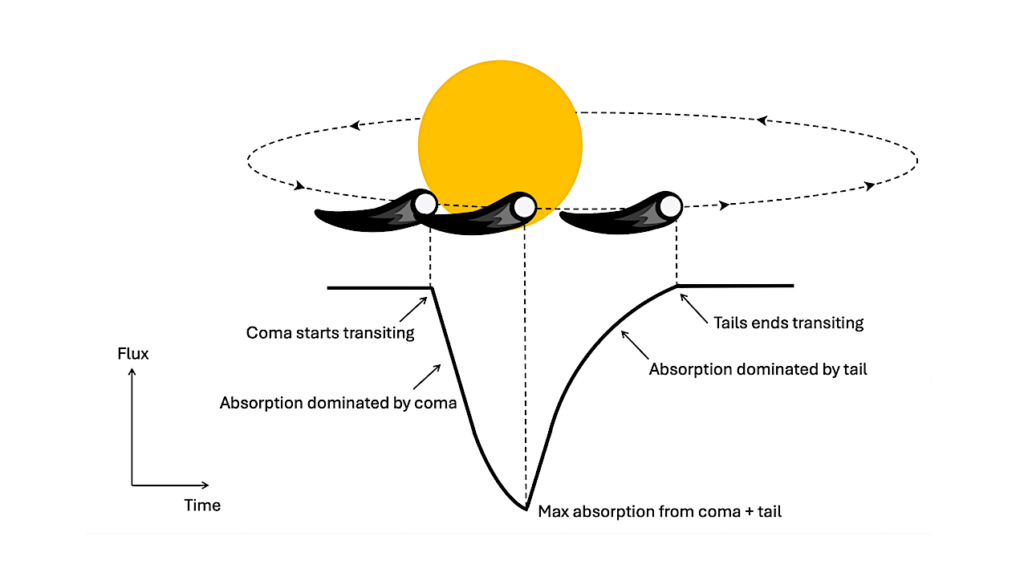
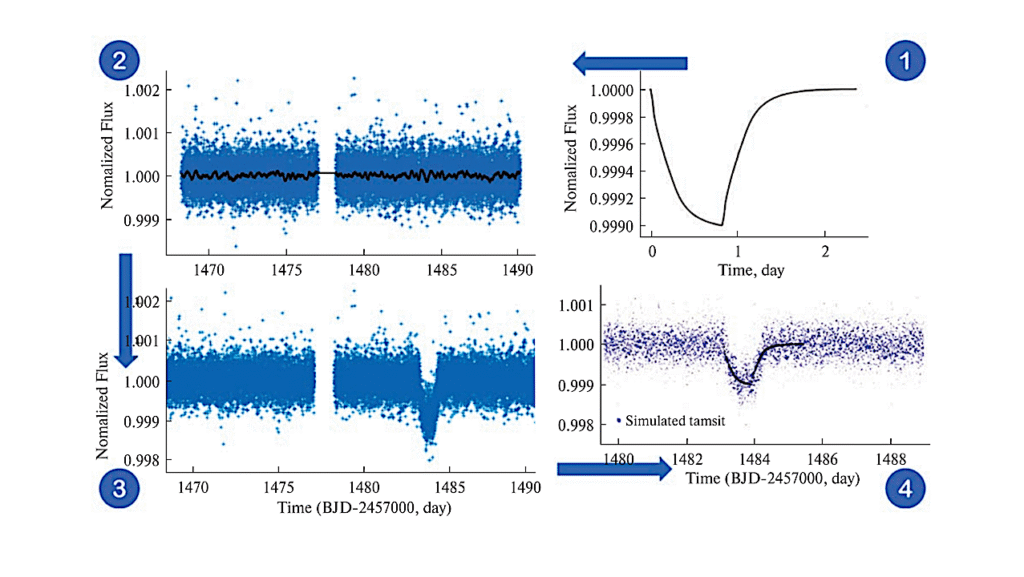
β Pictoris is a young nearby A5V star, about 20 Myr old, embedded in a prominent debris disc. For the past 40 years, variable absorption features have been observed in the stellar spectrum, produced by the gaseous tails of exocomets transiting the star.
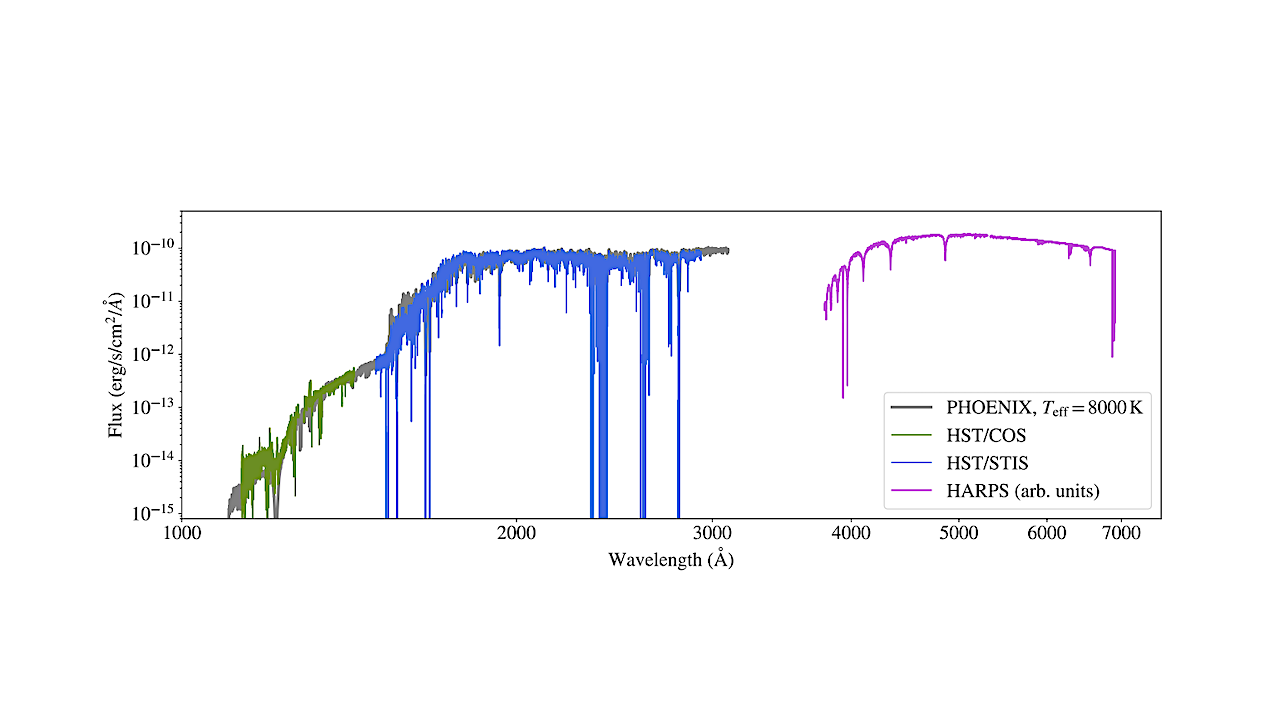
Yet, despite the large number of observations available, the origin and dynamical evolution of the exocomets remain poorly understood. Here we present new spectroscopic observations of β Pic, obtained on April 29, 2025, with the Hubble Space Telescope and the HARPS spectrograph.
We report the detection of three strong exocomet signatures at low radial velocities (-7.5, +2.5 and +10 km/s), in a large set of lines from various species and excitation levels. We show that the three exocometary tails have different excitation states, indicating that they are located at different distances from the star.
Using a detailed modelling of the excitation state of the transiting gas, which includes both radiative and collisional excitation, we derive the transit distance of the three exocometary gaseous tails to be 0.88±0.08, 4.7±0.3, and 1.52±0.15 au.
These values are much larger than previous estimates, which generally placed the transient features within 0.2 au. This reveals that gaseous tails produced by exocomets sublimating close to the star can expand and migrate over large distances, while still remaining detectable in absorption spectroscopy.
Our study provides a new method to measure the transit distance of exocomets, based on excitation modelling, complementing the acceleration method only applicable for high-velocity objects.
Théo Vrignaud, Alain Lecavelier des Etangs
Comments: Accepted for publication in Astronomy and Astrophysics
Subjects: Earth and Planetary Astrophysics (astro-ph.EP)
Cite as: arXiv:2601.15216 [astro-ph.EP](or arXiv:2601.15216v1 [astro-ph.EP] for this version
https://doi.org/10.48550/arXiv.2601.15216
Focus to learn more
Submission history
From: Théo Vrignaud
[v1] Wed, 21 Jan 2026 17:46:37 UTC (756 KB)
https://arxiv.org/abs/2601.15216
Astrobiology, Astronomy,