First Astrometric Limits On Binary Planets And Exomoons Orbiting β Pictoris b
The search for exomoons, or moons in other star systems, has attracted significant interest in recent years, driven both by advancements in detection sensitivity and by the expanding population of known exoplanets.
The β Pictoris system is a particularly favorable target, as its proximity and directly imaged planets allow for precise astrometric monitoring. We present astrometric constraints on the presence of binary planets and exomoons in the β Pictoris system using archival observations from the GRAVITY interferometer and SPHERE instruments.
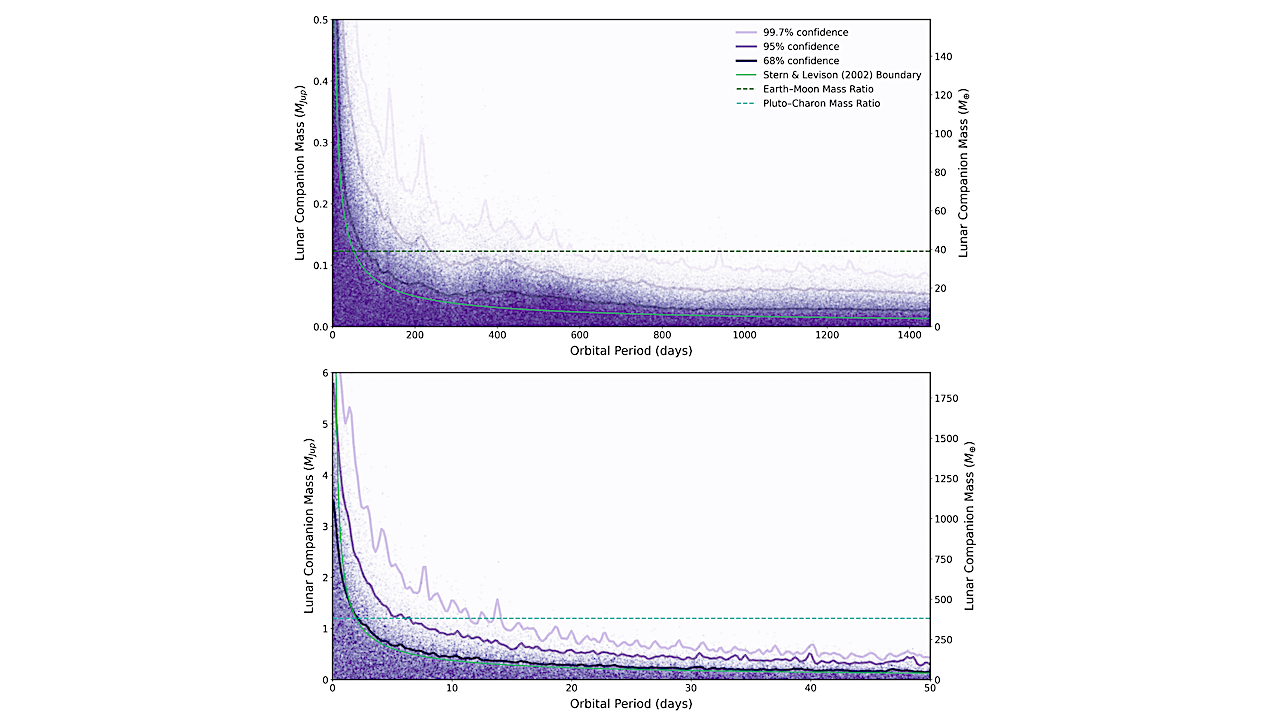
We calculate these limits by modeling the motion of the two orbiting planets and introducing an additional perturbation to the model that simulates the astrometric motion caused by an exomoon orbiting the planet β Pictoris b. We find that for short orbital periods (≈50 days), a lunar companion is only allowed if its mass remains below ≈180 M⊕ (0.6 MJup) at 3σ confidence.
At intermediate periods near 300 days, we exclude moons more massive than ≈65 M⊕ (0.2 MJup) at 3σ confidence. At longer orbital periods, we place the tightest constraints, ruling out any potential exomoon above ≈50 M⊕ (0.15 MJup) at 700 days and ≈30 M⊕ (0.1 MJup) at 1,100 days (both at 3σ confidence).
These results place the first astrometric constraints on moons and binary planets in the β Pictoris system and demonstrate the sensitivity of interferometric observations for exomoon studies.
Isabella Macias, Sydney Jenkins, Andrew Vanderburg
Comments: 16 pages, 4 figures, 4 tables. Submitted to AAS Journals. A machine-readable version of Table 4 is available in LaTeX source
Subjects: Earth and Planetary Astrophysics (astro-ph.EP)
Cite as: arXiv:2512.00160 [astro-ph.EP] (or arXiv:2512.00160v1 [astro-ph.EP] for this version)
https://doi.org/10.48550/arXiv.2512.00160
Focus to learn more
Submission history
From: Isabella Macias
[v1] Fri, 28 Nov 2025 19:01:01 UTC (3,309 KB)
https://arxiv.org/abs/2512.00160
Astrobiology,