The Uncertainty In Water Mass Fraction Of Wet Planets
Planets with masses between Earth and Neptune often have radii that imply the presence of volatiles, suggesting that water may be abundant in their interiors. However, directly observing the precise water mass fraction and water distribution remains unfeasible.
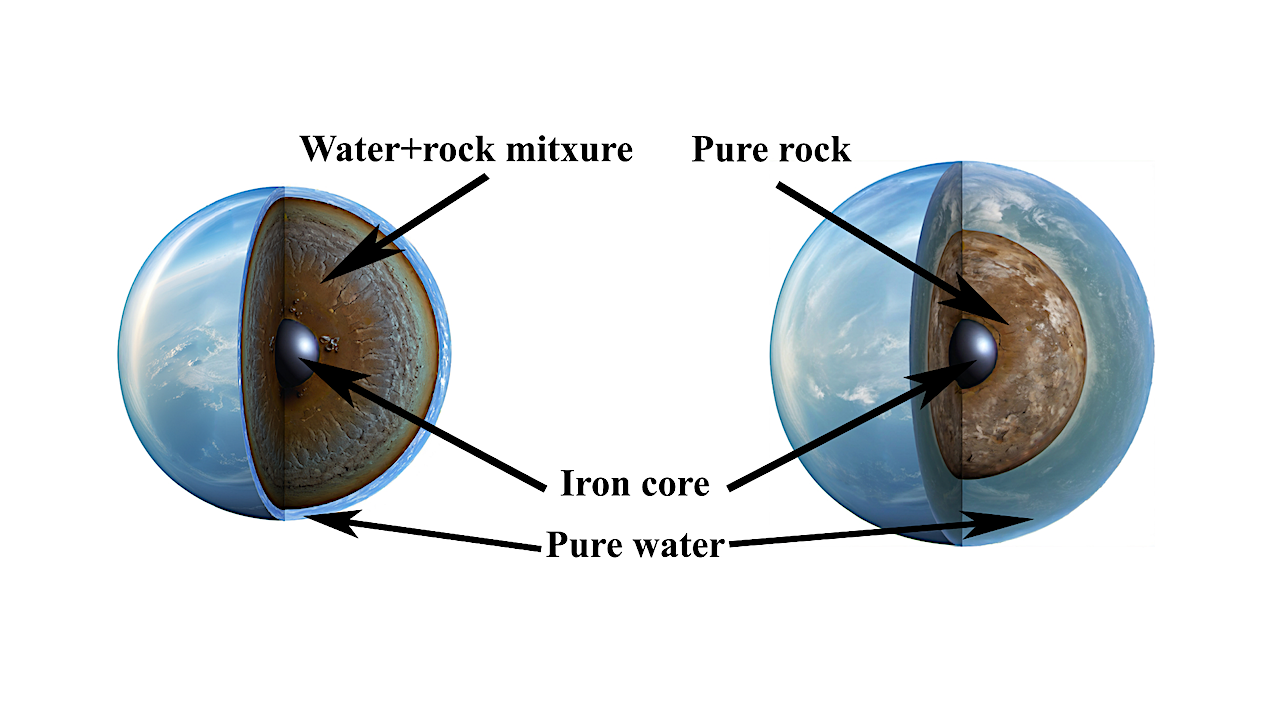
In our study, we employ an internal structure code MAGRATHEA to model planets with high water content and explore potential interior distributions. Departing from traditional assumptions of a layered structure, we determine water and rock distribution based on water-rock miscibility criteria. We model wet planets with an iron core and a homogeneous mixture of rock and water above it. At the outer regions of the planet, the pressure and temperature are below the rock-water miscibility point (the second critical point), causing the segregation of water and rock.
Consequently, a shell of water is formed in the outermost layers. By considering the water-rock miscibility and the vapor state of water, our approach highlights the uncertainty in estimating the water mass fraction of detected exoplanets.
Michael Lozovsky
Subjects: Earth and Planetary Astrophysics (astro-ph.EP)
Cite as: arXiv:2601.03932 [astro-ph.EP] (or arXiv:2601.03932v1 [astro-ph.EP] for this version)
https://doi.org/10.48550/arXiv.2601.03932
Focus to learn more
Related DOI:
https://doi.org/10.3847/1538-4357/ae2c56
Focus to learn more
Submission history
From: Michael Lozovsky
[v1] Wed, 7 Jan 2026 13:51:31 UTC (8,964 KB)
https://arxiv.org/abs/2601.03932
Astrobiology,