Seafloor Weathering and Stochastic Outgassing Unlikely to Significantly Shorten the Future Lifespan of Earth’s Terrestrial Biosphere

Current understanding suggests that as the Sun brightens in the far future, Earth’s carbonate-silicate cycle will offset increasing temperatures by drawing CO2 out of the atmosphere, ultimately leading to the extinction of all terrestrial plant life via either overheating or CO2 starvation.
Most previous estimates put the future lifespan of Earth’s terrestrial biosphere at ∼1 billion yr, but recent work used a new coupled climate-continental weathering model with up-to-date parameter constraints to revise this estimate upward to 1.6-1.86 billion yr. In this study, we extend the model to examine the impacts of seafloor weathering and stochastic variations in CO2 outgassing rates on the remaining lifespan of Earth’s terrestrial biosphere.
We find that if seafloor weathering has a stronger feedback than continental weathering and accounts for a large portion of global silicate weathering, then the remaining lifespan of the terrestrial biosphere can be shortened, but a lifespan of more than 1 billion yr (Gyr) remains likely.
Similarly, stochastic fluctuations in outgassing rates can have a significant impact if the size of the fluctuations exceed those observed over the last 1 billion yr. The impact of weak seafloor weathering and lower variability stochasticity are minor.
Our work provisionally supports a lengthened lifespan of Earth’s terrestrial biosphere, suggests robustness of this lengthened lifespan to planetary parameters that may vary among exoplanets, and identifies seafloor weathering as a key process that requires further study and constraint.
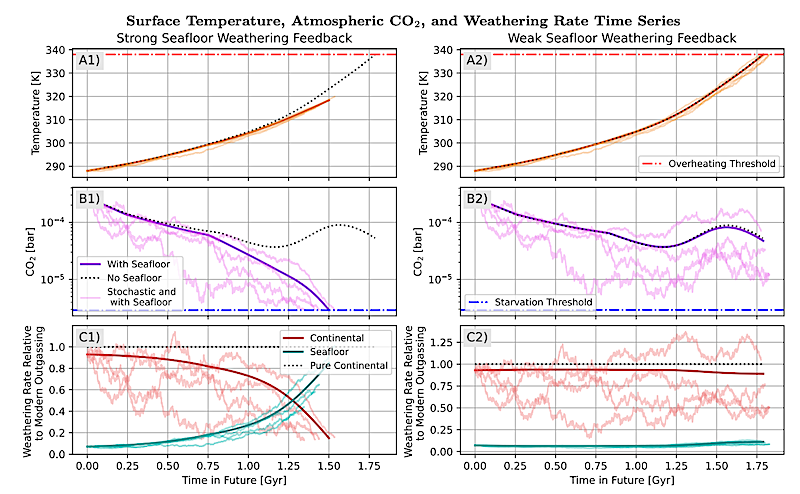
Strong seafloor weathering shortens the lifespan of the terrestrial biosphere by nearly 300 million years and shifts the biosphere kill mechanism from overheating to CO2 starvation, whereas weak seafloor weathering has little effect. Stochastic CO2 outgassing does not significantly impact results. Time series of surface temperature (A), atmospheric CO2 (B), and weathering rates (C) with a strong seafloor weathering feedback (Te,S = 9.07 K < Te,L, left column) and a weak seafloor weathering feedback (Te,S = 62 K > Te,L, right column). Results without seafloor weathering (dotted lines), without stochastic CO2 outgassing (dark colored lines), and for different realizations of stochastic CO2 outgassing (faint colored lines) are shown in each panel. Other parameter values are τ = 109 , σ = 10−4 , βS = 0.20, α = 0.075, βL = 0.41, and Te,L = 31 K. — astro-ph.EP
Livia Zhu, R.J. Graham, Dorian S. Abbot
Subjects: Earth and Planetary Astrophysics (astro-ph.EP)
Cite as: arXiv:2512.24538 [astro-ph.EP] (or arXiv:2512.24538v1 [astro-ph.EP] for this version)
https://doi.org/10.48550/arXiv.2512.24538
Focus to learn more
Journal reference: The Astrophysical Journal Letters, 996(1), L14 (2025)
Related DOI:
https://doi.org/10.3847/2041-8213/ae2b58
Focus to learn more
Submission history
From: Livia Zhu
[v1] Wed, 31 Dec 2025 00:51:54 UTC (1,038 KB)
https://arxiv.org/abs/2512.24538
Astrobiology, oceanography,