The Evolution in Coma Molecular Composition of Comet C/2017 K2 (PanSTARRS) Across the H2O Sublimation Zone: ALMA Imaging of an H2O-Dominated Coma
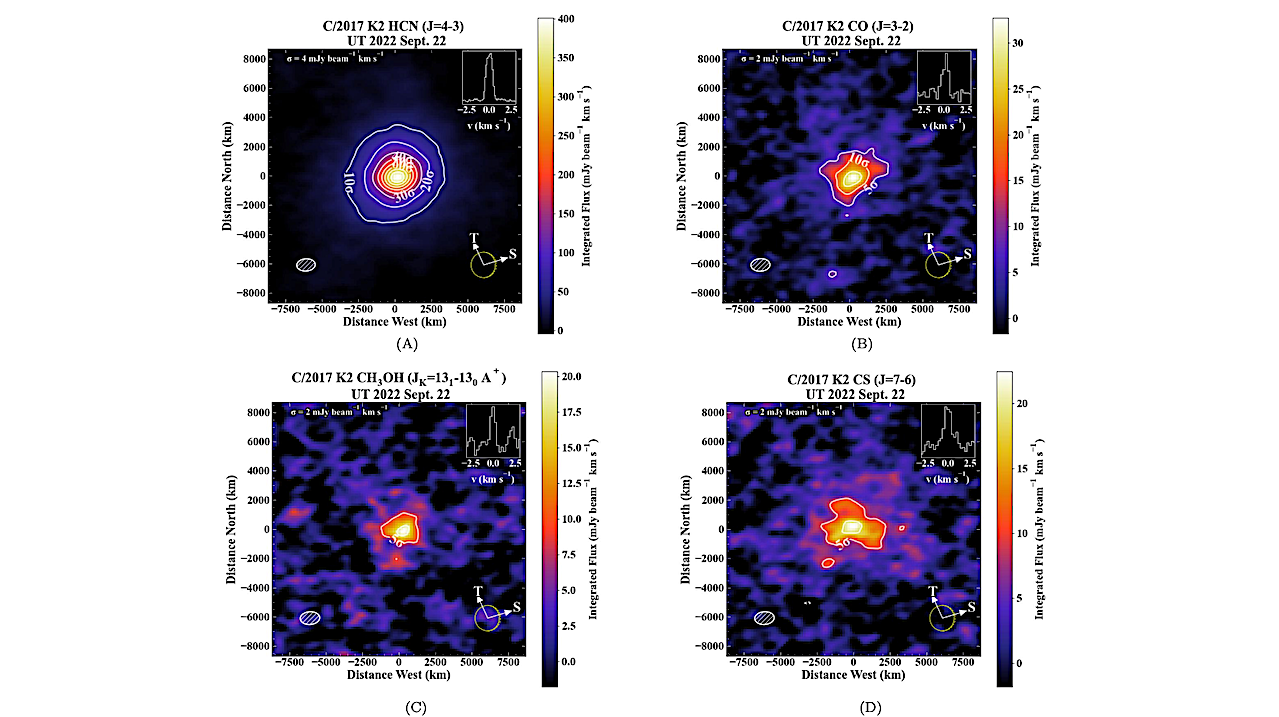
We report a survey of molecular emission from cometary volatiles using the Atacama Large Millimeter/Submillimeter Array (ALMA) toward comet C/2017 K2 (PanSTARRS) carried out on UT 2022 September 21, 22, and 23 at a heliocentric distance (rh) of 2.1 au.
These measurements of HCN, CS, CO, CH3OH, and H2CO (along with continuum emission from dust) sampled molecular chemistry in C/2017 K2 at the inner edge of the H2O sublimation zone, discerning parent from daughter or extended source species.
This work presents spectrally integrated flux maps, production rates, and parent scale lengths for each molecule. CH3OH, CO, and HCN were produced within ∼250 km of the nucleus, potentially including contributions from sublimation of icy grains.
CS was consistent with production from CS2 photolysis, and H2CO required production from extended sources in the coma. An ortho-to-para ratio OPR=2.9±0.4 for H2CO was derived from simultaneously measured transitions of each spin species. The continuum was extended and spatially resolved, consistent with thermal emission from dust in the coma.
Analysis of the continuum visibilities provided an upper limit on the nucleus diameter d<6.6 km and coma dust masses of 1.2−2.4×10¹¹ kg.
Nathan X. Roth, Stefanie N. Milam, Martin A. Cordiner, Anthony J. Remijan, Dominique Bockelee-Morvan, Nicolas Biver, Jeremie Boissier, Steven B. Charnley, Charles E. Woodward, Lillian X. Hart, Timothy N. Proudkii
Subjects: Earth and Planetary Astrophysics (astro-ph.EP)
Cite as: arXiv:2511.05662 [astro-ph.EP] (or arXiv:2511.05662v1 [astro-ph.EP] for this version
https://doi.org/10.48550/arXiv.2511.05662
Focus to learn more
Submission history
From: Nathan Roth
[v1] Fri, 7 Nov 2025 19:02:00 UTC (2,775 KB)
https://arxiv.org/abs/2511.05662
Astrobiology,