An Earthlike Density For The Temperate Earth-sized Planet GJ 12 b

While JWST has provided us with the opportunity to probe the atmospheres of potentially habitable planets, observations of the TRAPPIST-1 system have shown us that active stars severely complicate efforts at studying their planets.
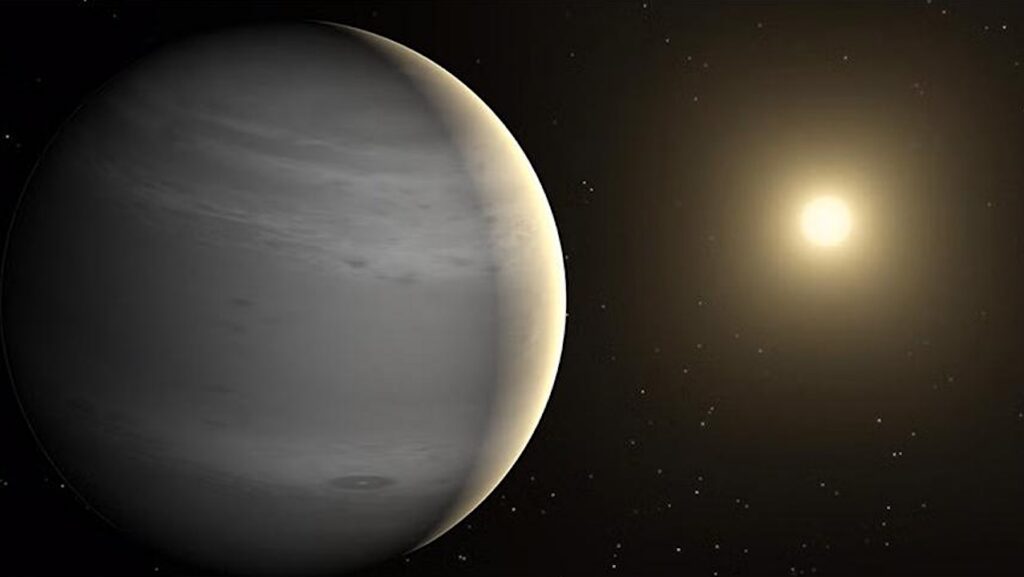
GJ 12 b is a newly discovered temperate (Teq ≈ 300 K), Earth-sized (Rp = 0.96 ± 0.05 R⊕) planet orbiting an inactive M dwarf that might be a good alternate to the TRAPPIST-1 planets for atmospheric characterization. In this paper, we use MAROON-X radial velocities to measure a mass of 0.70 ± 0.10 M⊕ for GJ 12 b.
We also recover a planetary eccentricity of 0.24, but there is no strong evidence that the planet has an eccentric orbit. GJ 12 b’s mass results in a planetary density comparable to or less dense than that of Earth, possibly indicating the presence of water or a low bulk iron mass fraction.
With its low mass, GJ 12 b is likely within reach of JWST transmission spectroscopy observations, making it an excellent target for determining the location of the cosmic shoreline. Its low mass may mean that the planet could have trouble retaining its primary atmosphere during the star’s active pre-main-sequence phase.
However, if it has a heightened eccentricity, it may be able to sustain a secondary atmosphere through tidally induced volcanism.
An Earthlike Density for the Temperate Earth-sized Planet GJ 12 b, The Astronomical Journal (open access)
Astrobiology,