Evolution of Stellar Activity and Habitable zone: I. Ultraviolet Emission of Dwarfs in Open Clusters and Field Stars
Near-ultraviolet (NUV) radiation from dwarf stars plays a critical role in shaping the habitability of planetary systems, yet its long-term evolution across different spectral types remains poorly investigated.
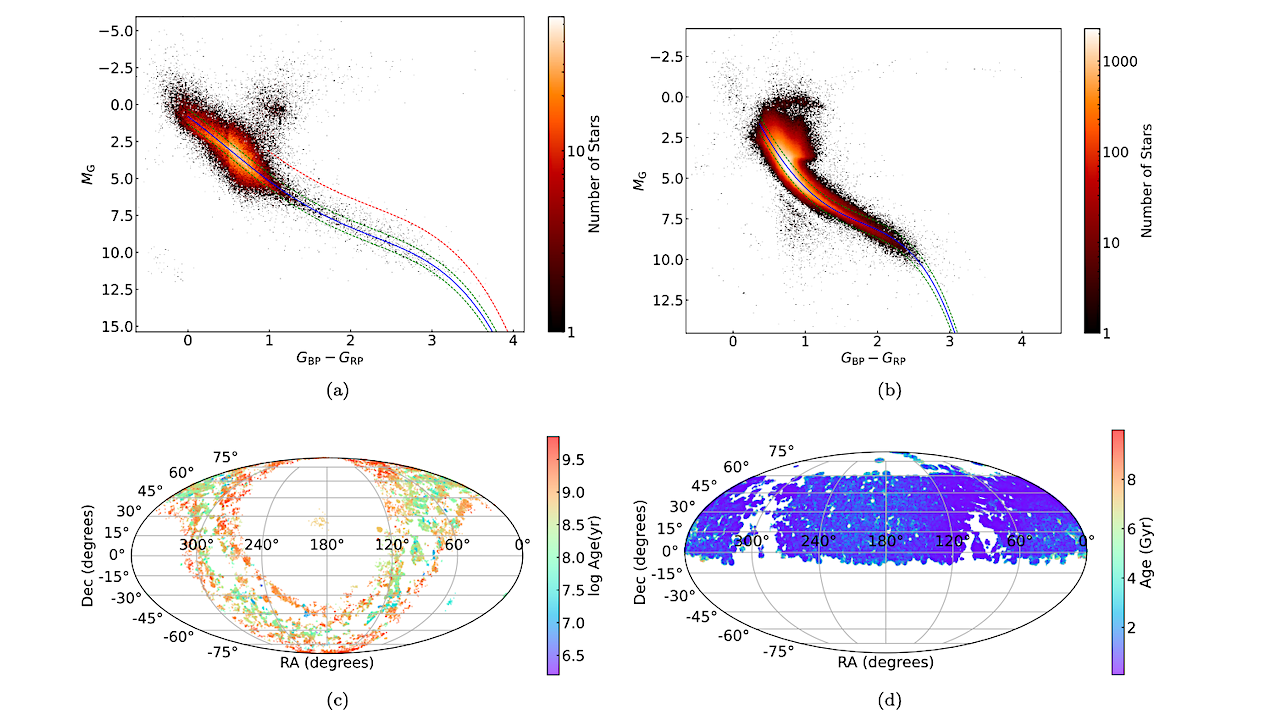
Based on GALEX NUV observations, we study the evolution of stellar NUV emission for a sample of 386,500 A- to M-type dwarfs spanning ages from 3 Myr to 10 Gyr, drawn from both open clusters and the field. The normalized NUV emission (fNUV/fJ) is used to trace the evolutionary trends.
Our results reveal distinct evolutionary pathways after considering the distance completeness: A and early-F dwarfs show a weak decline in NUV emission during the main-sequence phase; late-F to G dwarfs exhibit a clear decrease, consistent with continuous spin-down driven by magnetic braking; late-K and M-dwarfs undergo a rapid decline in NUV emission when they evolve from young stellar objects to main-sequence stars.
Furthermore, we construct the evolutionary tracks of stellar ultraviolet habitable zone (UHZ). By comparing stellar circumstellar habitable zone (CHZ) and UHZ, we find that G- and K-type stars offer the most stable overlap between thermal and UV habitability over long-term evolution.
Xue Li, Song Wang, Jun Ma, Henggeng Han, Yang Huang, Jifeng Liu
Comments: 23 pages, 16 figures, 3 tables. Accepted for publication in ApJS
Subjects: Solar and Stellar Astrophysics (astro-ph.SR); Astrophysics of Galaxies (astro-ph.GA)
Cite as: arXiv:2509.18559 [astro-ph.SR] (or arXiv:2509.18559v1 [astro-ph.SR] for this version)
https://doi.org/10.48550/arXiv.2509.18559
Focus to learn more
Submission history
From: Xue Li
[v1] Tue, 23 Sep 2025 02:33:46 UTC (21,291 KB)
https://arxiv.org/abs/2509.18559
Astrobiology,