Prospects Of Detecting Rotational Flatness Of Exoplanets From Space-based Photometry
In the era of photometry with space-based telescopes, such as CHEOPS (CHaracterizing ExOPlanets Satellite), JWST (James Webb Space Telescope), PLATO (PLAnetary Transits and Oscillations of stars), and ARIEL (Atmospheric Remote-sensing Infrared Exoplanet Large-survey), the road has opened for detecting subtle distortions in exoplanet transit light curves — resulting from their non-spherical shape.
We investigate the prospects of retrieval of rotational flatness (oblateness) of exoplanets at various noise levels. We present a novel method for calculating the transit light curves based on the Gauss-Legendre quadrature. We compare it in the non-rotating limit to the available analytical models.
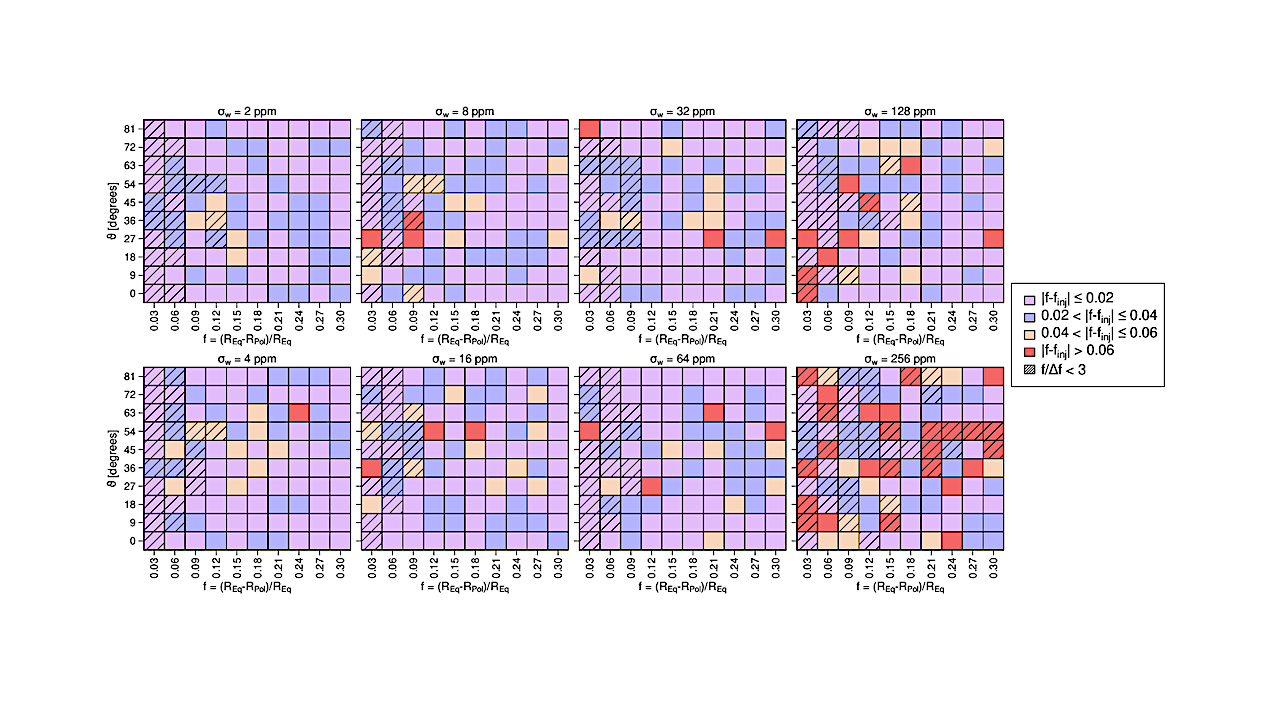
We conduct injection-and-retrieval tests to assess the precision and accuracy of the retrievable oblateness values. We find that the light curve calculation technique is about 25% faster than a well-known analytical counterpart, while still being precise enough.
We show that a 3σ oblateness detection is possible for a planet orbiting bright enough stars, by exploiting a precise estimate on the stellar density obtained e.g. from asteroseismology. We also show that for noise levels ≥256 ppm (expressed as point-to-point scatter with a 60~s exposure time) detection of planetary oblateness is not reliable.
Sz. Kálmán, Sz. Csizmadia, L. M. Bernabó, R. Szabó, Gy. M. Szabó
Comments: Provisionally accepted for publication in PASP on 18/07/2025. 23 pages, 17 figures
Subjects: Earth and Planetary Astrophysics (astro-ph.EP)
Cite as: arXiv:2507.15359 [astro-ph.EP] (or arXiv:2507.15359v1 [astro-ph.EP] for this version)
https://doi.org/10.48550/arXiv.2507.15359
Focus to learn more
Submission history
From: Szilárd Kálmán
[v1] Mon, 21 Jul 2025 08:10:49 UTC (2,197 KB)
https://arxiv.org/abs/2507.15359
Astrobiology, exoplanet,