Millimeter And Submillimeter Spectroscopy Of Methylallene, CH3CHCCH2
Small polycyclic aromatic hydrocarbons and somewhat larger cyano derivatives were detected in the cold dark cloud TMC-1 recently.
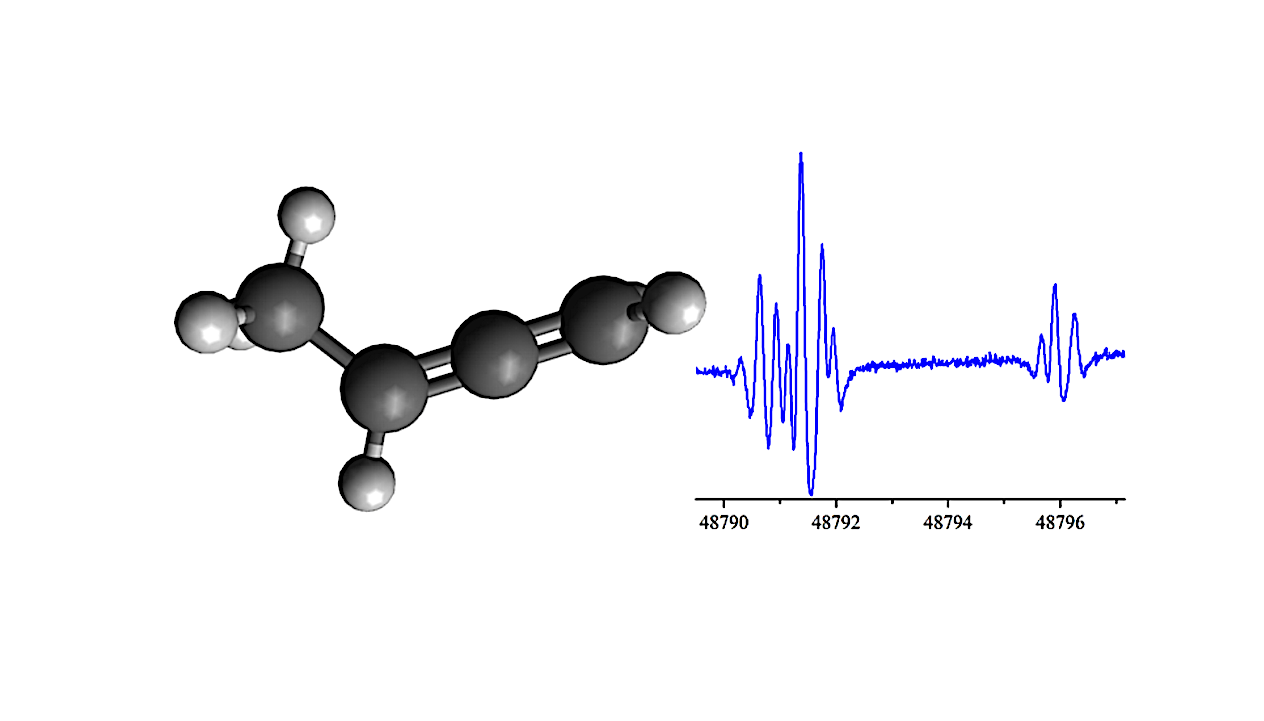
Their formation from smaller hydrocarbons is not well understood, in part because abundances of many species are not known. Methylallene, CH3CHCCH2, may be one of the building blocks, but its rotational spectrum was characterized only to a very limited extent.
We recorded rotational transitions in the 36−501 GHz region to extend the existing line list of methylallene and thus enable searches for the molecule in space. Quantum-chemical calculations were carried out to evaluate initial spectroscopic parameters. We obtained transition frequencies with J≤61 and Ka≤21 and resolved the internal rotation splitting of the CH3 group at least partially.
As a result, a full set of distortion parameters up to sixth order along with two octic ones were determined, as well as parameters describing the internal rotation of the methyl group. The spectroscopic parameters are accurate enough to identify methylallene up to 720 GHz, sufficient for searches even in the warm interstellar medium.
Holger S. P. Müller, Frank Lewen, Jean-Claude Guillemin, Stephan Schlemmer
Comments: accepted at Molecular Physics; 8 pages, 1Table, 4 Figures
Subjects: Astrophysics of Galaxies (astro-ph.GA); Instrumentation and Methods for Astrophysics (astro-ph.IM); Solar and Stellar Astrophysics (astro-ph.SR); Chemical Physics (physics.chem-ph)
Cite as: arXiv:2601.22872 [astro-ph.GA] (or arXiv:2601.22872v1 [astro-ph.GA] for this version)
https://doi.org/10.48550/arXiv.2601.22872
Focus to learn more
Related DOI:
https://doi.org/10.1080/00268976.2026.2625421
Focus to learn more
Submission history
From: Holger Müller
[v1] Fri, 30 Jan 2026 11:50:23 UTC (223 KB)
https://arxiv.org/abs/2601.22872
Astrobiology, Astrochemistry,