Lunar Spacecraft Exhaust Could Obscure Clues To Origins Of Life
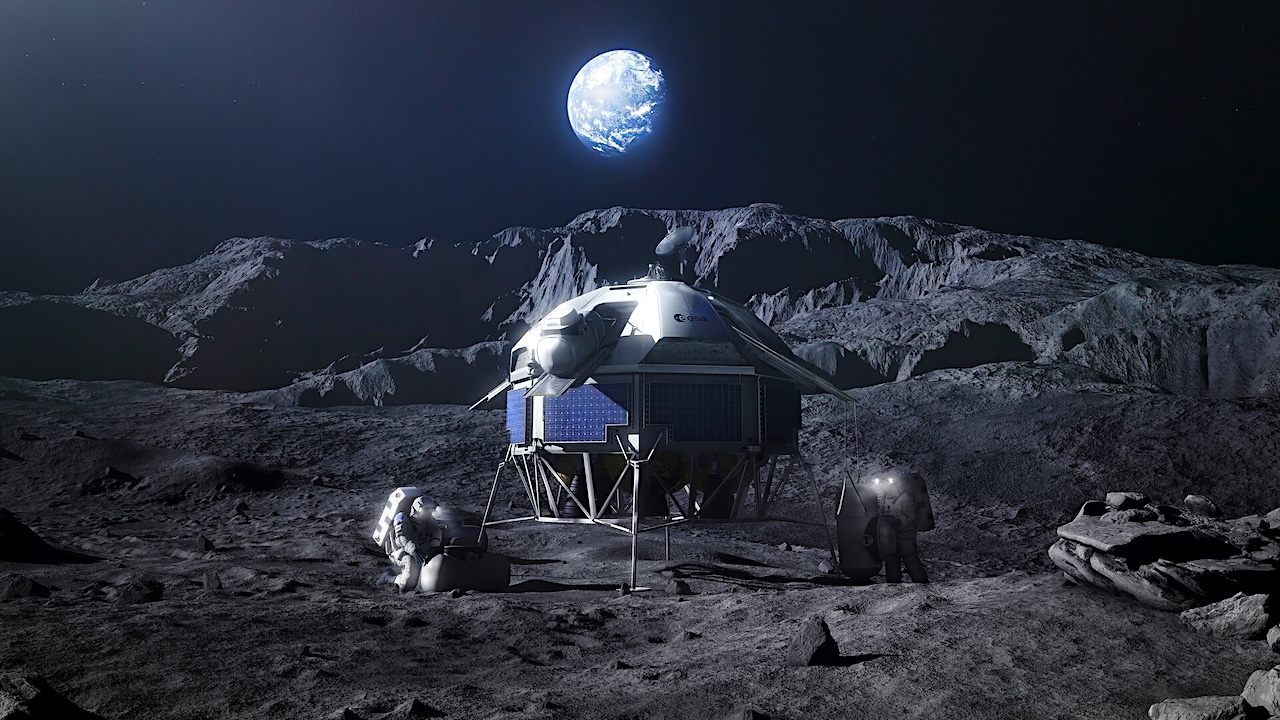
Over half of the exhaust methane from lunar spacecraft could end up contaminating areas of
the moon that might otherwise yield clues about the origins of earthly life, according to
a recent study. The pollution could unfold rapidly regardless of a spacecraft’s touchdown
site; even for a landing at the South Pole, methane molecules may “hop” across the lunar
surface to the North Pole in under two lunar days.
As interest in lunar exploration resurges among governments, private companies and NGOs,
the study authors wrote, it becomes crucial to understand how exploration may impact
research opportunities. This knowledge can help inform the creation of planetary
protection strategies for the lunar environment, as well as lunar missions designed to
minimize impact on that environment — and the clues about our past it may contain.
The study appears in Journal of Geophysical Research: Planets, AGU’s journal for original
research in planetary science.
“We are trying to protect science and our investment in space,” said Silvio Sinibaldi, the
planetary protection officer at the European Space Agency and senior author on the study.
The moon is a natural laboratory ripe for new discoveries, he said — but, paradoxically,
“our activity can actually hinder scientific exploration.”
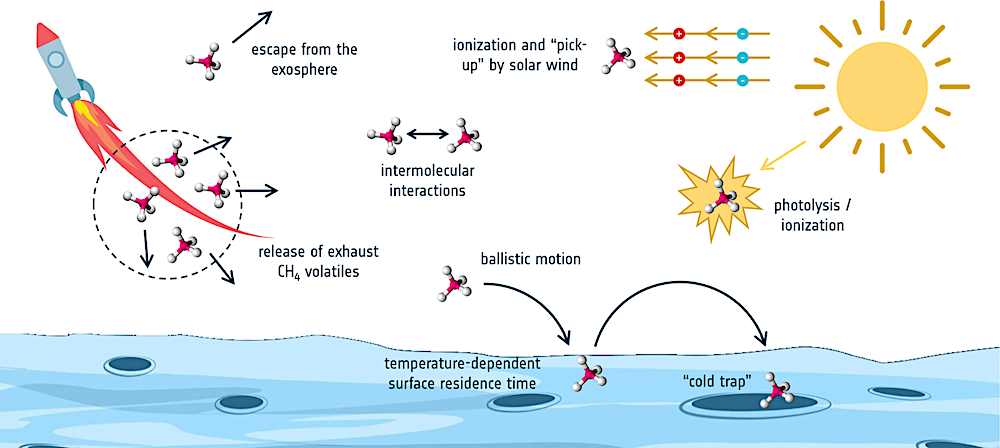
Schematic representation of the physical processes and pathways modeled for exhaust
CH4 molecules. Adapted from Prem et al. (2020). — Journal of Geophysical Research:
Planets
At the moon’s poles, craters cloaked in perpetual darkness (called permanently shadowed
regions) hold ice which might contain materials delivered to the moon and Earth via comets
and asteroids billions of years ago. Scientists hope those materials might include
“prebiotic organic molecules” — key ingredients that, under the right conditions, may have
combined to form the original building blocks of life, such as DNA. Finding those
molecules in their original form could allow researchers to study how they gave rise to
life on Earth.
“We know we have organic molecules in the solar system — in asteroids, for example,”
Sinibaldi said. “But how they came to perform specific functions like they do in
biological matter is a gap we need to fill.”
Earth’s dynamic, ever-changing surface likely erased any trace of what those original
molecules looked like long ago. The moon’s surface, parts of which have remained
relatively unaltered for billions of years, may preserve a better record — especially in
the permanently shadowed regions, where molecules tend to accumulate due to cold
temperatures that slow their movement. Unfortunately, that may also include molecules
released by lunar spacecraft, potentially obscuring pristine evidence of life-originating
materials.
A molecular mad dash
Sinibaldi and Francisca Paiva, a physicist at Instituto Superior Técnico and lead author
of the study, built a computer model to simulate how that contamination might play out,
using the European Space Agency’s Argonaut mission as a case study. The simulations
focused on how methane, the main organic compound released during combustion of Argonaut
propellants, might spread across the lunar surface during a landing at the moon’s South
Pole. While previous studies had investigated how water molecules might move on the moon,
none had done so for organic molecules like methane. The new model also accounted for how
factors like solar wind and UV radiation would impact the methane’s behavior.
“We were trying to model thousands of molecules and how they move, how they collide with
one another, and how they interact with the surface,” said Paiva, who was a master’s
student at KU Leuven and an intern at the European Space Agency during the research. “It
required a lot of computational power. We had to run each simulation for days or weeks.”
The model showed exhaust methane reaching the North Pole in under two lunar days. Within
seven lunar days (almost 7 months on Earth), more than half of the total exhaust methane
had been “cold trapped” at the frigid poles — 42% at the South Pole and 12% at the North.
“The timeframe was the biggest surprise,” Sinibaldi said. “In a week, you could have
distribution of molecules from the South to the North Pole.”
That’s partly because the moon has almost no atmosphere of other molecules to bump into.
Impeded only by gravity, methane molecules on the moon bound freely across the landscape
like bouncy balls across an empty room, energized by sunlight and slowed by cold.
“Their trajectories are basically ballistic,” Paiva said. “They just hop around from one
point to another.” That’s concerning, she explained, because it means there may be no
foolproof landing sites anywhere. “We showed that molecules can travel across the whole
moon. In the end, wherever you land, you will have contamination everywhere.”
That doesn’t mean there’s nothing to be done to minimize contamination. Colder landing
sites, Paiva noted, might still corral exhaust molecules better than warmer ones. There
might also be ways around the contamination: Sinibaldi wants to study whether exhaust
molecules might simply settle on the icy surfaces of PSRs, leaving material underneath
unscathed for research.
Above all, the duo said, the results need confirmation from both additional simulations
and real-life measurements on the moon. “I want to bring this discussion to mission teams,
because, at the end of the day, it’s not theoretical — it’s a reality that we’re going to
go there,” Sinibaldi said. “We will miss an opportunity if we don’t have instruments on
board to validate those models.”
Paiva hopes to study whether molecules other than methane, including those in spacecraft
hardware like paint and rubber, might also pose risks to research.
“We have laws regulating contamination of Earth environments like Antarctica and national
parks,” she said. “I think the moon is an environment as valuable as those.”
Notes for journalists: This study is published in Journal of Geophysical Research:
Planets, an AGU journal. View and download a pdf of the study here. Neither this press
release nor the study is under embargo.
Paper title: “Can Spacecraft-Borne Contamination Compromise Our Understanding of Lunar Ice Chemistry?”
Authors: Francisca S. Paiva, Instituto Superior Técnico, Lisbon, Portugal
Silvio Sinibaldi, European Space Agency, Noordwijk, The Netherlands; The Open University,
Milton Keynes, United Kingdom
AGU (www.agu.org) is a global community supporting more than half a million professionals
and advocates in Earth and space sciences. Through broad and inclusive partnerships, AGU
aims to advance discovery and solution science that accelerate knowledge and create
solutions that are ethical, unbiased and respectful of communities and their values. Our
programs include serving as a scholarly publisher, convening virtual and in-person events
and providing career support. We live our values in everything we do, such as our net zero
energy renovated building in Washington, D.C. and our Ethics and Equity Center, which
fosters a diverse and inclusive geoscience community to ensure responsible conduct.
Astrobiology