13CO And Potential Variability In β Pictoris b With GRAVITY+
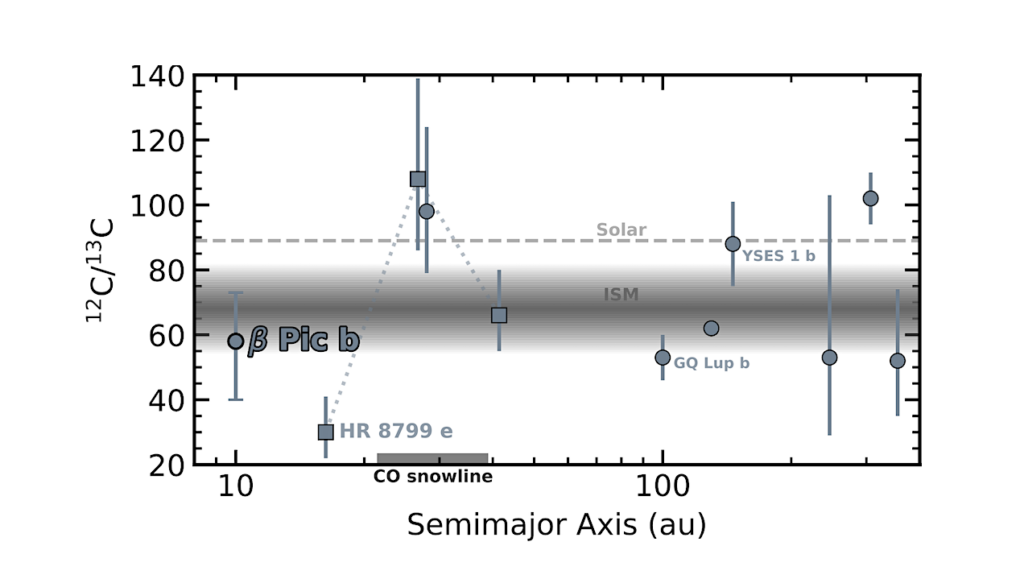
The 12CO/13CO ratio was introduced as an indicator for where in the disk a planet has formed. Previously a lower value compared to the host star’s was suggested to show that a planet accreted CO ice beyond the disk’s CO ice line.
In this letter we aim to determine the 12CO/13CO value of the directly imaged planet β Pictoris b, and whether we can link it to its formation. Its apparent brightness results in an exceptional S/N of up to ~60 per wavelength point. We present the first science observations with the upgraded GRAVITY+ instrument at a spectral resolution of R ~ 4000, which we analyse with petitRADTRANS.
Our retrievals robustly indicate the presence of 13CO with a 12CO/13CO ratio of 91+24−17, consistent with both a solar to ISM-like value. Our 12CO/13CO value corroborates recent interpretations that 13CO may be a less useful tracer of formation location in the disk than previously thought; nonetheless, we discuss theories with which this value is consistent.
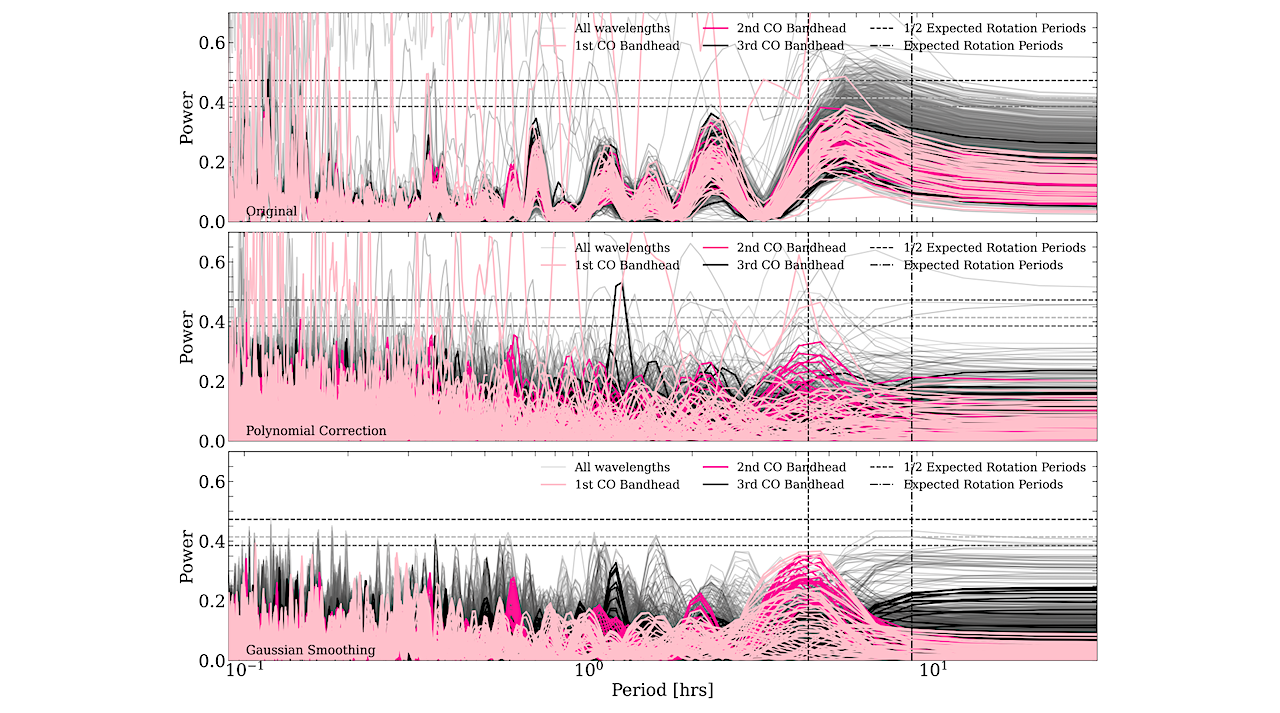
As our observations span ~7 hours, this enabled us to search for atmospheric variability in β Pictoris b; we report a tentative constraint on the variability amplitude of about 1.4+0.6−0.7%.
Antonia von Stauffenberg, Jonas Sauter, Paul Mollière, Matthieu Ravet, David Trevascus, Wolfgang Brandner, Anthony Berdeu, Mickaël Bonnefoy, Guillaume Bourdarot, Jean-Baptiste Le Bouquin, Gaël Chauvin, Frank Eisenhauer, Mathis Houllé, Laura Kreidberg, Elisabeth Matthews, Florentin Millour, Jules Scigliuto, Jason Wang, Jerry W. Xuan, Yapeng Zhang, the GRAVITY+ Collaboration
Comments: Accepted for publication in A&A (26th of May 2026), data products and models are available at this https URL
Subjects: Earth and Planetary Astrophysics (astro-ph.EP)
Cite as: arXiv:2606.11972 [astro-ph.EP] (or arXiv:2606.11972v1 [astro-ph.EP] for this version)
https://doi.org/10.48550/arXiv.2606.11972
Focus to learn more
Submission history
From: Antonia Von Stauffenberg
[v1] Wed, 10 Jun 2026 11:51:52 UTC (5,918 KB)
https://arxiv.org/abs/2606.11972
Astrobiology, Astrochemistry, exoplanet,