Asteroid Impact Site Reveals Possible Traces Of Early Life
A discovery by a South Korean research team suggests that impact-generated lakes may have fostered early oxygen-producing life.
A team of South Korean scientists has uncovered new evidence that could help explain how Earth’s atmosphere became rich in oxygen, one of the most transformative events in the planet’s history.
Researchers from the Korea Institute of Geoscience and Mineral Resources (KIGAM) report the finding stromatolites, layered structures formed by microbial communities, within the Hapcheon impact crater, the only confirmed impact crater on the Korean Peninsula. The study was published in Communications Earth & Environment (DOI: 10.1038/s43247-026-03206-7), a Nature Portfolio journal.
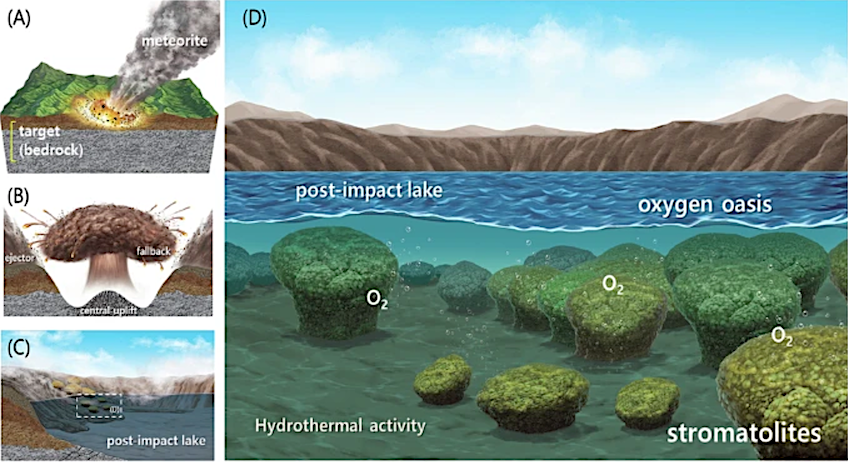
Graphical Abstract — Nature Communications & Environment
Impact Craters as Cradles of Early Life
The study suggests that the stromatolites formed in a hydrothermal lake environment created after asteroid collisions. Heat from molten rock generated during the impact events likely kept the water warm and rich in minerals for extended periods, creating conditions well suited for microbial growth.
Stromatolites are among the oldest known records of life on Earth, formed by microorganisms such as cyanobacteria that produce oxygen through photosynthesis. Fossil evidence shows that stromatolites date them back at least 3.5 billion years.
The research team identified multiple stromatolites in the northwestern part of the Hapcheon crater, each measuring approximately 10 to 20 centimeters in diameter. This marks the first such discovery at the site.
Revisiting the Great Oxidation Event
The findings offer new insight into the Great Oxidation Event (GOE), a period around 2.4 billion years ago when oxygen levels in Earth’s atmosphere rose dramatically.
The researchers propose that impact-generated hydrothermal lakes could have served as localized habitats where oxygen-producing microbes could thrive. These environments may have formed what the team describes as “oxygen oases.”
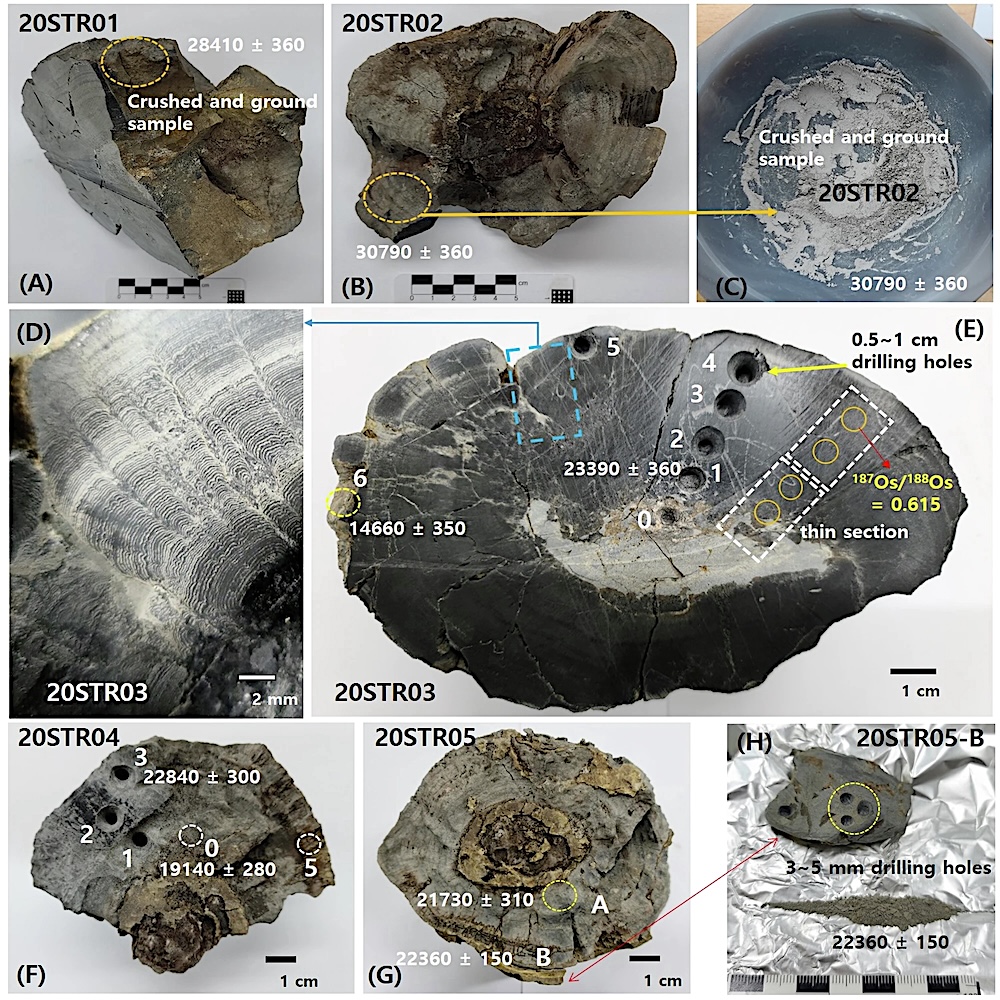
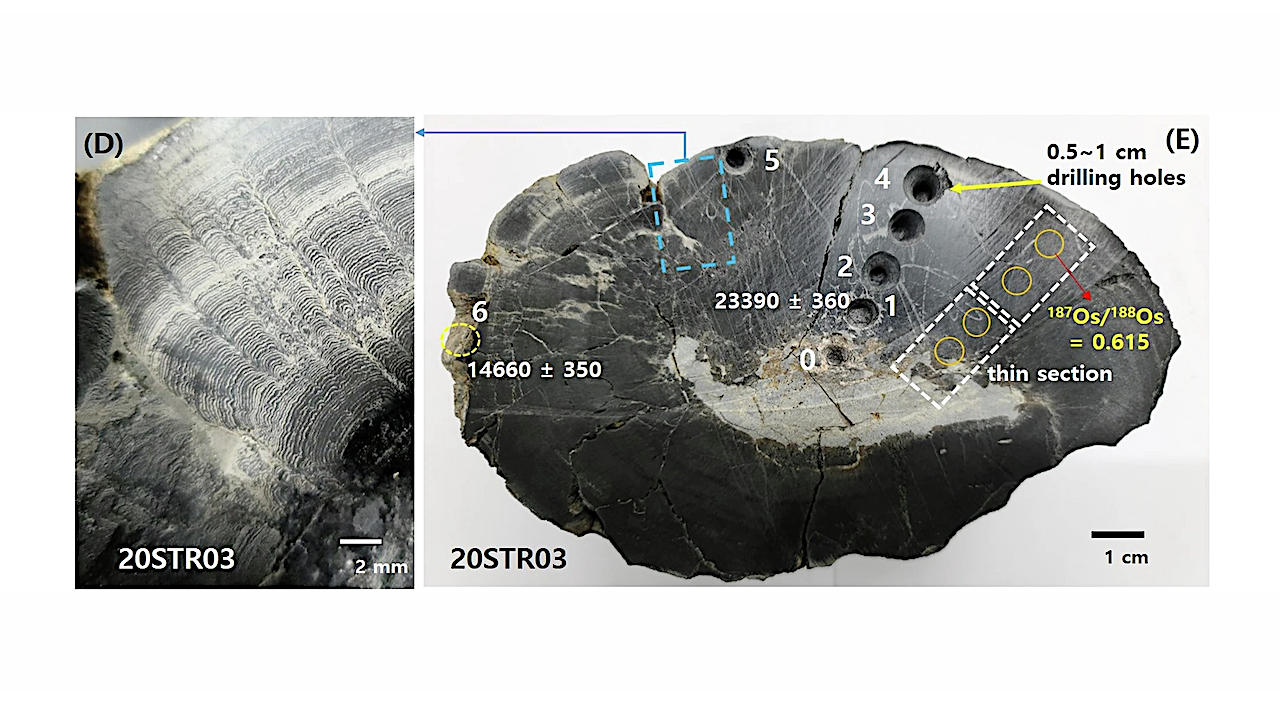
For 14C dating, subsamples of stromatolites were obtained by crushing-grinding (A–C) and drilling processes (E–H). D Example for digitate stromatolite. E Yellow circles (n = 4) in the thin sections indicate subsampling points for osmium isotope analysis (187Os/188Os).— Nature Communications & Environment
Geochemical Evidence Supports Hydrothermal Origin
Geochemical analyses of the stromatolites revealed several key features, including signatures of both extraterrestrial material and surrounding bedrock, as well as evidence of alteration by high-temperature water. The inner layers show stronger hydrothermal signals, suggesting they formed during an earlier, hotter phase.
Together, these findings support the interpretation that the stromatolites developed in a post-impact hydrothermal lake that gradually cooled over time
Implications Beyond Earth
The study also raises the possibility that similar environments may have existed on early Mars.
Because Mars is believed to have hosted water-filled impact craters in its early history, the researchers suggest that crater environments could be promising targets in the search for evidences of past life.
Research Context
The work builds on a 2021 study in Gondwana Research, in which KIGAM scientists first confirmed the Hapcheon impact crater. The new findings extend that research by identifying possible biological structures (e.g., stromatolites) within the crater environment.
Quote
“This is the first comprehensive evidence suggesting that stromatolites could form in hydrothermal lakes created by asteroid impacts,” said Dr. Jaesoo Lim, lead author of the study. “Such environments may have provided favorable conditions for early microbial ecosystems.”
About KIGAM
The Korea Institute of Geoscience and Mineral Resources (KIGAM) is a government-funded research institute specializing in geoscience, natural resources, and Earth system research.
Discovery of stromatolite formation in post-impact hydrothermal lacustrine environments and its implications for early Earth, Nature Communications & Environment (open access)
Astrobiology,