Tricorder Tech: DIYNAFLUOR: An Affordable DIY Plug-and-Play Nucleic Acid Fluorometer for eDNA Quantification in Resource Limited Settings
Editor’s note: with recent speculation about the potential habitability of other worlds and understanding the processes whereby other biospheres arise and evolve, thought needs to be given to developing sensor technology to do in situ analysis of samples collected by robotic systems and human crews. With size and power and energy constraints in mind, having the most compact way to quickly analyze a sample or monitor alien life forms will be of great utility to future astrobiology expeditions. Systems such as the one described below are good step in this direction. Such reverse translation/sequencing platforms also allow for proteins to be traced back to their original DNA sequencing.
Editor’s note: Nucleic acid fluorometry is a highly sensitive, specific method for quantifying DNA or RNA, using fluorescent dyes (e.g., PicoGreen, SYBR Green) that bind selectively to target molecules, emitting light proportional to the concentration. It is up to 1,000 times more sensitive than ultraviolet (UV-Vis) spectrophotometry and is ideal for low-concentration or precious samples
Nucleic Acid (NA) fluorometry is widely employed for quantifying environmental DNA (eDNA) samples and their downstream DNA sequencing libraries, owing to its sensitivity, accuracy, and speed.
However, the high cost of NA fluorometers presents a barrier to eDNA sequencing in resource limited settings (RLSs). For instance, at ∼$1.5-3.3k USD, current NA fluorometers present a greater capital cost than ONT’s $1k USD portable MinION third-generation Nanopore sequencing platform.
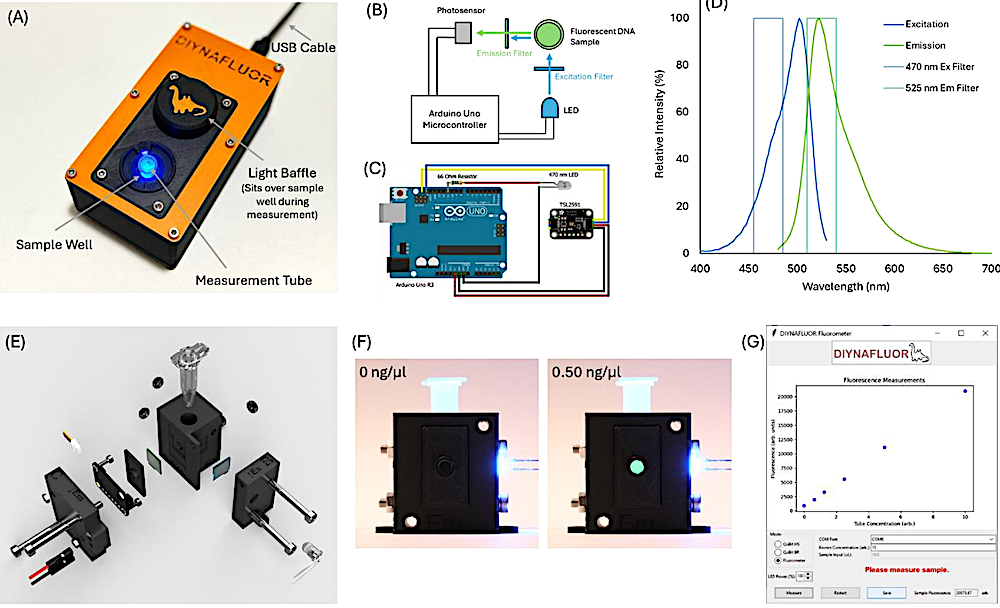
(A) The DIYNAFLUOR device. (B) A simplified systems architecture diagram. (C) Wiring diagram. (D) Emission and Excitation filters used in the DIYNAFLUOR overlayed on the fluorescent spectrum of Pico -green DNA dye. (E) An exploded 3D render of the “Filter Cube” that houses the core fluorescent detection components within the DIYNAFLUOR. (F) Images of the fluorescent signal produced within the filter cube for 0 and 0.50 ng/μL DNA samples using the Qubit HS reagents. (G) The DIYNAFLUOR control software.
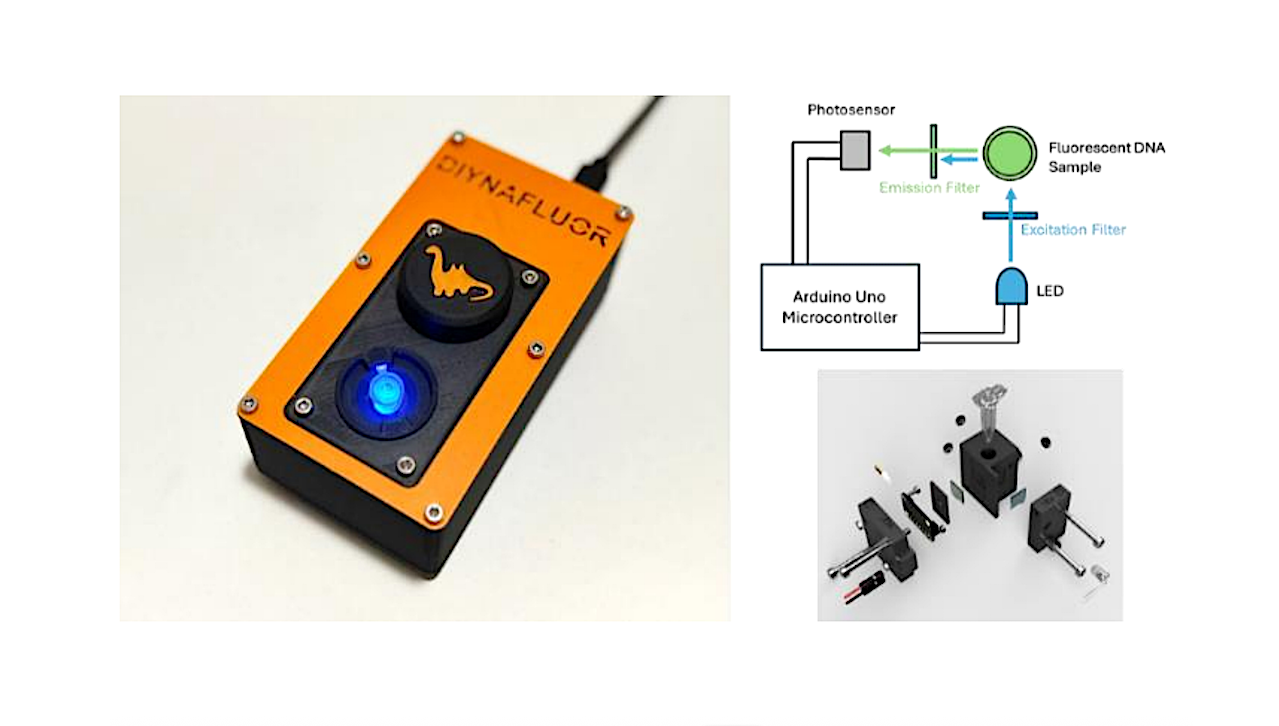
The collapse of international scientific device and consumable supply chains during the COVID-19 pandemic also highlighted the need for distributed manufacturing of molecular research tools to mitigate the impact of increased pricing to RLSs. To address these challenges, we have developed the “DIYNAFLUOR” (DIY Nucleic Acid FLUORometer), a portable, open-source, < $40 USD NA fluorometer, designed using readily available off-the-shelf components, simple 3D-printed parts, and plug-and-play, solder-free assembly.
The DIYNAFLUOR was primarily designed to be compatible with the popular DNA-centric Qubit High Sensitivity (HS) and Broad Range (BR) assay kits. Notably, the DIYNAFLUOR demonstrated an ‘in-assay’ Limit of Detection with the Qubit HS kit of 0.0028 ng/μL, and an average absolute bias of 0.018 ng/μL across a 0–10 ng/μL working range using a 2-point linear calibration methodology.
Device verification was performed by comparative measurements with a Qubit 4 fluorometer in a busy biotechnology laboratory, and build instructions were validated through assembly and qualification of three DIYNAFLUOR devices by researchers outside the primary design team. We also describe a custom “extreme”low-cost assay, <13¢ USD per-measurement, that uses SYBR Safe dye to quantify DNA across a working range of 0-0.5 ng/μL. This assay reports a lower sensitivity and accuracy than commercial kits but may be of use to RLSs in times of extreme resource constraints or as a teaching tool for STEM educators.
To demonstrate its practical application for field-based eDNA analysis in RLSs, the DIYNAFLUOR was used to perform all quality control measurements throughout the preparation of a 16S and 18S metabarcoding library generated from eDNA extracted from Australian lake water, leading to the successful identification of Australian fauna via Nanopore sequencing. Finally, configurations of the DIYNAFLUOR for RNA and Protein quantification are briefly described.
The DIYNAFLUOR (DIY Nucleic Acid FLUORometer) is a $40 USD, open source, 3D printed, solder-free, portable, robust, DNA Fluorometer YOU can build! —traulab/DIYNAFLUOR, GitHub
Astrobiology, Tricorder,