NASA Spaceline Current Awareness List #1,192 20 March 2026 (Space Life Science Research Results)
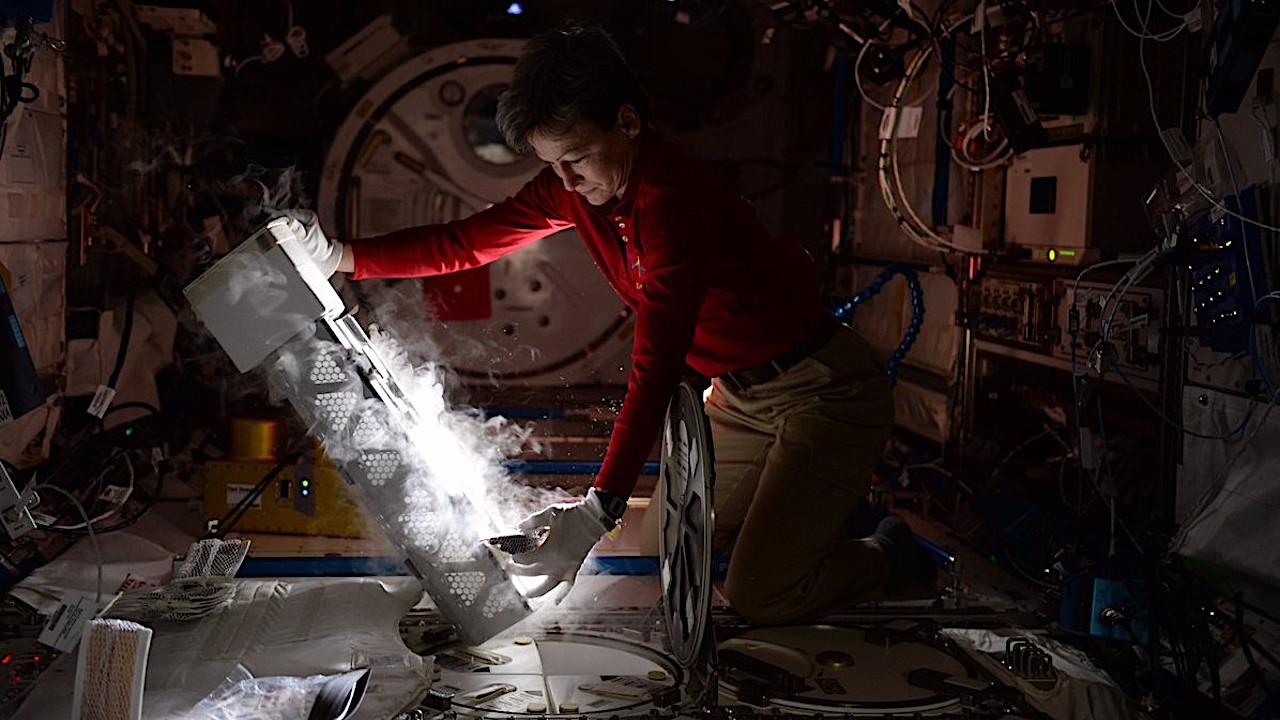
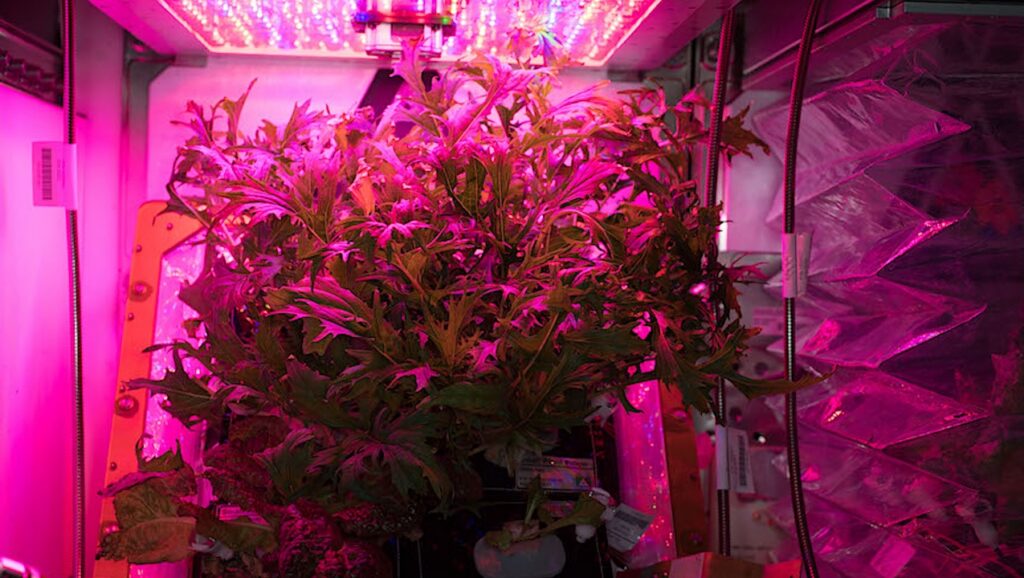
Astronaut Peggy Whitson At Work on the ISS — NASA
The abstract in PubMed or at the publisher’s site is linked when available and will open in a new window.
Papers deriving from NASA support:
- Tsuji R, Fujita R, Hayashi T, Sadaki S, Matsumoto T, Inoue Y, Murakami Y, Hamada M, Muratani M, Kobayashi H, Yumoto A, Okada M, Kamimura D, Okada R, Suzuki T, Kurosawa R, Otsuki A, Koshiba S, Vitaterna MH, Fuller CA, Mortreux M, Sung DM, Ciola J, Rutkove SB, Coulombe J, Kudo T, Yamamoto M, Bouxsein ML, Shiba D, Takahashi S.0.33g mitigates muscle atrophy while 0.67g preserves muscle function and myofiber type composition in mice during spaceflight.Sci Adv. 2026 Mar 13;12(11):eaed2258.PIs: M.H. Vitaterna, C.A. Fuller, M.L. BouxseinNote: ISS results. This article may be obtained online without charge.
Journal Impact Factor: 12.5
Funding: “…This research was also supported in part by AMED-CREST (JP23GM171008h to R.F. and S.T.) and by JST (JPMJPF2017). Additional support was provided by NASA (80NSSC19K0534, 80NSSC20K1501, and 80NSSC20K1519) and the National Institutes of Health (NIH; T32GM144273).” - Khanna R, Li Y, Cook M, Sawant P, Hounon R, Carroll D, Lowe L, Lindenroth L, Mahmoodi T, Raison N, Granados A, Ojha A, Bergeles C, Breda A, Ourselin S, Dasgupta P.Surgery for interplanetary space missions.Br J Surg. 2026 Mar 4;113(3):znag005. Review.Note: This article may be obtained online without charge.
Journal Impact Factor: 8.8
Funding: L. Lowe is affiliated with NASA Johnson Space Center. - Dothard MI, Caboni M, Norment D, Sigmund N, Allard SM, Gilbert JA, Gavrish E, Al-Ghalith G, Der-Avakian A, Strandwitz P.A human-derived Bacteroides strain attenuates depressive-like behavior in a rat model of social defeat-induced stress.BMC Medicine. 2026 Mar 10. Early access article.PI: P. StrandwitzNote: This article may be obtained online without charge.
Journal Impact Factor: 8.3
Funding: “PS, MC, and DN were supported by Holobiome’s Translational Research Institute for Space Health – Space Health Ingress Program through NASA NNX16AO69A. PS, MC, EG, JG and MD were supported by the National Institute of Health Small Business Innovation Research Grant R44DK120181. MD was supported by the National Science Foundation Graduate Research Fellowship Program under grant number DGE-2038238.” - Jordan ID, Ticak T, Lee JA, Marx CJ.Persistence preserves phenotypic heterogeneity in non-genetic formaldehyde resistance in Escherichia coli.BMC Res Notes. 2026 Mar 16. Online ahead of print.Note: This article may be obtained online without charge.
Journal Impact Factor: 1.7
Funding: J.A. Lee is affiliated with NASA Ames Research Center. - Sirunyan T, Lazaryan G, Hoakobyan S, Davitavyan S, Zakharyan R, Stepanyan A, Brojakowska A, Khlgatian MK, Bisserier M, Zhang S, Goukassian DA, Arakelyan A.Persistence of Western diet-associated pathway activity profiles in ventricular tissues: Western diet-associated pathway activity profiles in ventricular tissues.Reports of NAS RA. 2026 Jan 30;126(1):2.PI: D.A. GoukassianNote: This article may be obtained online without charge.
Journal Impact Factor: Not available for this journal
Funding: “This study was funded by the ADVANCE Research Grant provided by the Foundation for Armenian Science and Technology (D.A.G.), 25FAST-1F004 by the Higher Education and Science Committee of MESCS RA (D.A.G. and A.A.), and by the grant No: 80NSSC19K1079 from NASA Human Research Program to D.A.G.” - Trier HA, Douglas SB, Serrador JM, Wood SJ.Customizing galvanic vestibular stimulation amplitude: An objective technique using sway indices to account for individual sensitivity.Exp Brain Res. 2026 Mar 10;244(4):67.Note: This article may be obtained online without charge.
Journal Impact Factor: 1.6
Funding: S.J. Wood is affiliated with NASA Johnson Space Center. - Yang Z, Li X, Van Dongen HPA, Lin Y, Song Y, Du D.Europium nanoparticle label/lateral flow test strip integrated with a 3D-printed fluorescence smartphone reader for detection of melatonin in human blood.Nanoscale Horiz. 2026 Mar 11.Journal Impact Factor: : 6.6
Funding: “This work was supported by the National Aeronautics and Space Administration (NASA), grant no. 80NSSC25M7148. …” - Benmore CJ, Wilke SK, Lipke D, Weber R.High temperature diffraction from aerodynamically levitated materials.Advances in Physics: X. 2026 Mar 14;11(1):2642120.PI: R. WeberNote: This article may be obtained online without charge.
Journal Impact Factor: 10.8
Funding: “This material is based upon work supported by the U.S. Department of Energy, Office of Science, Funding for Accelerated, Inclusive Research (FAIR), under Award Number DE-SC0024692. This work was supported as part of the Centre for Steel Electrification by Electrosynthesis (C-STEEL), an Energy Earth shot Research Centre funded by the U.S. Department of Energy, Office of Science, Basic Energy Sciences (BES) and Advanced Scientific Computing Research (ASCR). Supporting grants from DOE DE-SC00018601 and NASA 80NSSC18K0059 and 80NSSC19K1288are also acknowledged. …”
Other papers of interest:
- Brawley HN, Reichard JF, Shennara K, Lovett D, Babcock L, MacDonald A, Easter B, Soares M, Mateus J, Rosenberg M, Nowadly C.Comparative analysis of pharmaceutical content following spaceflight and vacuum exposure during commercial extravehicular activity.Wilderness Environ Med. 2026 Mar 18;10806032261426910. Online ahead of print.Note: From the abstract: “Nineteen medications (13 repackaged solid, 6 liquid) flew as part of the SpaceX medical kit and were analyzed with lot-matched terrestrial controls. All samples underwent ultra-performance liquid chromatography mass spectrometry analysis upon return. The primary outcome was the percent difference in active pharmaceutical ingredient (API) between vacuum exposure and ground controls. A secondary outcome was the absolute API content expressed as a percentage of labeled dosage.” This article may be obtained online without charge.
- Alves S, Peyroteo M, Lapão LV.Immediate management of medical emergencies in space: A scoping review.Acta Astronaut. 2026 Mar 16. Online ahead of print.Note: This article may be obtained online without charge.
- Malakar V, Kuppusamy G, Vassilieva GY, Karri VVSR, Dhanabal SP, Mikhailovna MO, Poddar NK.Biological experiments in space: From microgravity to molecular insights.Microgravity Sci Technol. 2026 Feb 18;38(2):14. Review.
- Vicente Martínez L, Komorowski M, Calvet G, Chabani E, Trousselard M, Diamond M, Bolmont B, Clot C, Varlet T, Rufin F, Boyer L, Berthier A, Paillet A.Perspectives for future space biomedical research to ensure crew health and performance for future human space exploration missions beyond low-Earth orbit, a multidisciplinary approach.J Space Saf Eng. 2026 Mar 5. Online ahead of print.
- Callaway KR.Microbes afloat: Spaceflight supercharges viruses’ ability to infect bacteria.Sci Am. 2026 Mar 15;334(4):10.
- Ma Z, Lin H, Young D, Ansari A, Kunze M, Mulet-Sierra A, Febbraio M, Graf D, Dufour A, Adesida AB.Simulated microgravity models sex differences in knee osteoarthritis through a CD36-regulated mechano-metabolic circuit.Cell Commun Signal. 2026 Mar 14. Early access article.Note: A rotating-wall vessel was used in this study to simulate microgravity. This article may be obtained online without charge.
- Morita MT, Nishimura T, Shikata H.Gravity sensing for gravitropism.Annu Rev Plant Biol. 2026 Mar 5. Review. Online ahead of print.
- Repyuk N, Konev A, Faerman V, Rulev D, Yashchenko G.Analysis of fundamental frequency changes in astronaut speech in microgravity and in terrestrial conditions.Acoustics. 2026 Mar 12;8(1):18.Note: This article is part of Special Issue “Advancing Audio/Speech Machine Learning: From Static to Continual Learning” (https://www.mdpi.com/journal/acoustics/special_issues/Q42H1A0Y84) and may be obtained online without charge.
- Teja N, Karri VVSNR, karri, Kuppusamy G, Chatterjee S, Subramaniyan V.Stability and drug delivery challenges of pharmaceutical formulations in microgravity environments.Discov Appl Sci. 2026 Feb 4. Early access article.Note: From the abstract: “The stability and efficacy of pharmaceuticals during long-duration space missions on the International Space Station are critically challenged by unique conditions, such as microgravity, cosmic radiation, and temperature fluctuations. Initially, these environmental factors compromise drug formulation and stability, whereas spaceflight-induced physiological changes alter pharmacokinetics, including absorption, metabolism, and excretion. To address the challenges of long-term space conditions, innovative approaches such as nanotechnology-based drug encapsulation and 3D printing of personalized medicines have been developed, enabling enhanced stability and on-demand production in space.” This article may be obtained online without charge.
astrobiology, space biology, space medicine, microgravity, astrochemistry,