Quantifying Surface Heterogeneity Across Asteroid (101955) Bennu using Candidate Site Remote Sensing Data

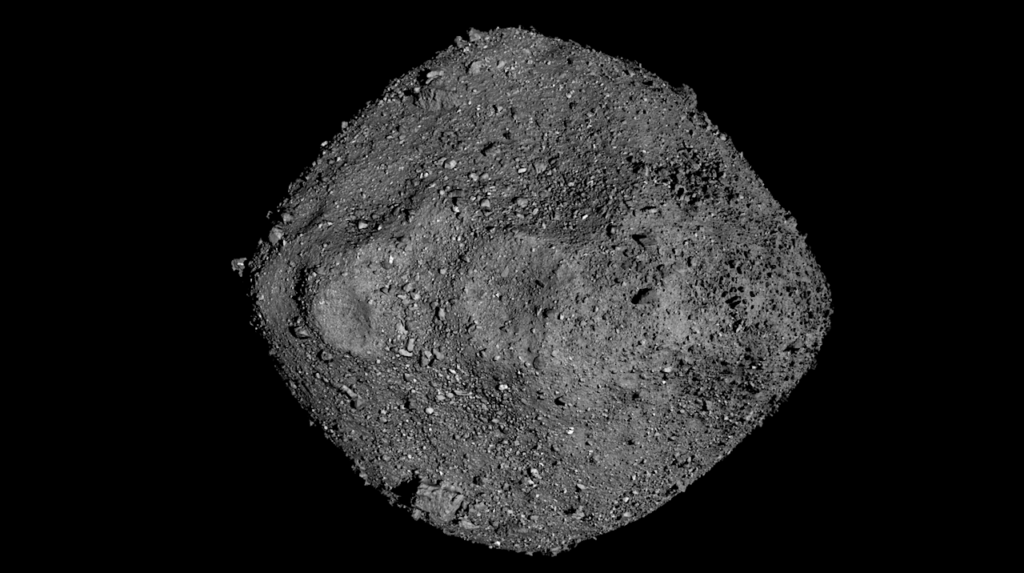
The OSIRIS-REx mission acquired spatially resolved (2-10 m spot sizes) visible-near infrared (VNIR) and thermal infrared (TIR) spectra across four candidate sampling sites on asteroid (101955) Bennu: Nightingale, Osprey, Sandpiper, and Kingfisher.
To quantify heterogeneity across a small body (about 500 m radius) like Bennu, we explore remotely observed spectral data to draw conclusions about the mineralogical composition and key physical processes that drive surface variability. We derive diagnostic band parameters from the OSIRIS-REx Visible and Infrared Spectrometer and the OSIRIS-REx Thermal Emission Spectrometer datasets to quantify compositional and physical variability across sites and assess their mineralogical context.
The VNIR spectra exhibit similar overall reflectance shapes but systematic differences in spectral slopes and the 2.74 micron OH absorption. TIR emissivity spectra reveal modest but statistically significant shifts in the Christiansen Feature, silicate stretching, and bending band positions, indicating differences in silicate composition, hydration state, and Mg/Fe relative abundance. Principal component analysis separates each site into distinct clusters in multivariate band-parameter space, whereas K-means clustering identifies intra-site spectral sub-populations.
Welch’s Analysis of Variance and Hotelling’s tests confirm that band-parameter variations between sites are significant. These results reveal that Bennu’s surface preserves measurable spectral heterogeneity at 2-10 m scales, with site-to-site variations in hydration indicators and silicate band positions.
The spectral properties of Nightingale encompass the full range observed across all four sites, establishing a remote sensing baseline for contextualizing laboratory analyses of the returned sample within Bennu’s broader composition diversity and alteration history.
Emma-Catherine Belhadfa, Neil E. Bowles, Katherine A. Shirley, Amy A. Simon, Victoria E. Hamilton, Hannah H. Kaplan
Comments: Currently under review at JGR: Planets
Subjects: Earth and Planetary Astrophysics (astro-ph.EP); Instrumentation and Methods for Astrophysics (astro-ph.IM); Applications (stat.AP)
Cite as: arXiv:2606.12642 [astro-ph.EP] (or arXiv:2606.12642v1 [astro-ph.EP] for this version)
https://doi.org/10.48550/arXiv.2606.12642
Focus to learn more
Submission history
From: Emma-Catherine Belhadfa
[v1] Wed, 10 Jun 2026 20:08:45 UTC (23,221 KB)
https://arxiv.org/abs/2606.12642
Astrobiology,