Planetary Exploration 3.0: A Roadmap for Software-Defined, Radically Adaptive Space Systems
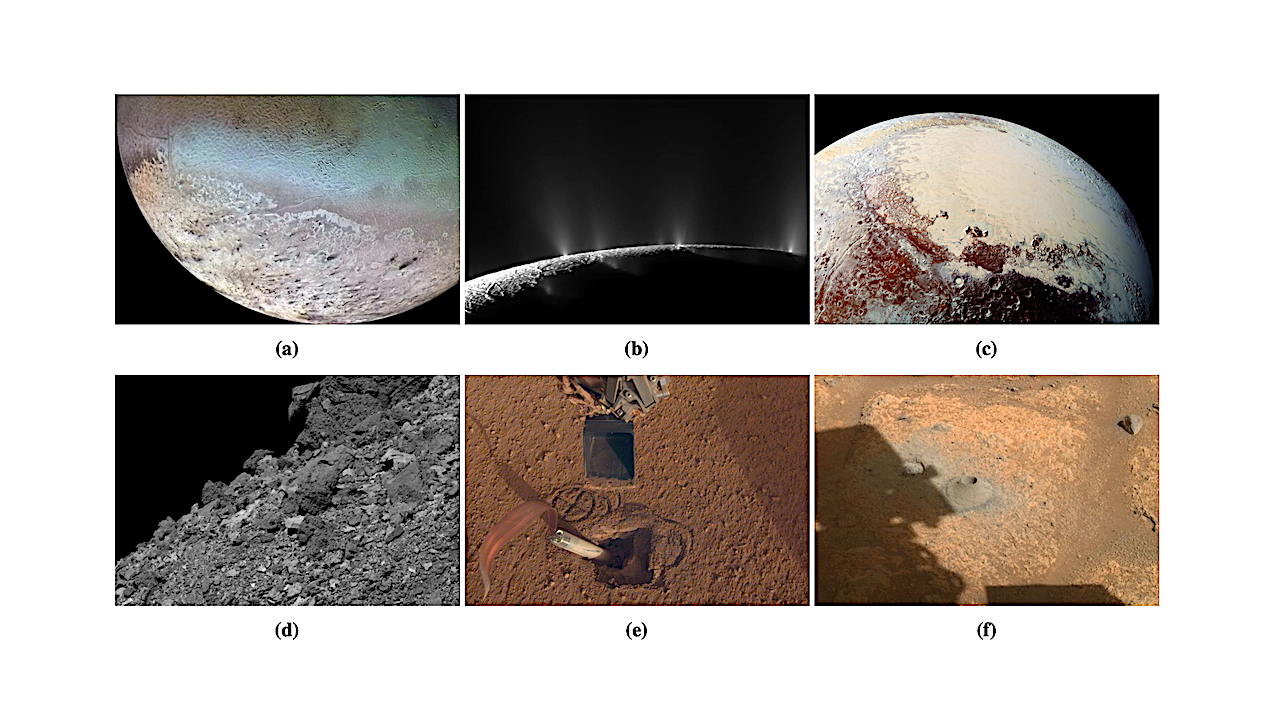
The surface and subsurface of worlds beyond Mars remain largely unexplored. Yet these worlds hold keys to fundamental questions in planetary science – from potentially habitable subsurface oceans on icy moons to ancient records preserved in Kuiper Belt objects.
NASA’s success in Mars exploration was achieved through incrementalism: 22 progressively sophisticated missions over decades. This paradigm, which we call Planetary Exploration 2.0 (PE 2.0), is untenable for the outer Solar System, where cruise times of a decade or more make iterative missions infeasible.
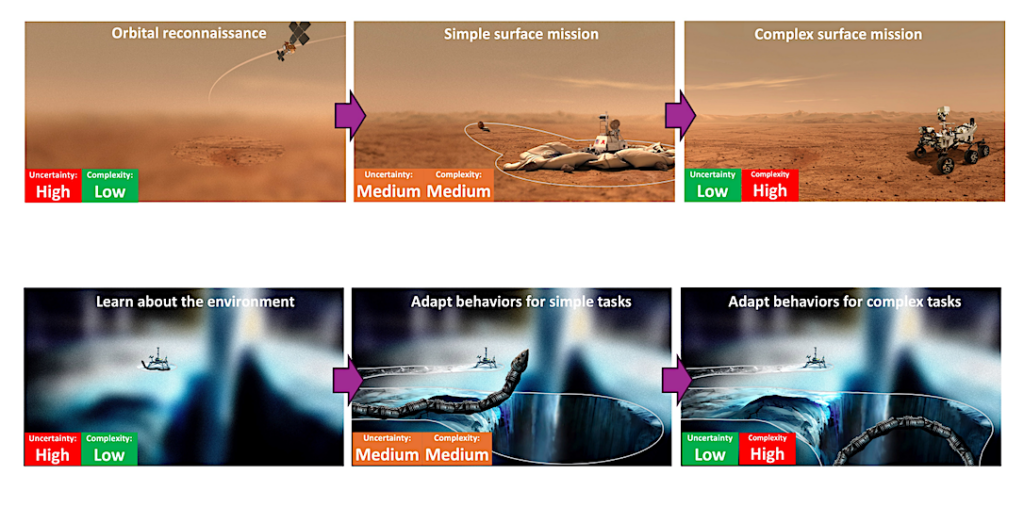
TOP: Planetary Exploration 2.0: Incremental sophistication over many missions, where the behaviors of the space system of each mission are largely pre-designed and fixed based on detailed environmental knowledge brought by prior missions. BOTTOM: Planetary Exploration 3.0 (Proposed): One-shot exploration with a highly adaptive space system, which evolves its behaviors in situ for incrementally complex tasks as it learns more about the environment. — astro-ph.IM
We propose Planetary Exploration 3.0 (PE 3.0): a paradigm in which unvisited worlds are explored by a single or a few missions with radically adaptive space systems. A PE 3.0 mission conducts both initial exploratory science and follow-on hypothesis-driven science based on its own in situ data returns, evolving spacecraft capabilities to work resiliently in previously unseen environments.
The key enabler of PE 3.0 is software-defined space systems (SDSSs) – systems that can adapt their functions at all levels through software updates.
This paper presents findings from a Keck Institute for Space Studies (KISS) workshop on PE 3.0, covering: (1) PE 3.0 systems engineering including science definition, architecture, design methods, and verification & validation; (2) software-defined space system technologies including reconfigurable hardware, multi-functionality, and modularity; (3) onboard intelligence including autonomous science, navigation, controls, and embodied AI; and (4) three PE 3.0 mission concepts: a Neptune/Triton smart flyby, an ocean world explorer, and an Oort cloud reconnaissance mission.
Masahiro Ono, Daniel Selva, Morgan L. Cable, Marie Ethvignot, Margaret Hansen, Andreas M. Hein, Elena-Sorina Lupu, Zachary Manchester, David Murrow, Chad Pozarycki, Pascal Spino, Amanda Stockton, Mathieu Choukroun, Soon-Jo Chung, John Day, Alexander Demagall, Anthony Freeman, Chloe Gentgen, Michel D. Ingham, Charity M. Phillips-Lander, Richard Rieber, Alejandro Salado, Maria Sakovsky, Lori R. Shiraishi, Yisong Yue, Kris Zacny
Subjects: Instrumentation and Methods for Astrophysics (astro-ph.IM); Earth and Planetary Astrophysics (astro-ph.EP); Artificial Intelligence (cs.AI); Robotics (cs.RO); Systems and Control (eess.SY)
Cite as: arXiv:2604.20910 [astro-ph.IM] (or arXiv:2604.20910v1 [astro-ph.IM] for this version)
https://doi.org/10.48550/arXiv.2604.20910
Focus to learn more
Journal reference: AIAA ASCEND 2026
Submission history
From: Elena Lupu
[v1] Wed, 22 Apr 2026 00:22:38 UTC (12,280 KB)
https://arxiv.org/abs/2604.20910
Astrobiology,