LMA Observations Of Acetone In Hot Cores
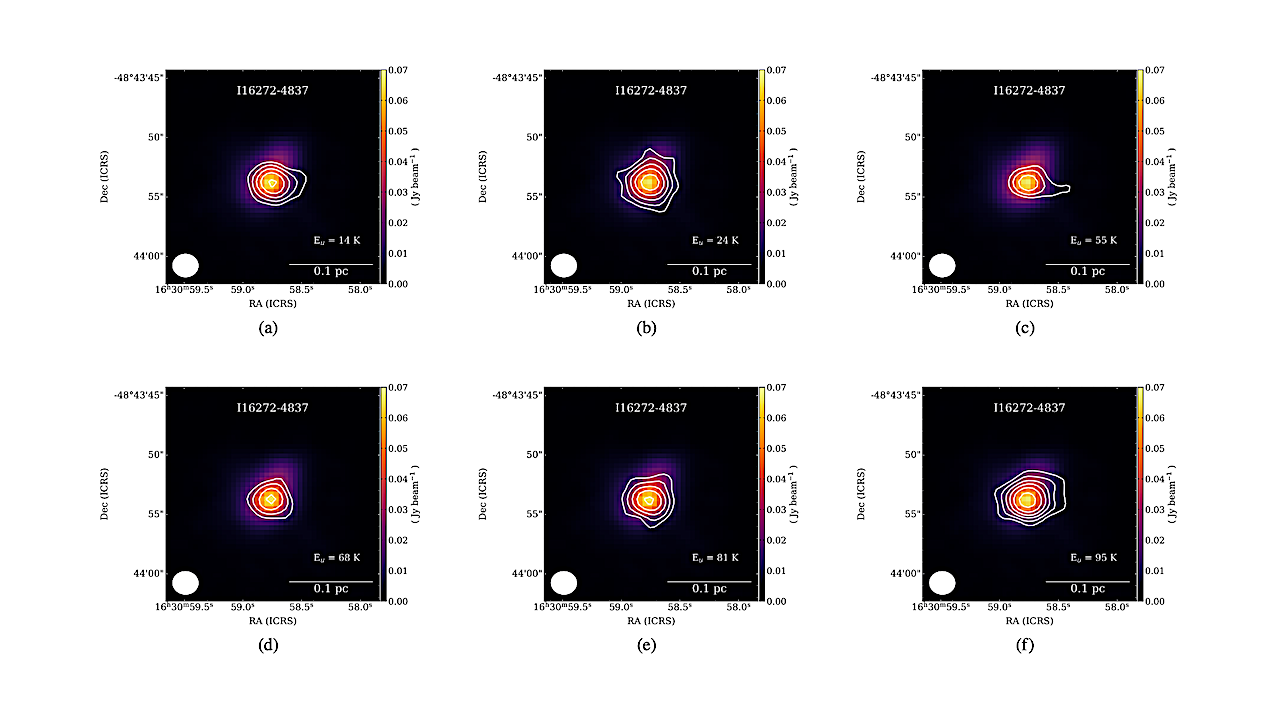
Acetone (CH3COCH3) is a ubiquitous interstellar molecule, and serves as an important tracer of hot core chemistry. We conducted a line survey of acetone and its precursor acetaldehyde (CH3CHO) towards 60 hot cores by using the ALMA 3 mm lines observations. We calculated the rotational temperatures and column densities of acetone using the XCLASS software.
Acetone was detected in 15 hot cores with rotational temperatures ranging from 89 to 176 K. Its column densities range from (0.9-24)x 1016 cm-2. The spatial distributions of acetone exhibit similarities with those of acetaldehyde.
The emissions of acetone are concentrated toward the hot core regions and generally exhibit a compact spatial distribution, whereas the emission of acetaldehyde shows a more extended spatial profile. Combined with previous studies, we found a moderately positive correlation between the column densities and rotational temperatures of acetone for the high-mass hot cores (r = 0.59).
We also found a strong positive correlation between the column densities of acetone and acetaldehyde (r = 0.82), indicating a chemical relationship between them. By comparing these observational results with the three-phase model results, we found that the models overpredict the ratio of acetone to methanol relative to the observational data.
This discrepancy suggests that current chemical networks may inadequately account for acetone destruction pathways or potential missing physical conditions in the model. Therefore, our large sample observations can provide constraints on chemical models and reinforce the role of acetone as a tracer of complex organic chemistry in warm, dense regions.
Xia Zhang, Xiaohu Li, Zhiping Kou
Comments: 11 pages, 7 figures, 2 tables in main body; 18 pages, 9 figures, 2 tables in Appendix, Accepted for publication in MNRAS
Subjects: Astrophysics of Galaxies (astro-ph.GA)
Cite as: arXiv:2604.19472 [astro-ph.GA] (or arXiv:2604.19472v1 [astro-ph.GA] for this version)
https://doi.org/10.48550/arXiv.2604.19472
Focus to learn more
Submission history
From: Xia Zhang
[v1] Tue, 21 Apr 2026 13:56:33 UTC (2,466 KB)
https://arxiv.org/abs/2604.19472
Astrobiology, Astrochemistry,