The Influence Of Hypothetical Exomoons On Planetary Thermal Phase Curves
More than 200 moons exist in our Solar System, yet no exomoon has been confirmed to date. While the innermost two planets of the Solar System lack natural satellites and most studies favour the existence of exomoons around long-period planets, some theoretical studies that take tidal dissipation, orbital decay, and migration processes into account suggest that exomoons may survive around short-period exoplanets.
We investigated the impact of exomoons on planetary thermal phase curves and assessed their detectability within a theoretical framework. We simulated the thermal phase curves of exomoon-exoplanet systems, including mutual transits and occultations, and explored their dependence on planetary orbital periods across a wide range of systems.
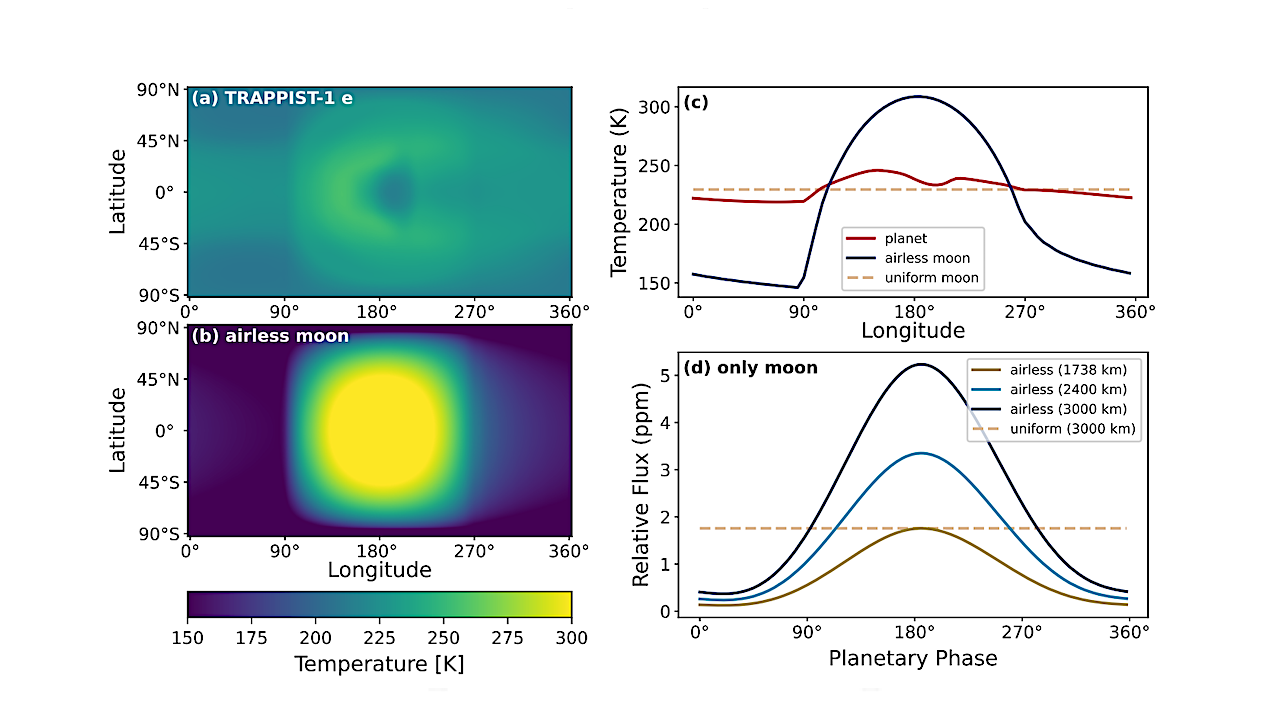
Close-in airless exomoons maintain large day-night temperature contrasts, amplifying the thermal phase-curve signal of the system. When the exomoon transits or is occulted by the exoplanet, the transit depth varies with the planetary phase, and the occultation depth varies with the exomoon’s phase.
The maximum occultation depth can reach ∼ 20 ppm for long-period systems. For short-period planets, the signal can reach up to ∼100 ppm, although such configurations may not be dynamically stable over long timescales. If exomoons are not accounted for, the planetary temperature distribution retrieved from observed thermal phase curves may overestimate the planetary day-night temperature contrast and underestimate the planetary horizontal heat transport.
In principle, the periodic exomoon-exoplanet mutual occultation signal could be extracted using methods such as box-fitting least squares, providing a framework for future observational studies and instrument planning.

Thermal phase curves and eclipses for the TRAPPIST-1 e system. Panel (a): Total thermal phase curve of the planet and a 3000 km tidally locked airless exomoon (blue line). Panel (b): Total thermal phase curve of the planet and a 3000 km exomoon with uniform temperature (dashed line). The exomoons orbit at 33300 km around TRAPPIST-1 e. The red lines in panels (a) and (b) show the planetary phase curve alone, i.e. the ratio of the planetary infrared emission to the stellar infrared emission. Panel (c): Occultation scenarios, with the exomoon blocked by the planet. The red indicators on the exomoon markers show the 180◦ longitude. Panel (d): Transit scenarios, with the exoplanet blocked by the exomoon. The observation direction in panels (c) and (d) is from bottom to top, as indicated by the black arrows at the bottom. — astro-ph.EP
Xinyi Song, Jun Yang, Yueyun Ouyang
Subjects: Earth and Planetary Astrophysics (astro-ph.EP)
Cite as: arXiv:2603.18437 [astro-ph.EP] (or arXiv:2603.18437v1 [astro-ph.EP] for this version)
https://doi.org/10.48550/arXiv.2603.18437
Focus to learn more
Submission history
From: Xinyi Song
[v1] Thu, 19 Mar 2026 02:52:07 UTC (1,230 KB)
https://arxiv.org/abs/2603.18437
Astrobiology,