Astronomers Observe Exoplanet Atmospheres With New Cloud-detecting Method
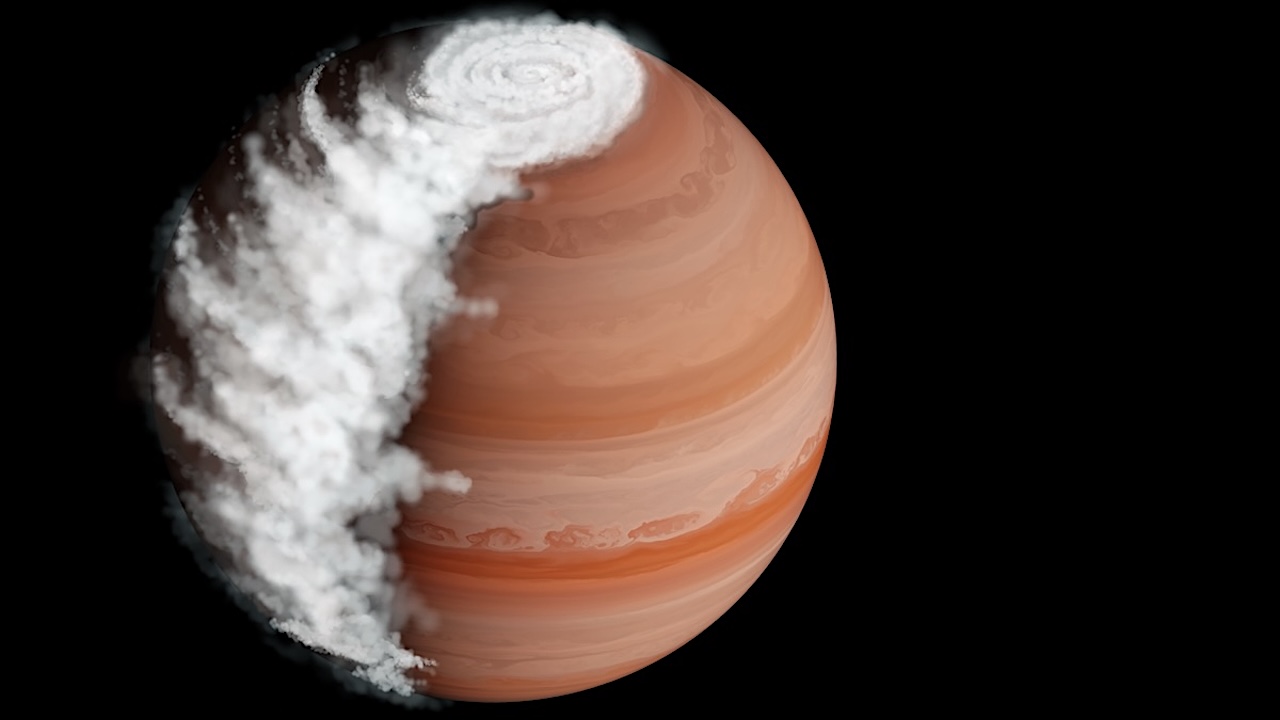
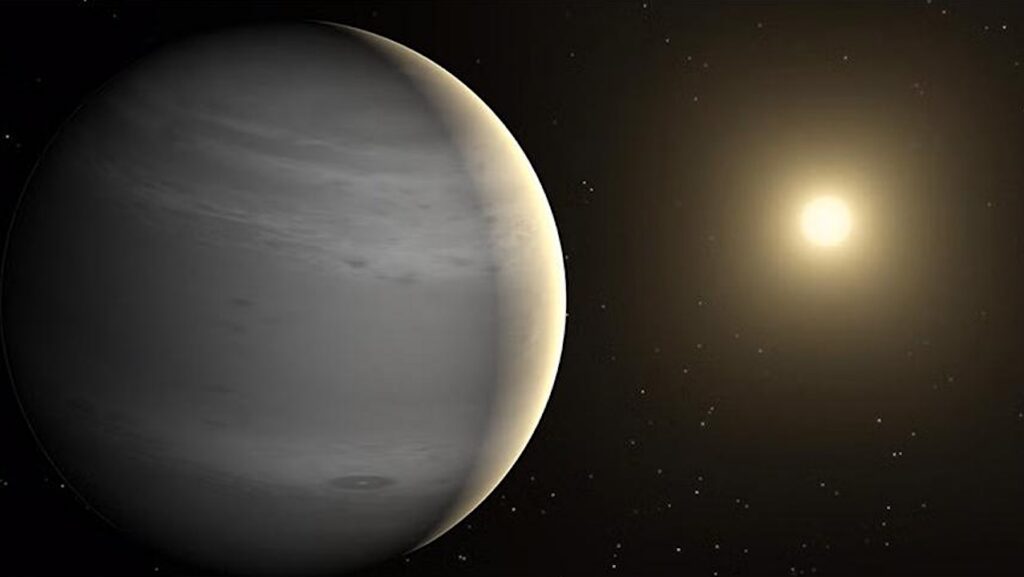
Every morning, clouds roll in, and by evening, they have cleared off. This sounds like a weather forecast for a coastal city here on Earth — but it’s for WASP-94A b, a well-studied gas giant orbiting a star located nearly 700 light-years away.
A new study published in the journal Science documents the first detection of repeating cloud cycles on a hot Jupiter exoplanet. The first author of the study is Sagnick Mukherjee, a 51 Pegasi b postdoctoral fellow at Arizona State University’s School of Earth and Space Exploration.
Mukherjee is part of a research team that analyzed data from the James Webb Space Telescope targeting WASP-94 A b, a gas giant in the constellation Microscopium. The team discovered that the planet’s morning side is blanketed in clouds of magnesium silicate, the same mineral found in common rocks, while its evening side is under clear skies.
To study WASP-94 A b, Principal Investigator David Sing and his team of researchers gathered data as the planet passed directly in front of its star. Using the high-powered, space-based JWST, the researchers were able to take separate measurements of WASP-94 A b’s leading edge as it began to cross in front of the star of the trailing edge as the planet completed its transit. At the leading edge, the air flows from the night side of the planet to the day side, effectively making it the morning. Air flows from day to night at the trailing edge, making it the evening.
“With the Hubble telescope, when we used to do this type of observation, we got an average view of the whole planet with data from the clouds and the atmosphere squished together and indistinguishable,” said Mukherjee, who was a student at Johns Hopkins University and UC Santa Cruz at the time of the research. “This approach with the JWST lets us localize our observations, which helps us see the cloud cycle.”
The researchers think one of two things could be causing the mornings to be riddled with clouds and the evenings to have clear skies. Powerful winds might lift clouds high into the sky on the cooler side of the planet and then plunge downward on the hotter dayside, dragging the clouds deep into the planet’s interior and effectively burying them out of sight before sunset. Alternatively, the phenomenon may be akin to morning fog burning off on Earth but on an extreme scale. Clouds would form in the darkness of the planet’s nightside. As they drift into the scorching heat of over 1,000 degrees on the day side, the chemicals that make up the clouds boil away, and the clouds simply vaporize.
“It was a huge surprise. People have expected some differences, like it’s cooler in the morning than the evening — that’s something natural that we experience here on Earth,” said co-author Sing, a Bloomberg Distinguished Professor of Earth and Planetary Sciences at Johns Hopkins. “But what we saw was a real dichotomy between the weather on both sides of the planet and huge differences in cloud coverage, and that changes our whole picture of the planet.”
Because the evenings were cloud-free, the researchers could look specifically at the trailing edge to see what the planet’s atmosphere looked like — something the Hubble telescope could not provide.
When the researchers looked at the clear evening sky, they found that WASP-94 A b was much more like Jupiter than they thought. Previously, when the clouds were averaged in, the data suggested the planet contained oxygen and carbon concentrations hundreds of times greater than Jupiter’s — a finding that baffled researchers, given it couldn’t be explained by planet formation theory. The new data, however, show WASP-94 A b has only five times the amount of oxygen and carbon.
Hot Jupiter planets orbit much closer to their stars — closer even than Mercury to the sun — and therefore are much hotter and exposed to more radiation. Because of their extreme environments, these planets also serve as ideal environments for studying the chemistry and physics of cloud dynamics.
Using WASP-94 A b as a benchmark, the team looked at eight other hot gas giants and discovered the same distinctive cloud cycle on two other worlds: WASP-39 b and WASP-17 b. Next, Mukherjee, Sing and their team will study cloud cycling across a wide variety of exoplanets using data from a new large JWST program, including an eccentric gas giant planet in the habitable zone.
This press release was written by Hannah Robbins, news and research communications manager at Johns Hopkins University with contributions from Kim Baptista at ASU’s School of Earth and Space Exploration.
Authors of the study include Guangwei Fu, Stephen Schmidt, Patrick McCreery, Natalie Allen, Katherine Bennett, Lakeisha Ramos Rosado, Zafar Rustamkulov, Kevin Schlaufman, Daniel Thorngren and Le-Chris Wang from Johns Hopkins University; Kevin Stevenson, Jacob Lustig-Yaeger, Erin May, L. C. Mayorga and K. S. Sotzen from the Johns Hopkins University Applied Physics Laboratory; Harry Baskett, Éric Hébrard, Nathan Mayne, Maria Zamyatina and Mei Ting Mak from the University of Exeter; Duncan Christie from the Max Planck Institute for Astronomy; Carlos Gascón from the Harvard-Smithsonian Center for Astrophysics; Jayesh Goyal from the National Institute of Science Education and Research; Joshua Lothringer and Mercedes López-Morales from Space Telescope Science Institute; and Henrique Reggiani from the International Gemini Observatory.
The research was funded by National Science Foundation grants AST 1828315 and DGE2139757, the John Templeton Foundation, Heising-Simons Foundation, Science and Technology Facilities Council, and UKRI grant number MR/T040866/1. Support was provided by NASA under NASA contract NAS 5-03127 and the European Union’s Horizon program grant 101004214.
Cloudy mornings and clear evenings on a gas giant exoplanet, Science (open access)
Astrobiology,