Exploring The Orbital Stability Of Large, Lightweight Mirrors Around Exoplanets
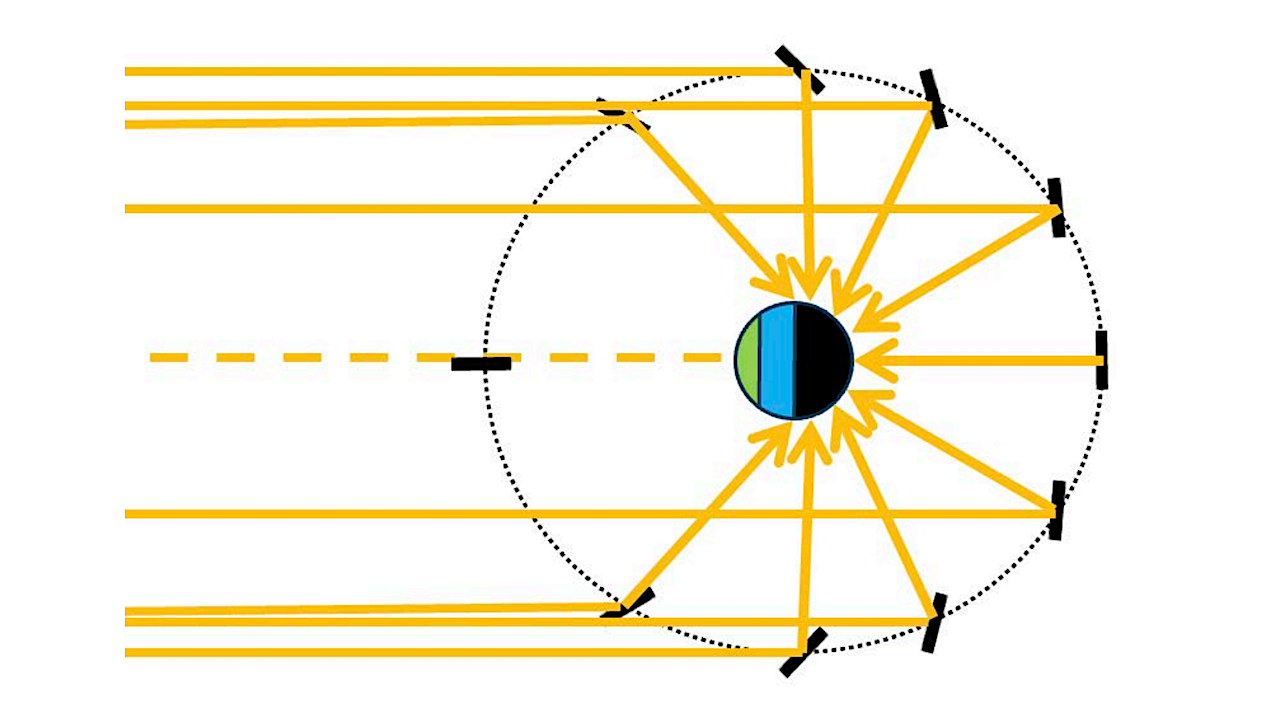
Extraterrestrial civilizations might place large, lightweight mirrors into orbit around an exoplanet, either to alter its climate or to provide illumination to the planet’s dark side. We previously analyzed the detectability of a fleet of 1km x 1km, 1000 kg mirrors (Korpela, Sallmen, & Leystra Greene 2015).
Because these mirrors are large and lightweight, their orbits are significantly affected by the star’s radiation pressure (RP). We created a simulation package based on the REBOUND N-body simulator, incorporating RP that directs starlight towards the planet’s center.
RP can always affect mirror orbits, or only during orbital night. We have simulated mirrors in initially circular orbits around exoplanets at various locations in the habitable zones of eight types of main-sequence stars. Initial mirror orbit sizes range from 2 to 10 planet radii, and we included 4 different initial mirror orbit orientations.
For each simulation, we have the mirror’s survival time, trajectory, distance from the planet center at each time, and velocity relative to the planet at each time. We present an analysis of trends in mirror orbit stability, and relate these to the ratios of RP and gravitational accelerations, as well as the ratio of planet orbit period to mirror orbit period.
Shauna M. Sallmen Eric J. Korpela
Comments: 4 pages, 5 figures. Submitted to Advancing the Search for Technosignatures, Proceedings of IAU Symposium #404 (forthcoming)
Subjects: Instrumentation and Methods for Astrophysics (astro-ph.IM); Earth and Planetary Astrophysics (astro-ph.EP); Popular Physics (physics.pop-ph)
Cite as: arXiv:2606.10140 [astro-ph.IM] (or arXiv:2606.10140v1 [astro-ph.IM] for this version)
https://doi.org/10.48550/arXiv.2606.10140
Focus to learn more
Submission history
From: Shauna Sallmen
[v1] Mon, 8 Jun 2026 20:17:08 UTC (439 KB)
https://arxiv.org/abs/2606.10140
Astrobiology, SETI, Technosignature,