Abiotic Sources Of Fixed Nitrogen Sustained Early Ecosystems For Several Hundred Million Years After The Origin Of Life
Nitrogen (N) plays a crucial role in controlling biological productivity. However, it remains unknown how Earth’s earliest ecosystems accessed bioavailable forms of nitrogen.
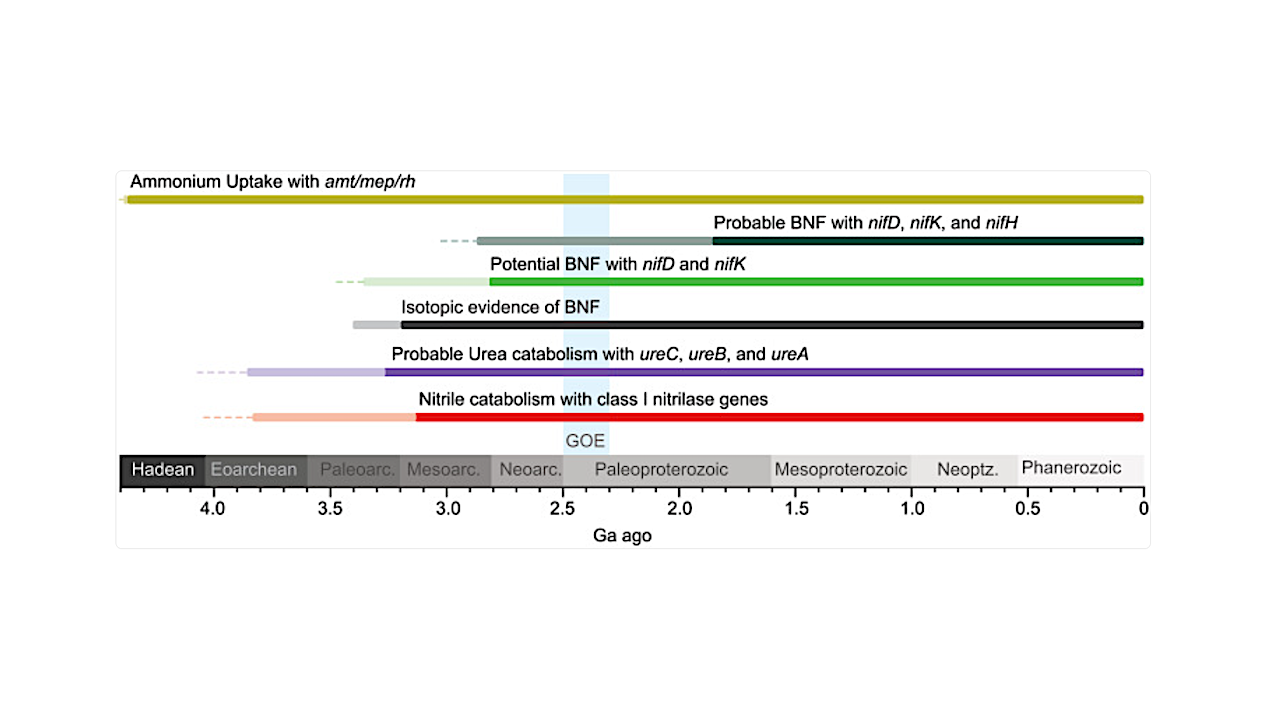
Here, we present genomic evidence that the last universal common ancestor (LUCA) had genes for importing ammonium into the cell, but the first organisms with all three catalytic nitrogen fixing genes emerged at least 1 billion years later.
Similarly, enzymatic pathways for accessing nitrogen from urea and nitriles appear to predate biological N2 fixation.
Our results imply that Earth’s earliest biosphere was maintained by environmental sources of ammonium and other N-bearing compounds, possibly derived from a combination of processes such as hydrothermal activity, photochemistry, rock weathering, lightning, or impact events.
Biological N2 fixation may have emerged in response to an increase in biological nutrient demand or due to declining abiotic supplies of ammonium, urea, and nitriles.
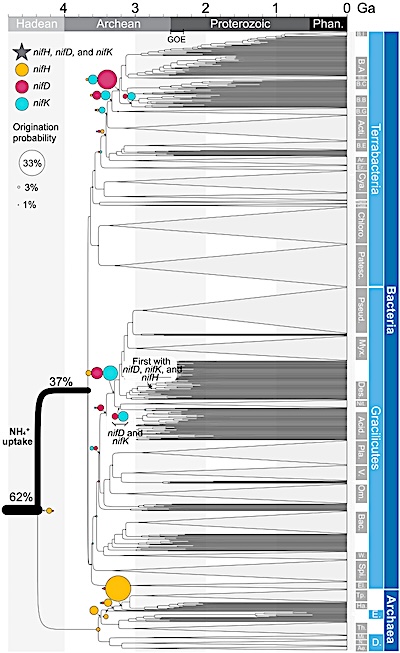
The most likely origins of nifH (yellow circles), nifD (pink circles), and nifK (turquoise circles) estimated with the CIR clock model are annotated with colored circles (sized in proportion to origination probability) on a time-calibrated tree of life where branch thicknesses are scaled to represent origination probabilities of ammonium-uptake genes (namely, amt/mep/rh). The grey star and associated annotation indicates the earliest lineage to host all three catalytic N fixing genes (namely, nifH, nifD, and nifK, host is defined as ≥50% presence probability for each gene). Text “nifD & nifK” indicates the first lineage with genes encoding both N2-interacting subunits of nitrogenase (defined as ≥50% presence probabilities of nifD and nifK). GOE, Great Oxygenation Event; Had., Hadean; Phan., Phanerozoic. Blue rectangles indicate bacterial and archaeal clades (E., Euryarchaeota; D., DPANN) and phyla (from top to bottom: B.I, Bacillota I; B.A, Bacillota A; B.D, Bacillota D; B.C, Bacillota C.; B.B, Bacillota B; B.G, Bacillota G; Acti., Actinobacteriota; B.E, Bacillota E; Ar., Armatimonadota; Er., Eremiobacterota; Cya., Cyanobacteriota; Ma., Margulisbacteriota; Therm., Thermotogota; Caldi., Caldisericota; Chloro., Chloroflexi.; Patesc., Patescibacteriota; Pseud., Pseudomonadota; Myx., Myxococcota; Des., Desulfobacterota; Nit., Nitrospirota; Acid., Acidobacteriota; Pla., Planctomycetota; V., Verrucomicrobiota; Om., Omnitrophota; Bac., Bacteroidota; W., WOR-3; Spi., Spirochaetota; El., Elusimicrobiota; Tp., Thermoplasmatota, Ha., Halobacteriota; Th., Thermoproteota; Mi., Microarchaeota; N., Nanoarchaeota; Ae., Aenigmatarchaeota). The CIR clock model is presented to aid comparison with other studies that use CIR for their main figures. — Abiotic sources of fixed nitrogen sustained early ecosystems for several hundred million years after the origin of life, Science Advances via PubMed (open access)
Abiotic sources of fixed nitrogen sustained early ecosystems for several hundred million years after the origin of life, Science Advances via PubMed (open access)
Astrobiology,