The Influences of Hydrogen-Silicate-Iron Miscibility on the Demographics of Sub-Neptunes and Super-Earths
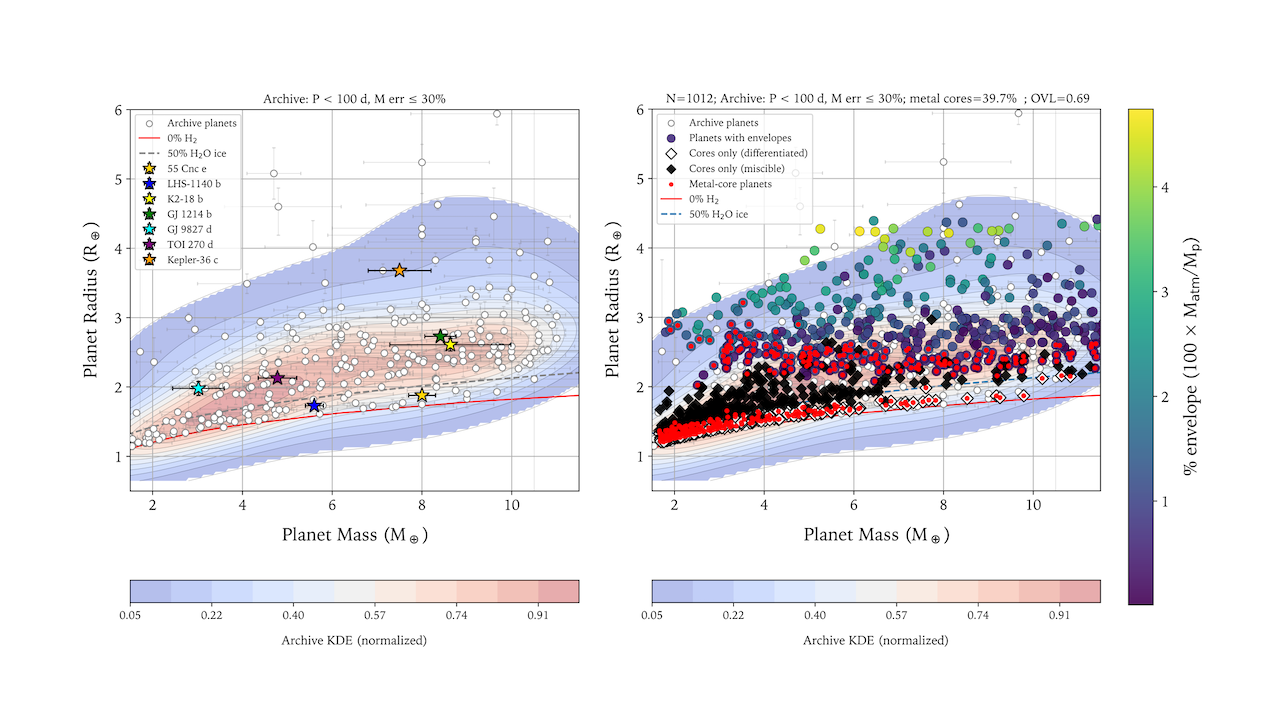
Models based on variable miscibility among hydrogen, molten silicate, and molten iron, coupled with atmospheric escape, can reproduce the observed occurrence density structure of sub-Neptunes and super-Earths in mass-radius space.
The models are also consistent with the radius gap and the observed radius-period relationship exhibited by these planets. The degree of overlap between predicted and observed planetary occurrences suggests that hydrogen-silicate-iron miscibility may serve as a unifying concept for the formation and evolution of these planet classes.
The well-defined equilibrium conditions at the boundary between supercritical magma oceans and the overlying hydrogen-rich envelopes are important features of the models. Planets formed with less than ~1 % hydrogen by mass develop discrete, terrestrial-like metallic cores, while those accreting greater hydrogen concentrations are predicted to have fully miscible interiors and no discrete metal cores.
Hydrogen-silicate-iron miscibility provides an overarching explanation for the full range of sub-Neptune and super-Earth architectures based on the accreted hydrogen mass fraction and the phase equilibria governing silicate, iron metal, and H2 miscibility.
Edward D. Young, Aaron Werlen
Comments: Submitted to ApJ
Subjects: Earth and Planetary Astrophysics (astro-ph.EP)
Cite as: arXiv:2604.28135 [astro-ph.EP] (or arXiv:2604.28135v1 [astro-ph.EP] for this version)
https://doi.org/10.48550/arXiv.2604.28135
Focus to learn more
Submission history
From: Edward Young
[v1] Thu, 30 Apr 2026 17:18:21 UTC (15,100 KB)
https://arxiv.org/abs/2604.28135
Astrobiology, exoplanet,