Equifinality Of Venus-like CO2 Atmospheres
While Earth locks much of its carbon in its crust as carbonates, Venus retains a comparable carbon inventory almost entirely in its atmosphere as CO2.
On Earth, the geological carbon cycle that has produced this vast crustal carbonate inventory is regulated by biology, liquid water, and plate tectonics, which together have stabilised climate over geological timescales. Venus presently lacks all these processes.
We test whether Venus’s massive CO2 atmosphere is diagnostic of a specific evolutionary pathway by quantifying three routes: primary magma-ocean outgassing, secondary volcanic degassing in a stagnant-lid regime, and remobilisation of crustal carbonates after climate destabilisation. Using a coupled climate–weathering framework, we find that a past habitable Venus could have stored ∼20 bar of CO2 as crustal carbonates. Following transition to runaway conditions, crustal heating releases this reservoir over tens of Myr.
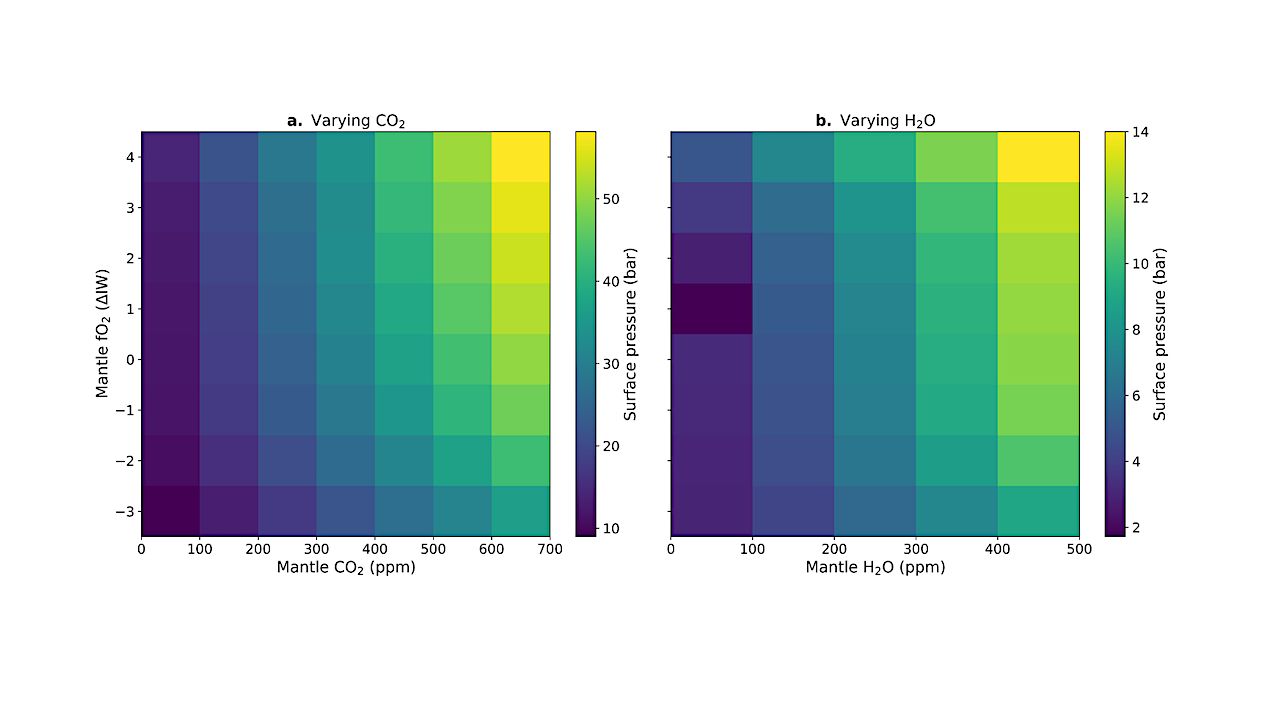
In stagnant-lid secondary-degassing models with a MORB-like mantle, outgassing reaches only ∼25 bar CO2, limited by progressive mantle volatile depletion. However, Venus-like inventories can be achieved through: (i) magmatic carbon enrichment, (ii) increased magmatic delivery to the surface (high extrusion or melt production), and (iii) the recycling of undegassed carbon back into the planet’s interior.
Primary magma-ocean outgassing can generate >102 bar CO2, but the retained fraction after early escape remains uncertain. Ultimately, a Venus-like massive CO2 atmosphere is an equifinal outcome and does not uniquely diagnose a temperate past.
Tereza Constantinou, Oliver Shorttle, Harrison Nicholls
Comments: Accepted for publication in MNRAS
Subjects: Earth and Planetary Astrophysics (astro-ph.EP)
Cite as: arXiv:2604.25810 [astro-ph.EP] (or arXiv:2604.25810v1 [astro-ph.EP] for this version)
https://doi.org/10.48550/arXiv.2604.25810
Focus to learn more
Submission history
From: Tereza Constantinou
[v1] Tue, 28 Apr 2026 16:20:19 UTC (12,947 KB)
https://arxiv.org/abs/2604.25810
Astrobiology, exoplanet,