TMC-1: Probing The Onset Of Chemical Complexity In Space
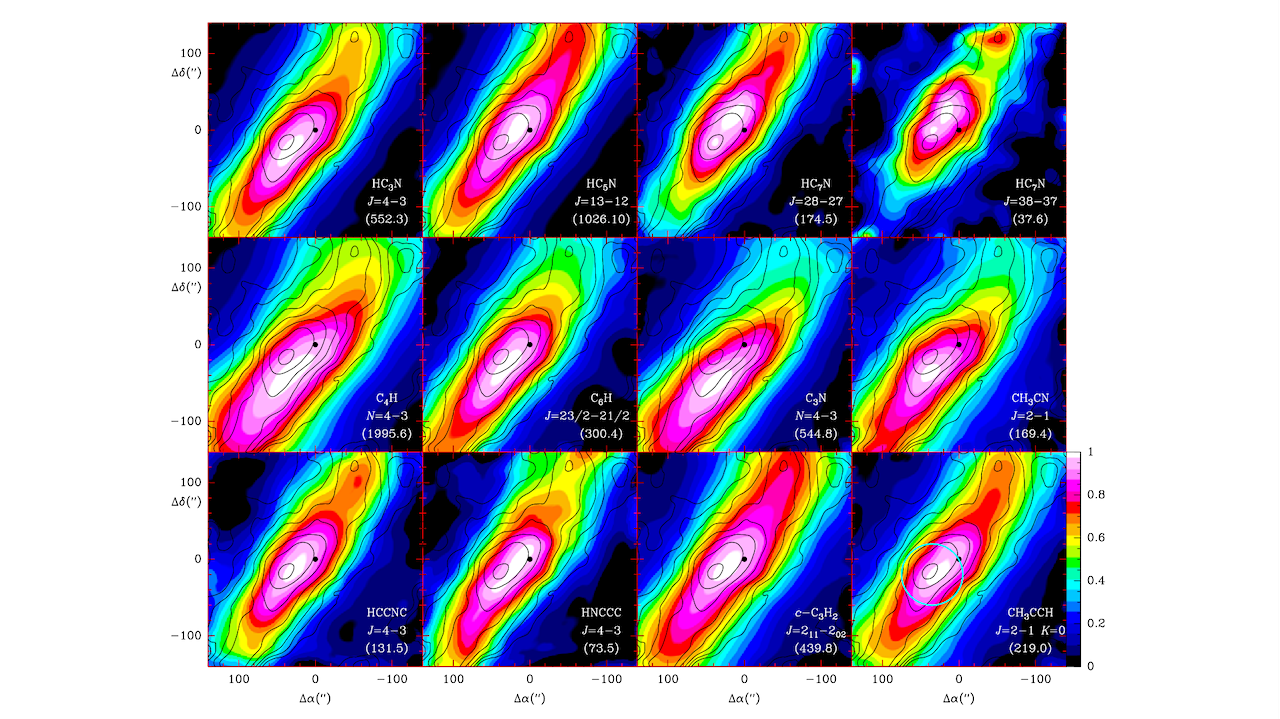
In recent years, the obsessive interest in the observation of TMC-1 has brought a boost in our knowledge of the chemistry of cold dark clouds. The number of molecules detected in this particular cloud has been more than doubled.
Two observational programmes, GOTHAM and QUIJOTE, are responsible for this spectacular achievement. Here we provide an overall view of QUIJOTE, which is a line survey carried out in the Q band (31-50 GHz) with the Yebes 40m radiotelescope, summarize the actual observational status of TMC-1, and discuss the chemistry of this remarkable source.
We highlight the successes and failures of state-of-the-art chemical models to describe its chemical composition, with a particular emphasis on the origin of PAHs, which is yet far from being understood.
Marcelino Agundez, Jose Cernicharo
Comments: Accepted for publication in ACS Earth and Space Chemistry, special issue “Eric Herbst Festschrift”
Subjects: Astrophysics of Galaxies (astro-ph.GA)
Cite as: arXiv:2604.26439 [astro-ph.GA] (or arXiv:2604.26439v1 [astro-ph.GA] for this version)
https://doi.org/10.48550/arXiv.2604.26439
Focus to learn more
Submission history
From: Marcelino Agundez
[v1] Wed, 29 Apr 2026 08:49:43 UTC (4,089 KB)
https://arxiv.org/abs/2604.26439
Astrobiology, Astrochemistry,