The POKEMON Speckle Survey of Nearby M dwarfs. IV. Distance-Limited Catalog (POKEMON-DLC)
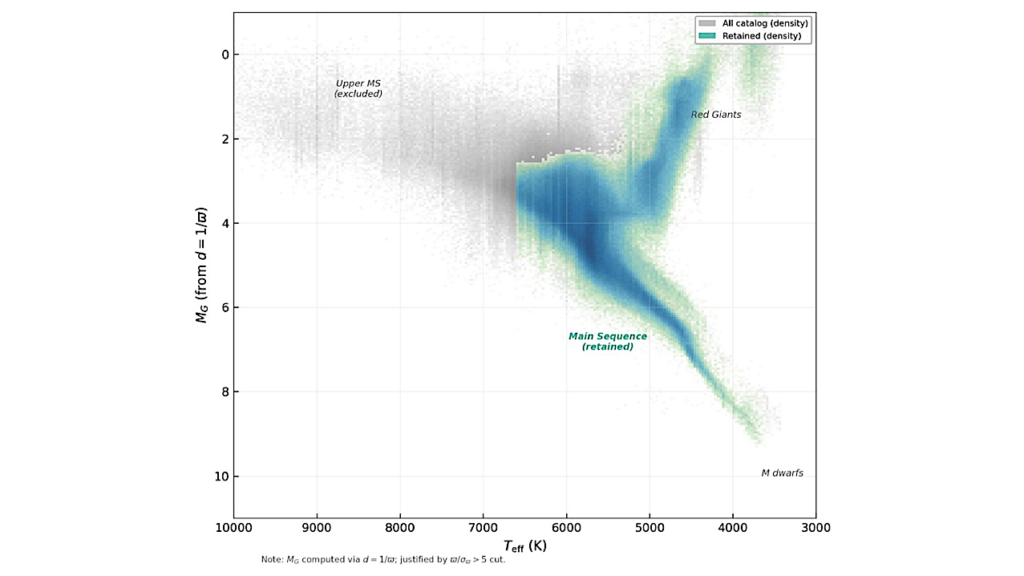
The Solar Neighborhood is dominated by stars smaller, colder, and fainter than the Sun: the M dwarfs.
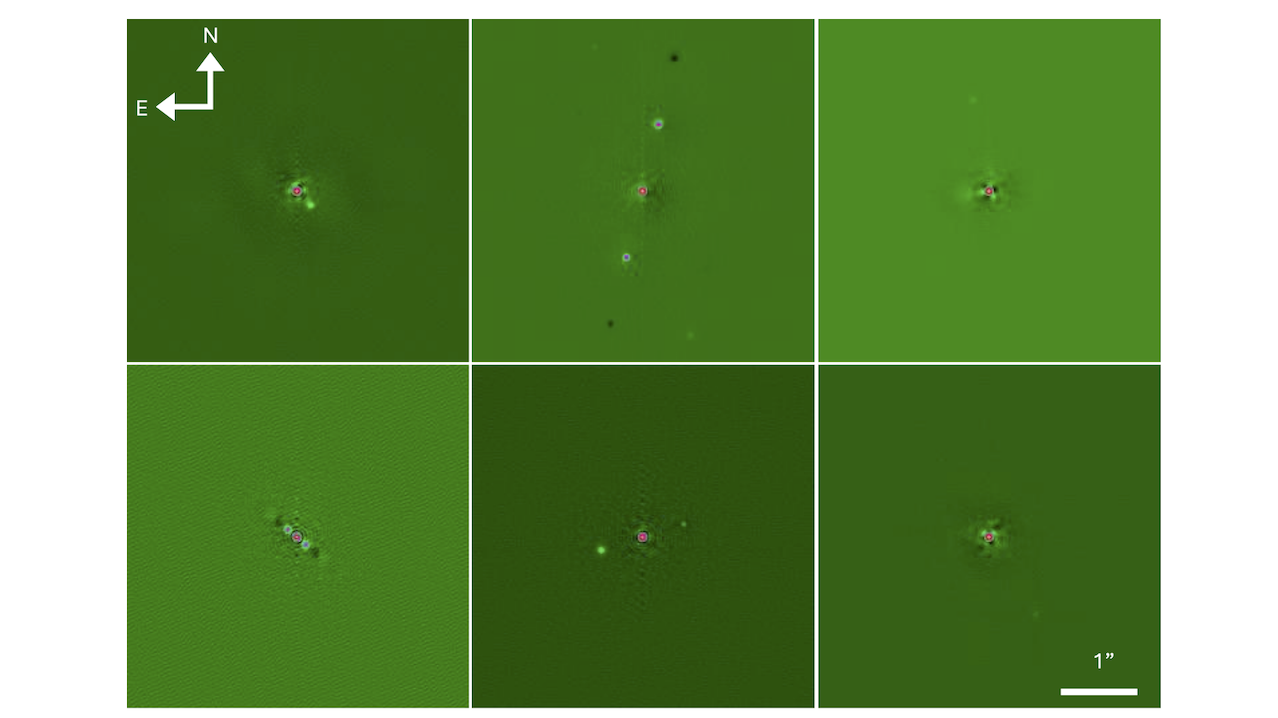
If we are to understand the context in which the Sun formed and evolved, then we must investigate the system architectures of our low-mass neighbors. We have therefore carried out the Pervasive Overview of Kompanions of Every M Dwarf in Our Neighborhood (POKEMON) speckle survey of nearby M-dwarf primaries.
We created the survey with the goal of observing a volume-limited (north of -30 degrees) sample of M-dwarf primaries through M9 out to 15 pc at diffraction-limited resolution. Pre-Gaia parallax measurements yielded a catalog of 454 nearby M-dwarf primaries.
However, the precise astrometry from Gaia indicated that there are additional low-mass sources within 15 pc. Here we present the POKEMON-Distance Limited Catalog (POKEMON-DLC), a supplemental catalog that consists of speckle observations for the 66 additional M-dwarf primaries identified by Gaia, increasing the number of ultracool dwarf (later than M6.5) primaries in the POKEMON catalog by a factor of 1.6. In our observations we detect four likely bound companions.
After carrying out a literature search for additional companions, we update the projected separation distribution and find a peak at 7.91 au σlog(a) = 1.1, SElog(a) = 0.10). We also update the M-dwarf stellar multiplicity and companion rates, and find values of 22.7 p/m 1.8% and 27.5 p/m 2.0%, respectively. These results emphasize the utility of Gaia for identifying low-mass, nearby sources, and we find that ensuing characterization of these sources by SPHEREx will continue to clarify the nature of the Solar Neighborhood.
Catherine A. Clark, Zafar Rustamkulov, Gerard T. van Belle, Mark E. Everett, Colin Littlefield, Sarah J. Deveny, David R. Ciardi, Kaspar von Braun
Comments: 22 pages, 7 figures. Accepted for publication in the Astronomical Journal
Subjects: Solar and Stellar Astrophysics (astro-ph.SR); Earth and Planetary Astrophysics (astro-ph.EP); Astrophysics of Galaxies (astro-ph.GA)
Cite as: arXiv:2604.22983 [astro-ph.SR] (or arXiv:2604.22983v1 [astro-ph.SR] for this version)
https://doi.org/10.48550/arXiv.2604.22983
Focus to learn more
Submission history
From: Catherine Clark
[v1] Fri, 24 Apr 2026 19:53:04 UTC (7,513 KB)
https://arxiv.org/abs/2604.22983
Astrobiology, Astronomy, Exoplanet,