POSEIDON II: The Anti-Aligned Orbit of the Warm Neptune TOI-1710 A b
We present an observation of the Rossiter-McLaughlin effect for the warm-Neptune system TOI-1710 obtained with the NEID spectrograph on the WIYN 3.5 m telescope.
These observations reveal that the planet orbits in the opposite direction to the stellar spin, with a sky-projected obliquity λ=179±19∘. Combined with information about the rotation period of the host star, we measure a true obliquity of ψ=158+11−13∘.
The host star has an M-dwarf companion at a separation of ∼3600 au, but this companion is too distant to be solely responsible for misaligning the warm Neptune. The host star also shows a long-term radial velocity trend, indicative of a companion at intermediate separations.
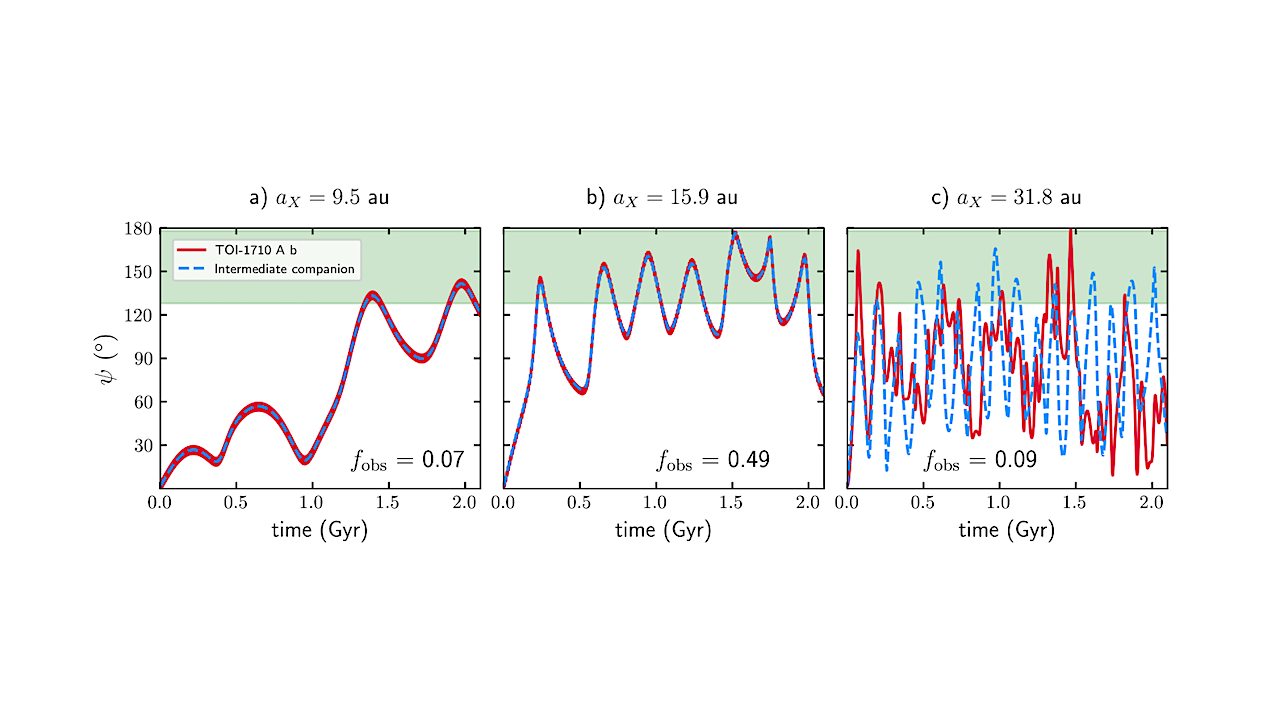
We show that such a companion can dynamically couple the warm Neptune to the distant M dwarf, enabling the transfer of inclination from the wide binary orbit to the planetary orbit.
Assuming this scenario is correct, we predict the intermediate companion is a ∼5MJ planet on a ∼15-au orbit that is nearly aligned with the transiting planet’s orbit.
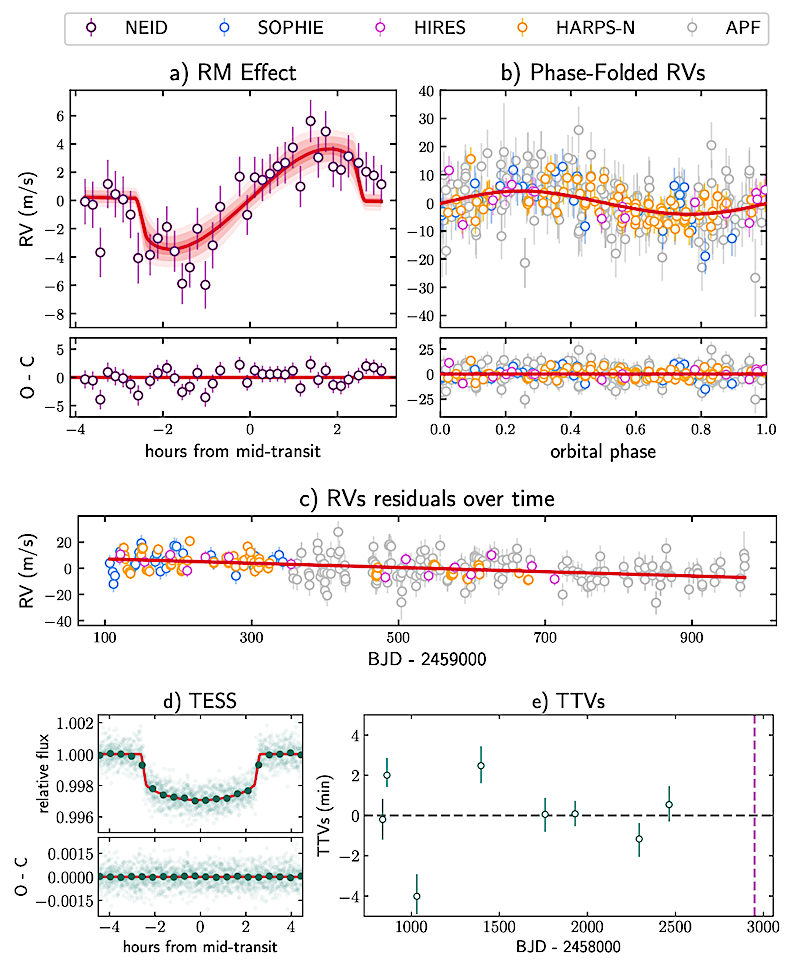
Observations of TOI-1710 A. (a) NEID RVs, after subtracting a long-term linear trend (purple) along with the best-fit model including the RM effect (red curve) and the associated confidence intervals (1, 2, and 3σ, shaded red). Residuals are shown below. (b) Out-of-transit RVs versus orbital phase, along with the best-fit model (the confidence intervals are too small to be seen clearly). Residuals are shown below. (c) RV residuals versus time, after subtracting the signal of TOI-1710 A b. The red line is a linear RV trend, which is detected with 8σ confidence. (d) Transit photometry from TESS (green) along with the best-fit model (red). The darker points are time-averaged data. Residuals are shown below. (e) Deviations between measured transit times and the best-fit constant period model as a function of time. The vertical dashed line indicates the transit that was observed spectroscopically with NEID. — astro-ph.EP
Juan I. Espinoza-Retamal, Hareesh Bhaskar, Joshua N. Winn, Cristobal Petrovich, Rafael Brahm, Caleb Lammers, Guðmundur Stefánsson, Elise Koo, Andrés Jordán, Felipe I. Rojas
Subjects: Earth and Planetary Astrophysics (astro-ph.EP)
Cite as: arXiv:2604.03364 [astro-ph.EP] (or arXiv:2604.03364v1 [astro-ph.EP] for this version)
https://doi.org/10.48550/arXiv.2604.03364
Focus to learn more
Submission history
From: Juan Ignacio Espinoza Retamal
[v1] Fri, 3 Apr 2026 18:00:00 UTC (2,508 KB)
https://arxiv.org/abs/2604.03364
Astrobiology,