Dust Evolution During Protoplanetary Disk Bbuildup Enhances CO Ice Relative To Water
Water ice is expected to be the dominant volatile component of bodies formed in the outer Solar System.
However, recent observations of comets and trans-Neptunian objects suggest that the relative abundances of ices can vary substantially, with some bodies exhibiting unusually high CO/H2O ratios.
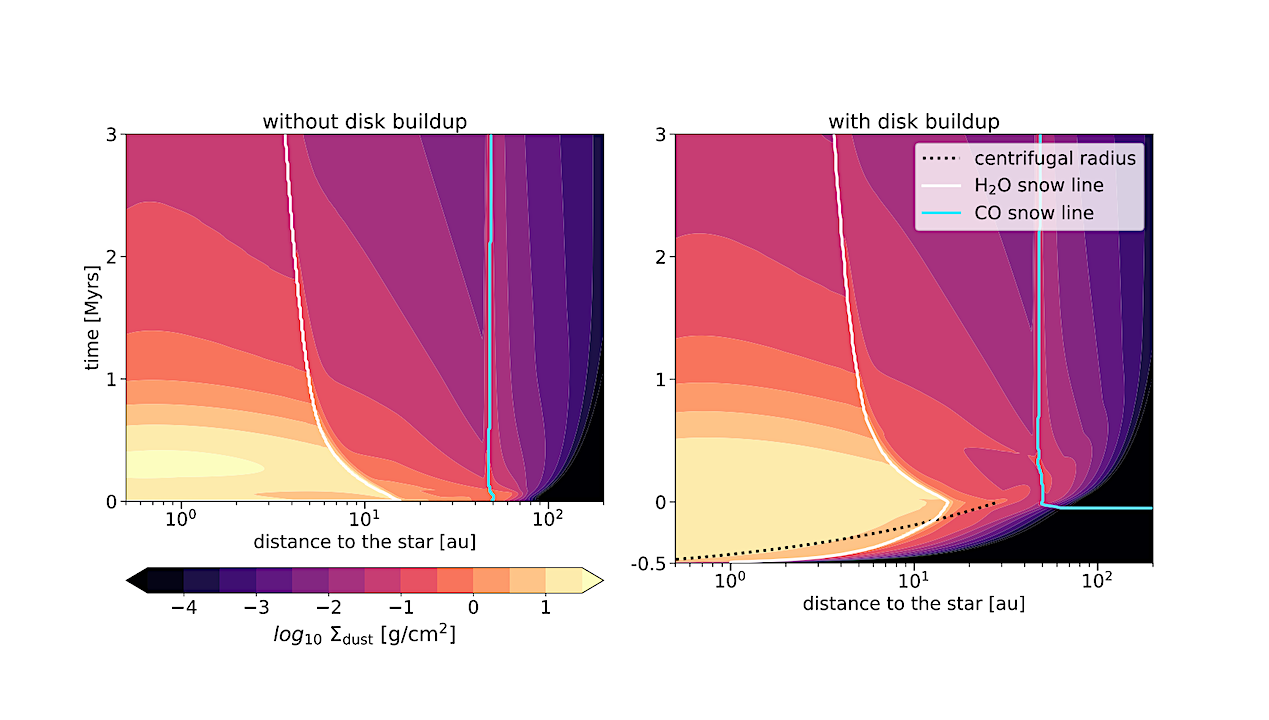
We study the prospects of producing CO-rich pebbles and planetesimals. We use a one-dimensional protoplanetary disk model with dust evolution including coagulation, fragmentation, and radial drift, water and CO ice and vapors evolution, and planetesimal formation via the streaming instability.
We compare models with and without the disk formation stage. CO-rich pebbles can be formed at the CO snow line due to the cold finger effect, regardless of whether the disk buildup is included. Models including disk buildup show stronger CO enhancement relative to water in the outer disk.
However, CO-rich planetesimals do not form in the smooth disk models. The formation of CO-rich planetesimals likely requires mechanisms that preserve the CO-enriched ice reservoir, such as pressure traps or gas removal processes.
Models concerning the chemical evolution of protoplanetary disks and its impact on the atmospheric C/O ratio of forming planets should consider the disk buildup stage.
Joanna Drazkowska
Comments: 8 pages, 8 figures, accepted for publication in A&A
Subjects: Earth and Planetary Astrophysics (astro-ph.EP)
Cite as: arXiv:2603.26876 [astro-ph.EP] (or arXiv:2603.26876v1 [astro-ph.EP] for this version)
https://doi.org/10.48550/arXiv.2603.26876
Focus to learn more
Submission history
From: Joanna Drazkowska
[v1] Fri, 27 Mar 2026 18:00:09 UTC (1,626 KB)
https://arxiv.org/abs/2603.26876
Astrobiology,