Constraining Electron-Impact Ionization of O2 Through UV Aurora Observations at Ganymede
While photoionization rates of Ganymede‘s O2 dominated atmosphere are well constrained, the contribution of electron-impact ionization is rather uncertain.
Previous quantitative estimates have relied on assumptions about densities and energy distributions of precipitating electrons, or on rare spacecraft measurements that cannot be unambiguously mapped to the regions of ionization.
In this study, we present a novel approach to quantify electron-impact ionization rates directly through OI 1356 Å emission brightness observations. The analysis of measured cross sections reveals that the ionization-to-excitation ratio is limited to 10-60 over all electron energies, reducing the uncertainty of estimating ionization rates to a factor less than 6.
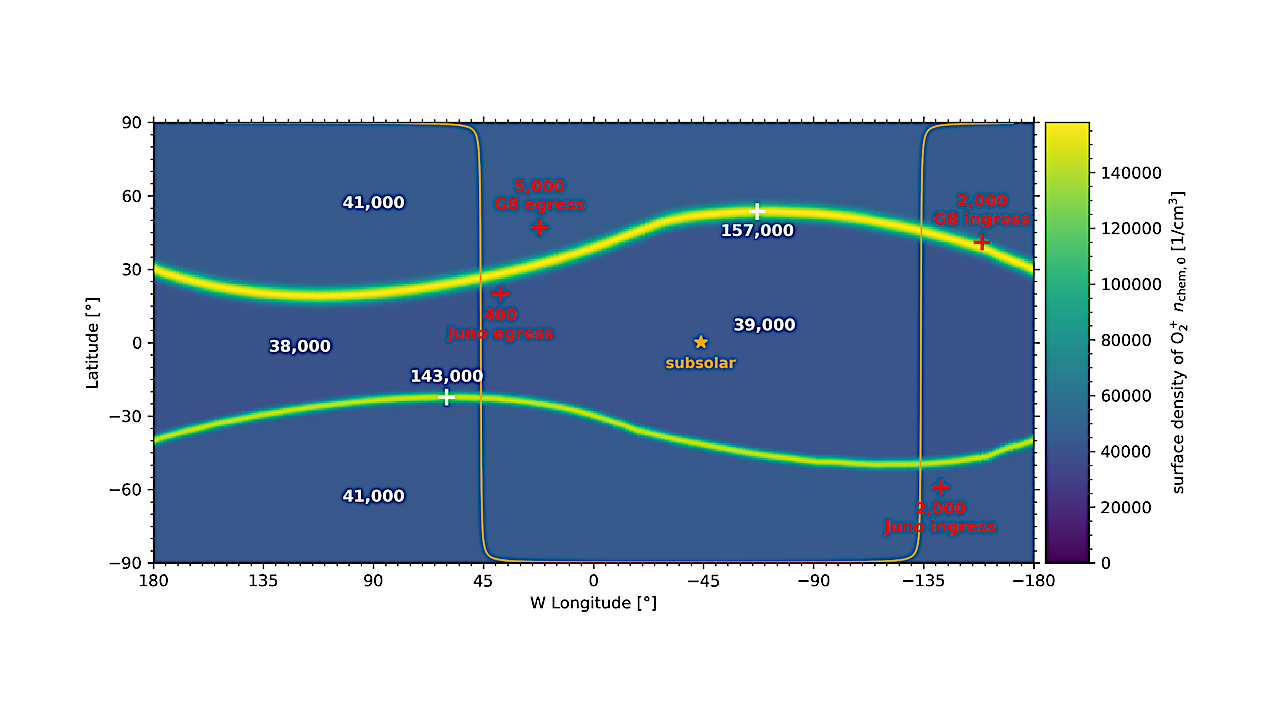
We apply this method to Juno UVS observations of Ganymede’s aurora. We find that the OI 1356 Å brightness of the auroral ovals is well described by 3-5° latitude wide Gaussian distributions centered on the open-closed field line boundary, with an average peak of 120 R. The average brightness outside the ovals in the polar and equatorial background regions is ~8 R. From these observations, we derive a global map of electron-impact ionization rates, which are at least an order of magnitude higher than photoionization rates.
The estimated total global ionization rate is 1.3-7.6×1026 s−1, with average column rates of ~5×109 cm−2s−1 in the ovals and ~3×108 cm−2s−1 in the background regions. Comparison of radio occultation measurements with predicted electron densities indicates that transport processes are the dominant loss mechanism in Ganymede’s ionosphere. The rate of ionospheric outflow of O+2 is 0.1-2×1026 s−1 or 0.5-11 kg s−1, indicating 0.03-0.5 cm Myr−1 erosion of Ganymede’s surface ice.
Stefan Duling, Joachim Saur, Darrell Strobel, Philippa Molyneux, Jamey R. Szalay, Thomas K. Greathouse
Subjects: Earth and Planetary Astrophysics (astro-ph.EP); Space Physics (physics.space-ph)
Cite as: arXiv:2604.12729 [astro-ph.EP] (or arXiv:2604.12729v1 [astro-ph.EP] for this version)
https://doi.org/10.48550/arXiv.2604.12729
Focus to learn more
Submission history
From: Stefan Duling
[v1] Tue, 14 Apr 2026 13:44:20 UTC (2,609 KB)
https://arxiv.org/abs/2604.12729
Astrobiology, Astrogeology, Space Weather,