Physical Vetting of the Ultra-Short-Period Sub-Earth TOI 864.01
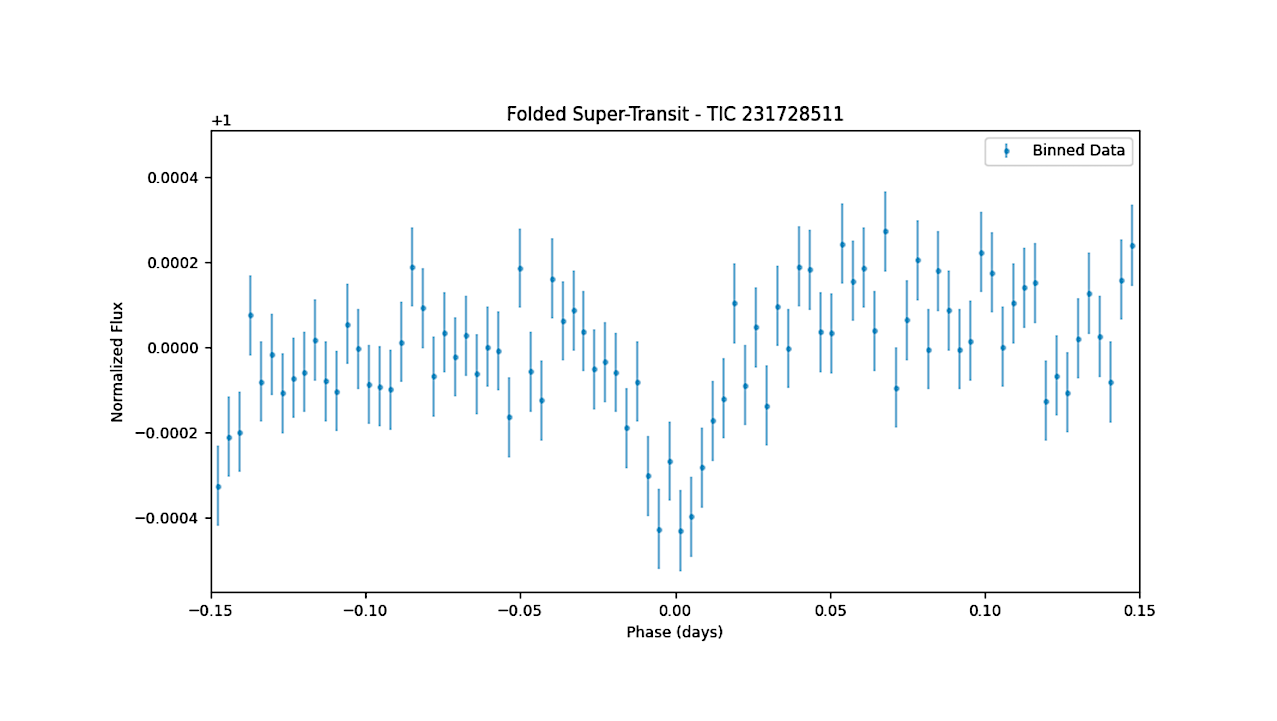
We present a comprehensive analysis of TOI 864.01, a transit-like signal associated with the M-dwarf TIC 231728511.
Utilizing the full baseline of TESS photometry (54 sectors), we recover a periodic signal with P=0.52067 d and a shallow depth of ∼158 ppm. To assess the planetary nature of the candidate, we performed a rigorous vetting process combining centroid analysis, Bayesian model comparison, and false-positive probability calculations.
While the low signal-to-noise ratio of the sub-Earth candidate yielded inconclusive formal statistical validation metrics (FPP) and Bayesian evidence (ΔlnZ), we demonstrate the planetary nature of the system through physical exclusion of false positive scenarios. The TRICERATOPS Nearby False Positive Probability (NFPP) of 0.0000, combined with centroid stability, rules out background contamination.
Furthermore, we calculate that a stellar-mass companion at the derived orbital separation (a≈5R⋆) would induce ellipsoidal variations of order ≳5000 ppm. The absence of such variations in the TESS photometry (<200 ppm limit) physically precludes stellar binary scenarios. We derive a planetary radius of Rp≈0.55R⊕, confirming TOI 864.01 as a physically vetted ultra-short-period sub-Earth.
Biel Escolà Rodrigo
Comments: 4 pages, 3 figures
Subjects: Earth and Planetary Astrophysics (astro-ph.EP)
Cite as: arXiv:2601.02171 [astro-ph.EP] (or arXiv:2601.02171v1 [astro-ph.EP] for this version)
https://doi.org/10.48550/arXiv.2601.02171
Focus to learn more
Submission history
From: Biel Escolà Rodrigo
[v1] Mon, 5 Jan 2026 14:47:52 UTC (313 KB)
https://arxiv.org/abs/2601.02171
Astrobiology,