Functionalization Of Benzene Ices by Atomic Oxygen
Small aromatic molecules, including functionalized derivatives of benzene, are known to be present throughout the different stages of star and planet formation. In particular, oxygen-bearing monosubstituted aromatics, likely including phenol, have been identified in the coma of comet 67P.
This suggests that, earlier in the star and planet formation evolution, icy grains may act as both reservoirs and sites of functionalization for these small aromatics. We investigate the ice-phase reactivity of singlet oxygen atoms (O(1D)) with benzene, using ozone as a precursor that is readily photodissociated by relatively low-energy.
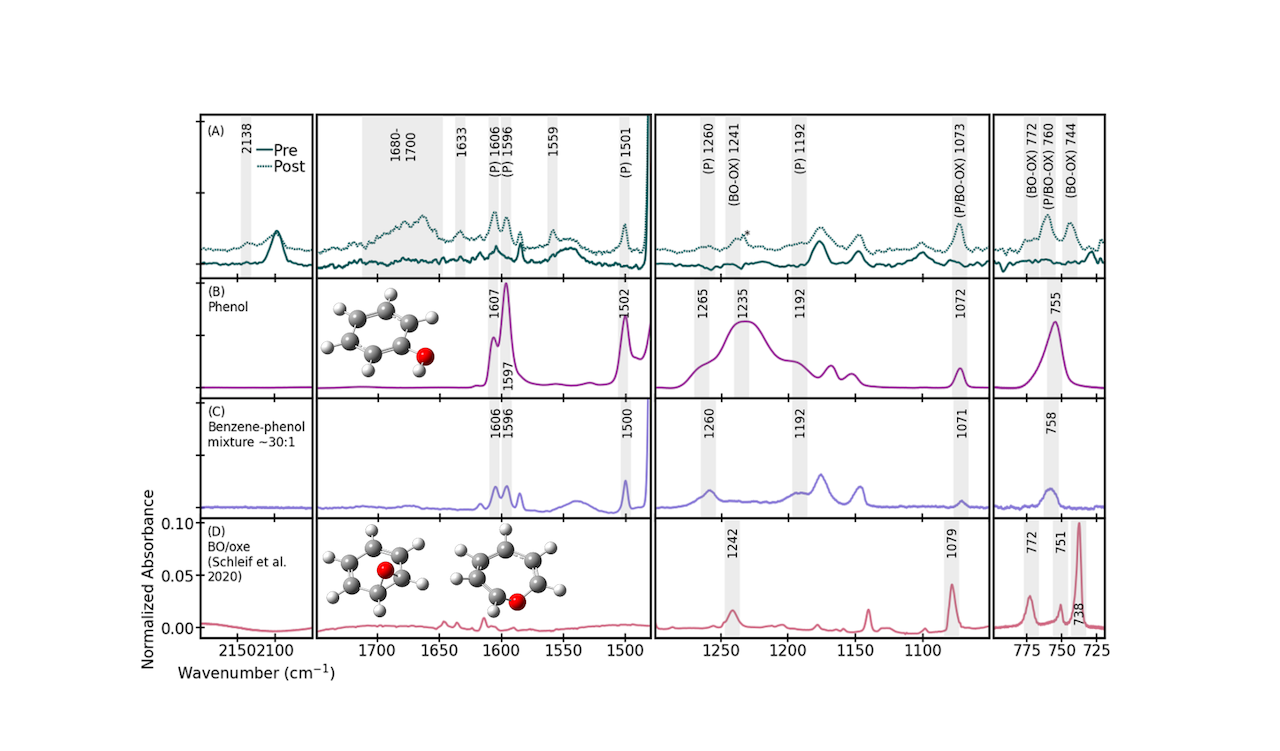
Our experiments show that O(1D) efficiently reacts with benzene, forming phenol, benzene oxide, and oxepine as the main products. Phenol formation is temperature-independent, consistent with a barrierless insertion mechanism.
In contrast, the formation of benzene oxide/oxepine shows a slight temperature dependence, suggesting that additional reaction pathways involving either ground-state or excited-state oxygen atoms may contribute. In H2O and COO ice matrices we find that dilution does not suppress formation of phenol.
We extrapolate an experimental upper limit for the benzene-to-phenol conversion fraction of 27-44% during the lifetime of an interstellar cloud, assuming O(1D) production rates based on CO2 ice abundances and a cosmic-ray induced UV field.
We compare these estimates with a new analysis of data from the comet 67P, where the C6H6O/C6H6 ratio is 20±6%. This value lies within our estimated range, suggesting that O(1D)-mediated chemistry is a viable pathway for producing oxygenated aromatics in cold astrophysical ices, potentially enriching icy planetesimals with phenol and other biorelevant compounds.
Elettra L. Piacentino, Alexandra McKinnon, Nora Hänni, Amit Daniely, Estefania Rossich Molina, Tamar Stein, Jennifer Bergner, Mahesh Rajappan, Karin I. Öberg
Subjects: Earth and Planetary Astrophysics (astro-ph.EP); Instrumentation and Methods for Astrophysics (astro-ph.IM); Solar and Stellar Astrophysics (astro-ph.SR); Chemical Physics (physics.chem-ph)
Cite as: arXiv:2601.07457 [astro-ph.EP] (or arXiv:2601.07457v1 [astro-ph.EP] for this version)
https://doi.org/10.48550/arXiv.2601.07457
Focus to learn more
Submission history
From: Elettra Piacentino
[v1] Mon, 12 Jan 2026 12:05:44 UTC (3,356 KB)
https://arxiv.org/abs/2601.07457
Astrobiology, Astrochemistry,