Arsenic Enrichment Patterns Are Defined By Microbialite Morphology, Fabric, And Accretion Mechanism.
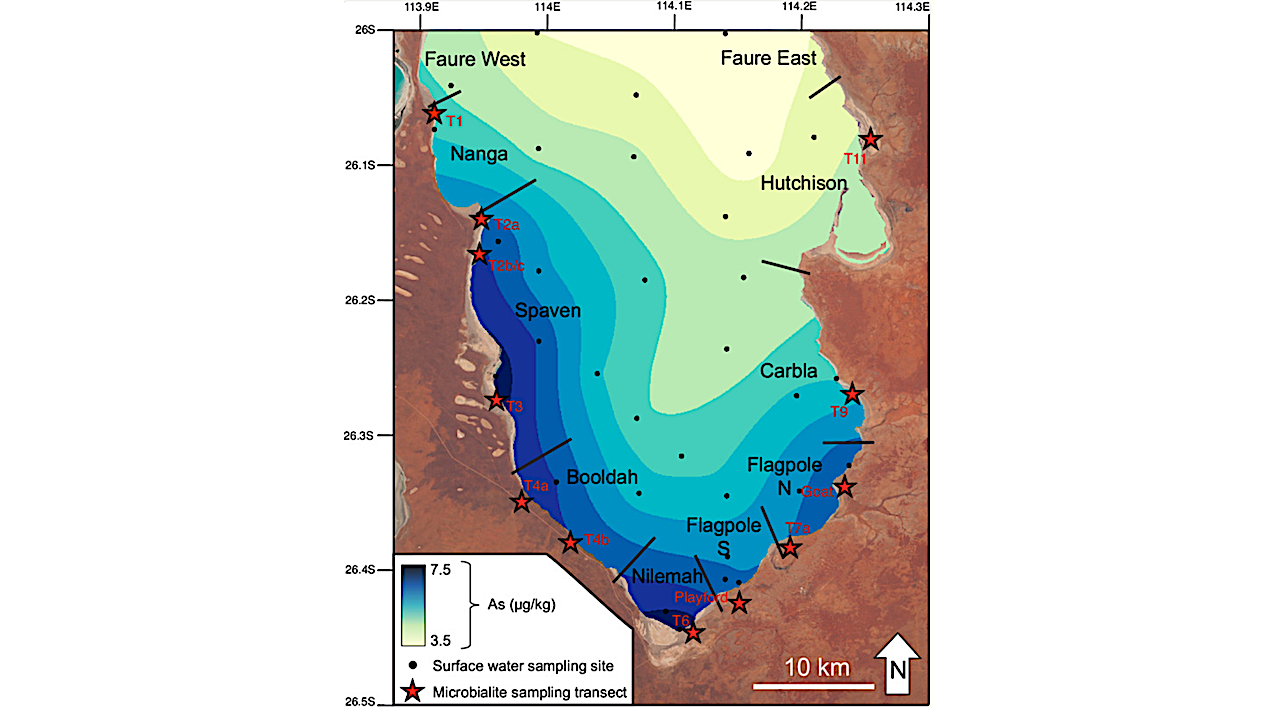
Microbialites accrete through microbe-environment interactions and incorporate elements like arsenic, creating enrichment patterns that can preserve evidence of ancient microbial activity.
However, the effects of morphology, fabric, and accretion mechanism on arsenic incorporation in microbialites is poorly understood, complicating the use of arsenic enrichment patterns as a chemical biosignature.
By analyzing arsenic concentrations in actively accreting microbialites with diverse architectures from Hamelin Pool, Australia, we document the effects of morphology, fabric, and accretion mechanism on arsenic enrichment patterns.
Our results demonstrate that arsenic enrichment patterns originate from microbial activity, sedimentary inputs, and seawater chemistry, the proportions of which vary with changing aspects of microbialite morphogenesis.
Here we show that initial microbialite architecture is a fundamental yet underexplored factor that controls the geochemical composition of microbialites through geological time.
- Arsenic enrichment patterns are defined by microbialite morphology, fabric, and accretion mechanism, Nature Communications via PubMed
- Arsenic enrichment patterns are defined by microbialite morphology, fabric, and accretion mechanism, Nature Communications (open access)
Astrobiology