Ancient Mars Climate With a Polar Ocean and Ice Sheet Dynamics
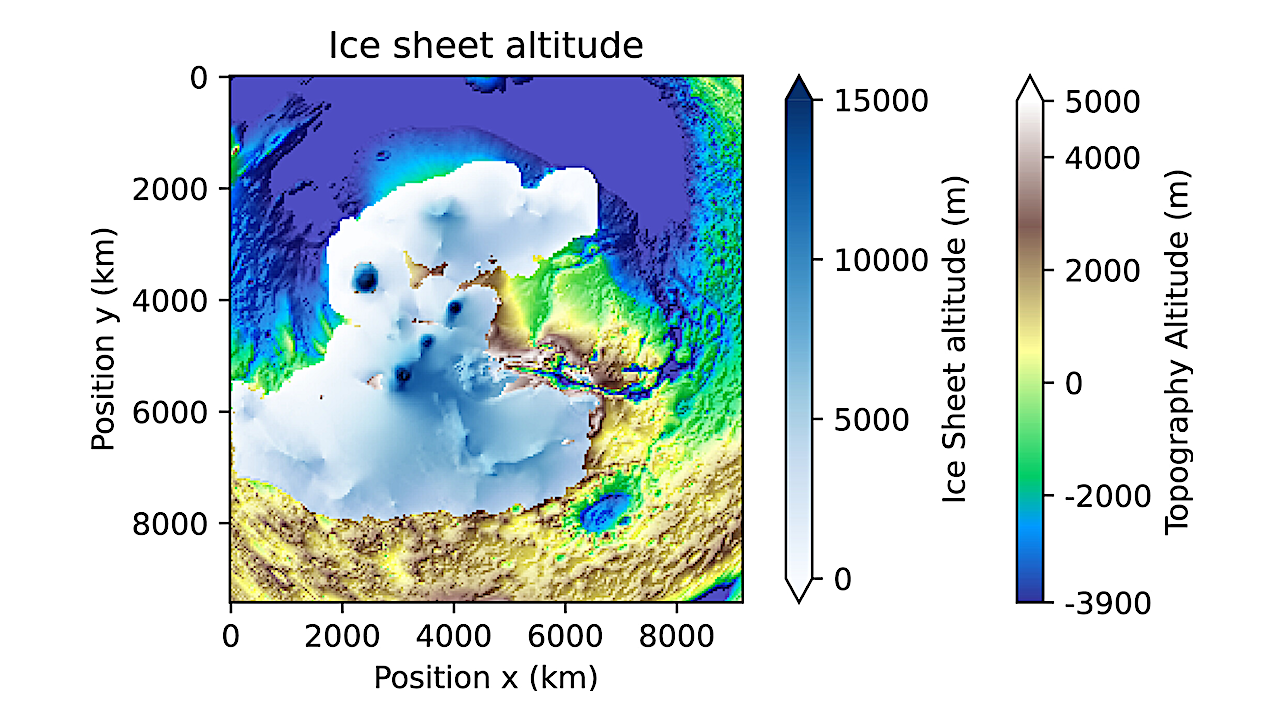
In this article, we study the conditions required to maintain a stable ocean on Mars 3 Ga using a new suite of simulations.
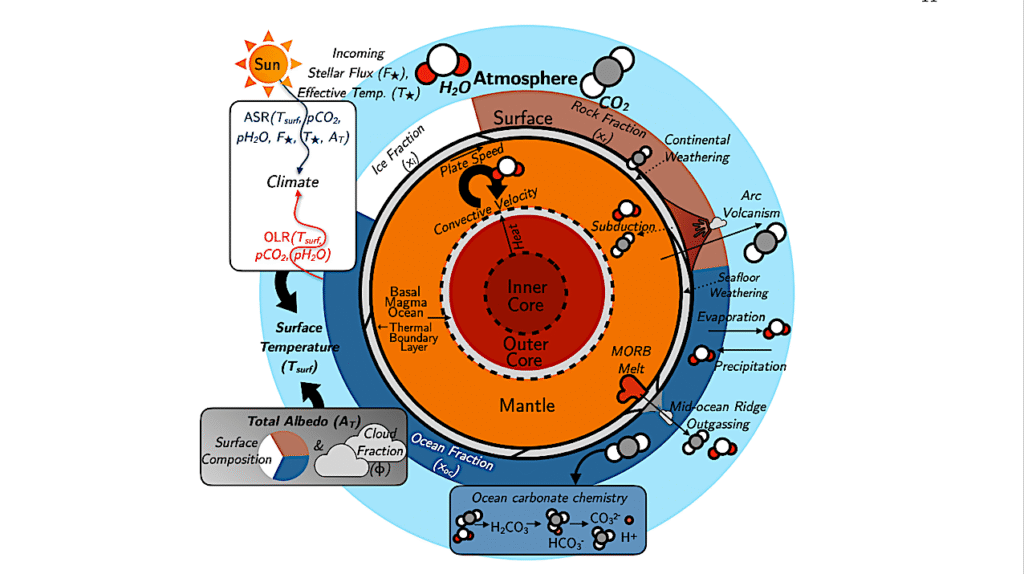
These simulations couple a 3D Global Climate Model with ocean dynamics and ice sheet flow. The model includes the main processes of the atmosphere/hydrosphere/cryosphere to investigate Mars’ ancient climate.
The results show that the total water content required to maintain an ocean is ~700 m, global equivalent layer, half in the ocean, half in the ice sheet. This number seems plausible if a significant amount of water has been absorbed by the ground. This could be in the form of mineral alteration, or in a deep porous reservoir.
In addition, the results show that the equilibrium mass flux from the ice sheet adjacent to the northern ocean is ~1015 kg/y with a very low sliding velocity (1 m/y), except for few warm regions in the lowest altitudes that could reach up to 300 m/y. Finally, the global atmosphere/hydrosphere/cryosphere equilibrium should be reached in a few 100 ky.
This indicates that the ocean will have a stabilizing feedback on timescales longer than this. An extensive sensitivity study of the ice sheet was performed. This included the effects of a geothermal heat flux, viscosity and basal drag. Finally, we studied the possible effects of planetary obliquity and a reduced ocean extent.
Ancient Mars Climate With a Polar Ocean and Ice Sheet Dynamics, JGR Planets (open access)
Astrobiology, Astrogeology,