Can Surface Fractures on Earth, Mars, and Europa Predict Habitability On Other Planets?
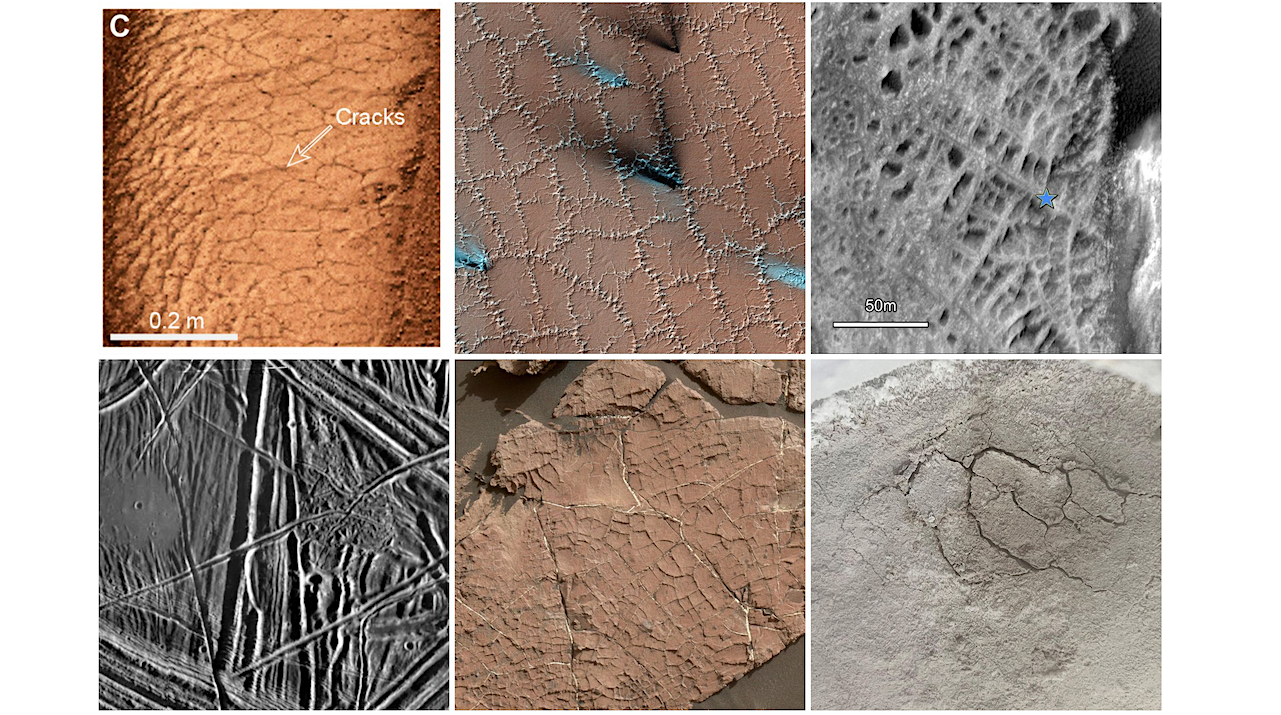
When a mudflat crumbles on Earth, or an ice sheet splinters on one of Jupiter’s moons (Europa), or an ancient lakebed breaks on Mars, do these fractures follow a hidden geometric script? Could similar patterns on another planet hint that water once existed there—and possibly sustained life?
To most, these questions would be idle curiosities, but to geophysicist Douglas Jerolmack at the University of Pennsylvania and mathematician Gábor Domokos at Budapest University of Technology and Economics, they hold the key to decoding the surfaces of distant planets across the solar system.
Their latest study, published in the Proceedings of the National Academy of Science, suggests that the way a planetary body fractures is no random accident, and their findings could offer insights into detecting potentially habitable environments on other worlds.
“What’s wild is that nature keeps favoring the same patterns across vastly different environments,” says Jerolmack, Edmund J. and Louise W. Kahn Endowed Term Professor of Earth and Environmental Science. “We expected some consistency, but the degree to which planetary surfaces organize themselves into predictable crack geometries—whether it’s ice, rock, or mud—was surprising. It suggests these patterns are fundamental, not just quirks of specific planets.”
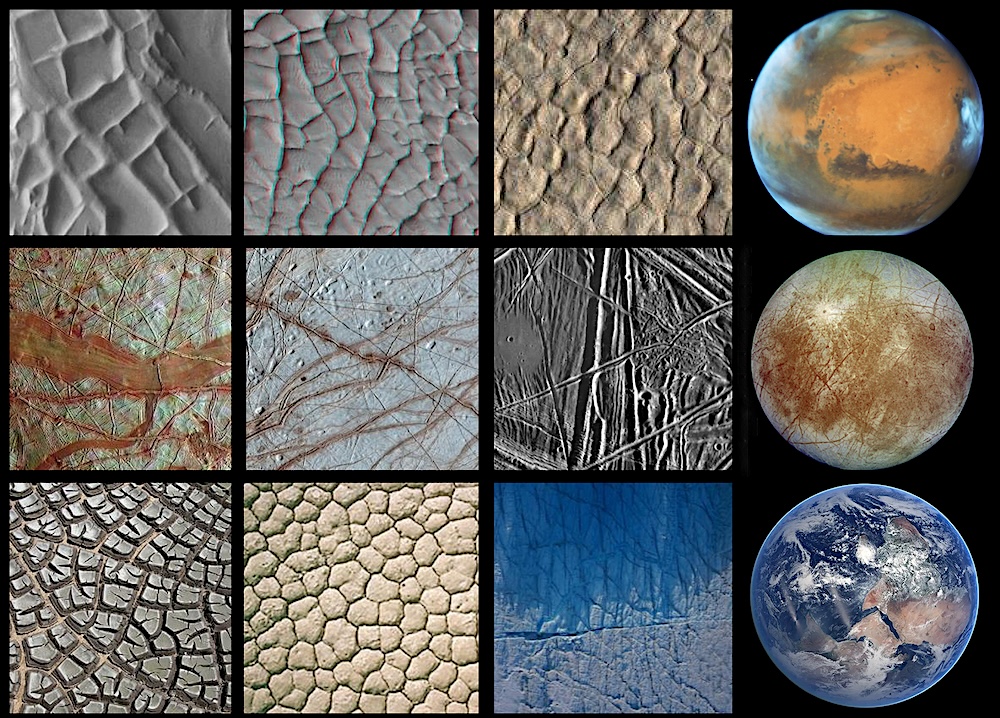
(Top to bottom) Surface crack patterns on three different worlds: Mars, Europa, and Earth that reveal how fractures form under vastly different environmental conditions. Penn geophysicist Douglas Jerolmack and longtime collaborator Gábor Domokos used the mathematical framework they developed for understanding fracture patterns on Earth to survey two-dimensional fracture networks across the solar system. Their findings could offer insights into detecting potentially habitable environments on other planets.– University of Pennsylvania
Their insights build upon prior work where the team confirmed a prediction by the ancient Greek philosopher Plato who once declared that Earth itself was composed of cubelike units. In that paper, they demonstrated that, “rather surprisingly, if you take the thousands of fragments that are produced and you measure the number, you count the number of faces and corners and edges, and you average the hell out of it,” Jerolmack says, “then you end up with six as an average for the faces, eight, as an average number for the vertices, and 12 for the number of edges.”
Their more recent work, however, focuses on two-dimensional fracture networks on planetary surfaces, examining the patterns of cracks on thin shells of planetary bodies, rather than the shapes of individual fragments.
“We wanted to explain patterns on other planets that are here right now, because the problem is, we don’t get to see how they evolved,” says Domokos. “We weren’t there. And we can’t go back in time.”
The challenge, he explains, is that they are working with a single frame of a moving picture—a frozen snapshot of the current state of crack patterns on planetary surfaces. The forces that created these networks are no longer directly observable, and the fractures may still be evolving toward some unknown future state.
“But what if, from this one snapshot, you could extrapolate the whole plot of the movie?” Domokos asks.
Cracking the code of the cracks
To answer this question, Sophie Silver, a Ph.D. candidate in Jerolmack’s lab, began by first examining images of planetary bodies across the solar system to see if nature has preferences for certain geometric patterns.
“I looked at a bunch of satellite images of planetary surfaces, compared them to lab experiments and geological formations on Earth, and tried to figure out the distinct ‘fingerprints’ or the geometric signatures in their crack networks,” Silver says.
Within their approach lies a simple classification system that analyzes the relative proportions of three types of crack junctions: T’s, X’s, and Y’s.
“The T’s take on a sort of brick wall-like formation. They’re the most common, the most boring—we see them all over the place, on Earth and in space—and they’re associated with hierarchical fracture networks formed by repeated breakage,” Silver says.
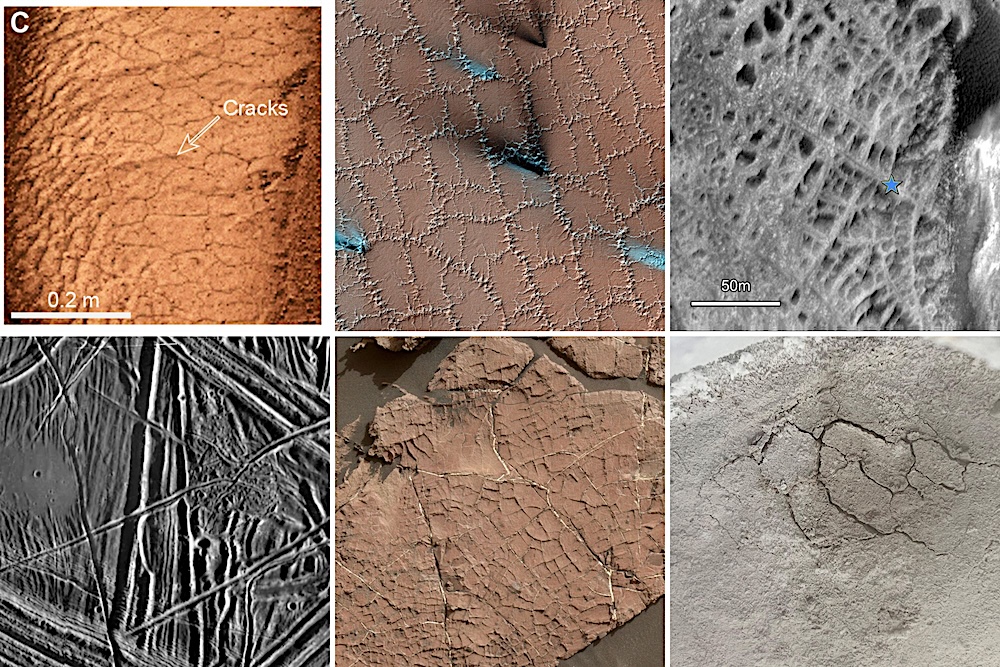
These pictures highlight surface cracks on Mars (top row), the icy crust of Jupiter’s moon Europa (bottom left), and terrestrial analogs on Earth (bottom middle and right). Although each environment differs vastly in temperature, material composition, and scale, similar fracture patterns emerge, offering clues about the geological forces shaping these planetary surfaces. (Image: Courtesy of Sophie Silver and Krisztina Regős)
Networks dominated by X’s, however, are rare—and they only appear in ice. “So far, excluding Earth, we’ve only spotted X’s on Europa, Jupiter’s smallest of its four largest moons,” she notes. These patterns indicate crack healing and overprinting—when a fracture is sealed (often by refreezing water), allowing new cracks to propagate through the healed area, intersecting older cracks to create an X shape.
Y junctions, which form honeycomb-like patterns, on the other hand, begin as T junctions and then, through repeated expansion and contraction—such as what is seen during wet-dry cycles in mud and hot-cold temperature shifts in ice—twist into Y’s.
Modeling the evolution of planetary surfaces
Mathematician Krisztina Regős, a Ph.D. candidate at the Budapest University of Technology and Economics, refined the mathematical framework with her advisor Domokos and mathematician Péter Bálint by treating fracture networks as evolving mosaics, whose patterns are shaped by their own specific physical constraints.
Bridging this gap between physical processes and the patterns they form helped lead to the development of what mathematicians call the dynamical systems theory.
“If we understand the rules governing how the cracks form and change, we can ‘rewind the tape’ and reconstruct the missing frames of the movie,” says Domokos. “If we had actual time-lapse footage of a planetary surface changing over millennia, we could just watch and learn. But since we don’t, we had to create a mathematical model that lets us extract time from space.”
Regős’s model maps fracture patterns onto a symbolic plane—an abstract mathematical space where the evolution of crack networks can be traced over time. By analyzing the average geometric properties of the fracture mosaics, specifically, the proportions of T, X, and Y junctions, and observing how these cluster within the symbolic plane, researchers can infer how these networks developed, even in the absence of direct observation.
“We don’t have movies of planetary surfaces cracking and shifting over eons,” Donokos says, “but this model allows us to create something similar. By using a dynamical model that incorporates the rules of fracture and change, we can get pretty close to showing the evolution, by predicting how a crack network started and how it may end.”
To validate their approach, the team compared their model’s predictions to existing geological observations of fracture patterns on Earth, Mars, Venus, and Europa. The model’s predictions aligned with the geological information related to the formation of the fracture networks in each case, leading the researchers to describe their model as a “jolly good guess.”
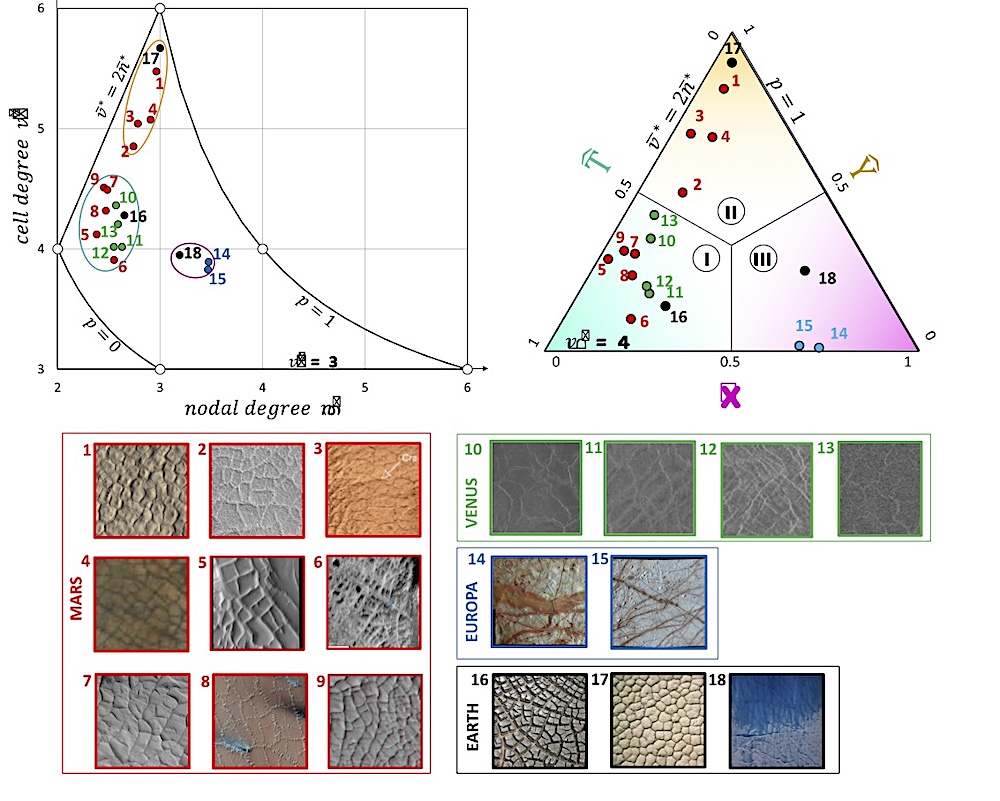
In the top left graph, these plots classify fracture networks from multiple planets and a moon—Mars (numbers 1–9 in red), Venus (numbers 10–13 in green), Europa (numbers 14–15 in blue), and Earth (numbers 16–18 in black)—based on their “cell degree” (vertical axis) and “nodal degree” (horizontal axis). In the top right graph, networks from planets are plotted on the relative proportions of T-, X-, and Y-shaped crack junctions. The images below each numbered data point show actual examples of the cracks, revealing how similar fracture patterns can arise under vastly different planetary conditions. (Image: Courtesy of Sophie Silver and Krisztina Regős)
Looking ahead
“This project started with an absurdly simple geometric categorization of crack networks,” notes Jerolmack. “The dynamical systems theory then distilled the different mechanisms for cracking into absurdly simple geometric rules. We created a toy universe of fracture patterns and processes; shockingly, the actual universe seems happy to comply with this model. But we need to test this more.”
Silver is currently running experiments designed to recreate planetary cracking processes under controlled conditions—in particular, simulating the mud cracks on Mars and cracked ice on Europa. These experiments will allow the researchers to truly watch the movie of a crack network evolve, enabling the team to perform a strong test of the dynamical crack model.
“I’m hopeful that presenting these results from the experiments and how well they corroborate the model will influence more people to implement this method on planetary surfaces, on Earth surfaces, and even in laboratory settings,” says Silver.
“I ideally want to see this methodology widely reproduced and used by multiple people in multiple different fields … potentially identifying good places to send a Rover; for example, it’d be cool if someone thought, ‘Oh, this place has lots of hexagons here—maybe that means that it’s been wetted and dried a bunch,’ and thought to launch a probe.”
And while they won’t have actual movies from the field on other planets for the next 20 to 30 years, they plan to use static images from space missions to continue to build tools and frameworks to make inferences on what may have happened what’s to come for each planet.
“It was a great opportunity to work on this interplanetary project,” says Regős, “because even if you can’t make these movies yet, I think it will have an impact on how we approach space travel.”
The team is eagerly anticipating the arrival of NASA’s Europa Clipper, which is set to arrive at Jupiter in 2030, and ESA’s Jupiter Icy Moons Explorer (Juice), which is already en route to Jupiter’s moons, as they will provide high-resolution imagery of ice-covered worlds that will offer new opportunities to test their framework.
“We’ve built this theoretical structure, but the real test will come when we get fresh, high-resolution images of these planetary surfaces,” Jerolmack says. “With more detailed data from upcoming missions, we can refine our model, test its predictive power, and even identify places where we should look for evidence of past water activity.”
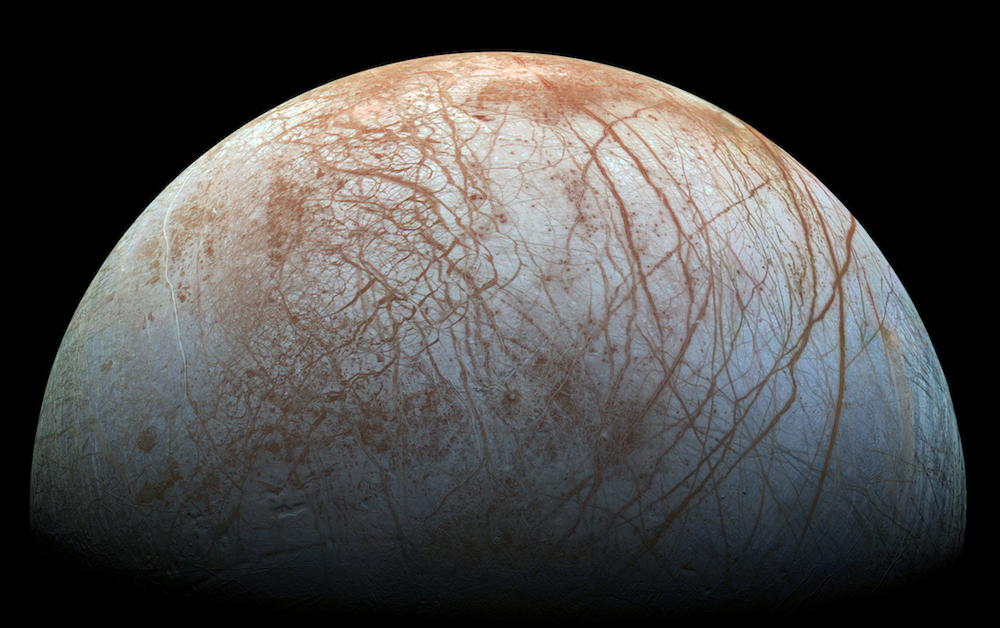
A global view of Jupiter’s moon Europa displaying extensive surface fractures—long, curving lines carved into the ice by tidal forces from Jupiter. These cracks hint at dynamic activity beneath Europa’s frozen shell and may provide clues about the moon’s potentially habitable subsurface ocean. (Image: Courtesy of NASA/JPL-Caltech)
The team also hopes to collaborate with planetary geologists studying ancient lake beds on Mars and Europa’s icy crust, using their method to make more precise inferences about environmental conditions in these landscapes.
Douglas Jerolmack is a professor in the Department of Earth and Environmental Science in the School of Arts & Sciences and in the Department of Mechanical Engineering and Applied Mechanics in the School of Engineering and Applied Science at the University of Pennsylvania.
Gábor Domokos is a professor and director of the HUN-REN-BME Morphodynamics Research Group at the Budapest University of Technology and Economics.
Sophie Silver is a Ph.D. candidate in Penn Arts & Sciences.
Krisztina Regős is a Ph.D. candidate at the Budapest University of Technology and Economics.
The research was supported by NASA PSTAR (Grant 80NSSC22K1313); the Hungarian Research Fund (Grant 149429); The Hungarian Ministry of Innovation and Technology through the Budapest University of Technology and Economics; Benjamin Franklin Fellowship through the University of Pennsylvania; and the Albrecht Science Fellowship.
Astrobiology