ALH84001: The Key to Unlocking Secrets About Mars-15 Years and Counting
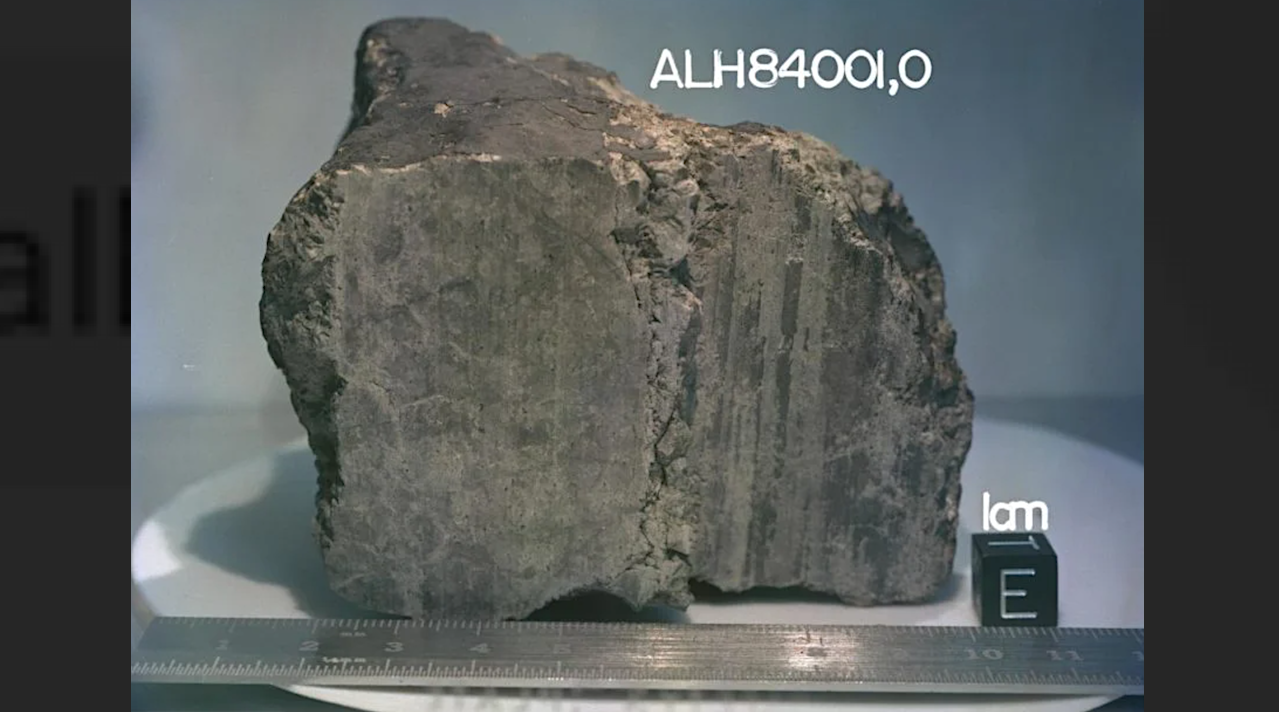
From the December 27, 1984 discovery of ALH84001, and its subsequent identification as a sample of Mars in 1993, mystery and debate has surrounded the meteorite [1].
With the realization that the ALH84001 sample was a orthopyroxenite and one of the oldest SNC meteorites (~4.09 Ga) [2] available to study, important and critical information about the Martian hydrosphere and atmosphere along with the early history and evolution of the planet could be obtained by studying the unique carbonate globules (~3.9 Ga) in the sample [3].
The initial work showed the carbonate globules were deposited within fractures and cracks in the host-orthopyroxene by low-temperature aqueous fluids [4]. Ideas that the carbonates were formed at temperatures [5] approaching 800o C were ruled out by later experiments [6].
The 1996 announcement by McKay et al. [7] that ALH84001 contained features which could be interpreted as having a biogenic origin generated considerable excitement and criticism. The NASA Administrator Dan Goldin said the 1996 ALH84001 announcement “saved” NASA’s Mars planetary exploration program and injected $6 billion dollars over five years into the scientific research and analysis efforts [8].
All of the original four lines of evidence for possible biogenic features within ALH84001 offered by McKay et al. have withstood the test of time. Criticism has been directed at the interpretation of the 1996 analytical data. Research has expanded to other SNC meteorites. Despite the numerous attacks on the ideas, the debate continues after 15 years.
The 2009 paper by Thomas-Keprta et al. [9] on the origins of a suite of magnetites within the ALH84001 has offered strong arguments that some of the magnetites can only be formed by biogenic processes and not from thermal decomposition or shock events which happened to the meteorite.
NASA’s Astrobiology Institute was formed from the foundation laid by the ALH84001 hypothesis of finding life beyond the Earth. The strong astrobiology outreach programs have expanded because of the work done on the Martian meteorites. Despite the criticism on the biogenic-like features in ALH84001, the meteorite has opened a window into the early history of Mars.
Clearly low-temperature fluids have left their signatures within the ALH84001 meteorite and subsequent cratering events on Mars have been recorded on observable features within the meteorite. The 15 years of detailed study on ALH84001 and its unique carbonate globules have clearly shown formational and secondary processes at work on Mars. Now we need a well documented Mars sample return mission.
References: [1] Meyer C. 1996. Mars Meteorite Compendium-1996. NASA-JSC. [2] Lapen T.J. et al. 2010. Science 3328:347-351. [3] Borg L. et al. 1999. Science 286:90-94. [4] Romanek C.S. et al. 1994. Nature 372:655-657. [5] Harvey R.P. and H.Y. McSween 1996. Nature 382:49-51. [6]Valley J.W. et al. 1997. Science 275:1633-1638.]. [7] McKay D.S. et al. 1996. Science 273:924-930. [8] Sawyer K. 2006. The Rock from Mars, Random House, 416 pgs. [9] Thomas-Keprta K.L. et al. 2009. Geochimica et Cosmochimica Acta 73:6631-6677.
ALH84001: The Key to Unlocking Secrets About Mars–15 Years and Counting E.K. Gibson1 , D.S. McKay1 , K. L. Thomas-Keprta2 , and S. J. Clemett2 ; 1 ARES, NASA/JSC, Mail Code KA, Houston, TX 77058, 2 ESCG at NASA/JSC, Mail Code JE23, Houston, TX 77058. Email: [email protected]
Astrobiology