NASA Presentation: Exploring Mars Together: Draft for Community Feedback (2023)
Editor’s note: this presentation at NASA was assembled in 2023 prior to the cancellation of the Mars Sample Return Mission. While the notion of returning samples from Mars by NASA is not totally ded, no mission has been announced to make such an attempt However CHina’s will launch the Tianwen-3 Mars sample return mission in 2028.
Introduction
Over the past two decades NASA and the Mars Exploration Program (MEP) have been making progressive steps to better understand the planet and to search for past and present life at Mars through a series of orbiters, landers, and rovers
This critical chapter in Mars exploration would culminate in the return of samples to Earth through the planned Mars Sample Return campaign.
The Mars Exploration Program is now at an inflection point at which it must adapt to the changing space business environment (i.e., broadening international participation and expanding commercial interest/capability), address critical/aging infrastructure, and prepare for a human presence at Mars
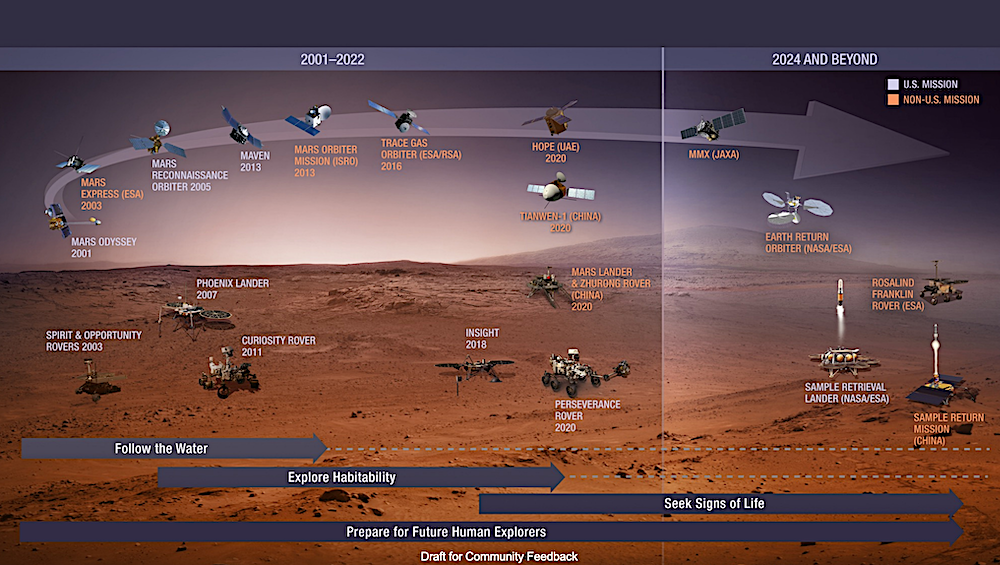
Notional NASA Mars Exploration overview in 2023 prior to MSR cancellation
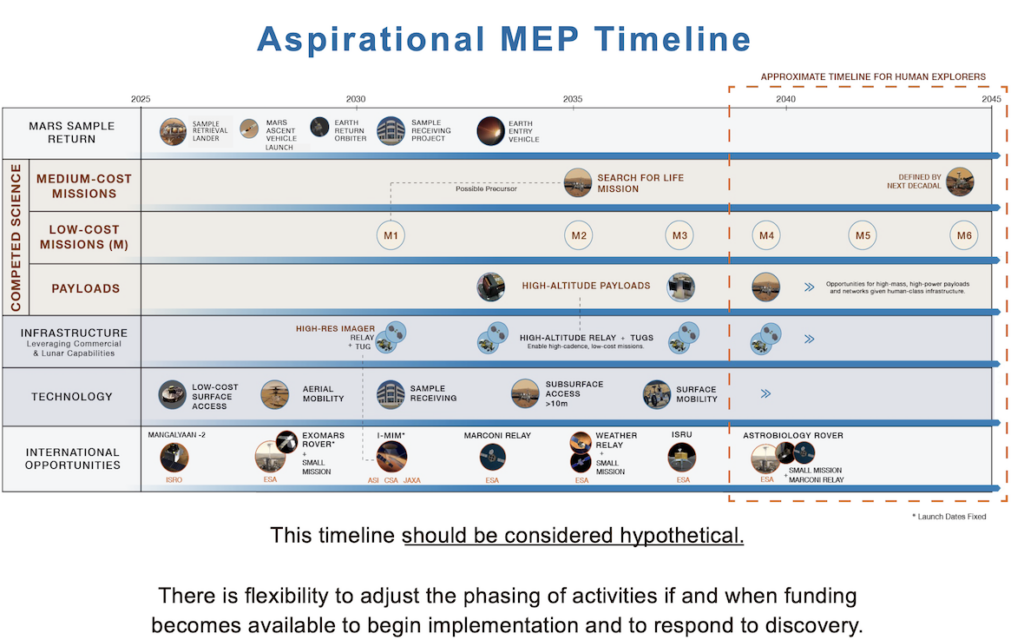
IMAGE
SCIENCE THEME — 1: Explore the Potential for Martian Life
1.1 Search for Biosignatures, Past & Present Determine whether the Martian geologic record has biosignatures and identify areas most likely to capture preserved biosignatures based on what is known about past and current habitability at Mars.
1.2 Understand Temporal and Geographic Patterns of Habitability Leverage Mars’ unique ancient geologic record to understand the extent of habitability and its temporal evolution, the existence of any present-day, subsurface habitable environments (including ice), and how habitable environments on Mars and Earth may have diverged.
1.2.1 Physical Access to the Subsurface Advance investigations related to subsurface and ice science and access to the ice-rich subsurface as a major programmatic focus, building on water- and habitability-related scientific discoveries of the previous two decades.
1.3 Examine Samples from MSR to Understand Martian Geological & Biological Processes Study returned samples to understand organic chemistry processes on Mars, what the samples reveal on global, regional and temporal scales, the nature of any biosignatures, and the relationship between Mars’ geological and potential biological history.
Planetary protection principles are key across our presence at Mars and upon return to Earth with samples and astronauts, especially as it relates to our search for life.
A focus on potential “special regions” (natural or spacecraft-induced) and the environmental characterization of candidate landing/exploration sites is important to mitigate risks for future human explorers and/or to their astrobiological research. Search for evidence of past or present life on Mars in potentially habitable environments and establish how the Martian environment and habitability co-evolved over time.
SCIENCE THEME — 2: Support Human Exploration of Mars
Make observations that are synergistic with objectives for the human exploration of Mars and prepare for the science that humans will do once there.
2.1 Define Priority Human-Led Science at Mars Define, with multidisciplinary community input (science, human mission planning), the highest value scientific objectives humans could uniquely advance while traveling to and from Mars and on the surface.
2.2 Characterize Potential Ice-rich Sites for Human Exploration Scientifically study the environment of candidate ice-rich sites to determine optimal locations for high-priority humanled science, resource potential, and operational feasibility/safety.
2.3 Study Atmospheric Science and Weather for Human Needs Target investigations of the Martian atmosphere/exosphere sufficient to support prediction of extreme events (e.g., dust storms), human-class landing/launch operations, and a better understanding of how terrestrial microbes released during human operations could propagate in the Martian atmosphere.
2.4 Understand Potential Health and Safety Hazards for Humans (Supporting) Coordinate with ESDMD to understand mechanical properties (e.g., abrasiveness for suit and hatch seal designs) and breathing hazards to humans (e.g., particle size and potential biological exposures). Supporting biological and physical science objectives in the Moon-to-Mars initiative, develop remote-sensing technologies and obtain data on the Martian environment relevant to human-mission planners in assessing ways to protect and strengthen human health and performance.
2.5 Construct Analogue Missions to Prepare for Expeditions on Mars (Collaborative) Coordinate with ESDMD to simulate science-driven, robot-assisted expeditions to prepare astronauts and the wide Mars science community on Earth for future interplanetary collaboration in making discoveries “in the Martian field” and in transit. Draw on human lunar activities to feed forward into Mars operational strategies where relevant.
SCIENCE THEME — 3: Discover Dynamic Mars
Reveal geological and climatological changes through Martian history to understand the evolution of Mars and its potential support of life; conduct interdisciplinary systems-science investigations of Mars and its moons in relation to other planets in our solar system and around other stars.
3.1 Investigate Ancient and Modern Drivers of Change on an Active Planet
S3.1.1 Characterize Geologic Planetary Evolution from Early Mars through the Present
S3.1.2 Understand Early Environmental Change through the Stratigraphic Record
S3.1.3 Determine Recent Climate Evolution through the Study of Volatile Cycles
S3.1.4 Study Dynamic Modern Environments and their Processes
S3.1.5 Characterize Modern Habitability
3.2 Understand Mars as a System through Investigations of the Global Environment Conduct investigations through orbital, aerial, and landed spacecraft to illuminate the ways in which individual components of the Martian global environment – the atmosphere, hydrosphere, cryosphere, and geosphere – are integrated to make up the Martian system.
3.3 Study the Uniquely Available Geological Conditions on Mars to Conduct Comparative Planetology and Understand “Goldilocks Worlds” Provide research opportunities that link the uniquely available geological conditions on Mars to fundamental understanding of comparative planetology. These elements are directly responsive to the primary MEPAG goals of life, climate and geology
NASA Presentation Exploring Mars Together: Draft for Community Feedback (2023) (pdf)
Astrobiology,